
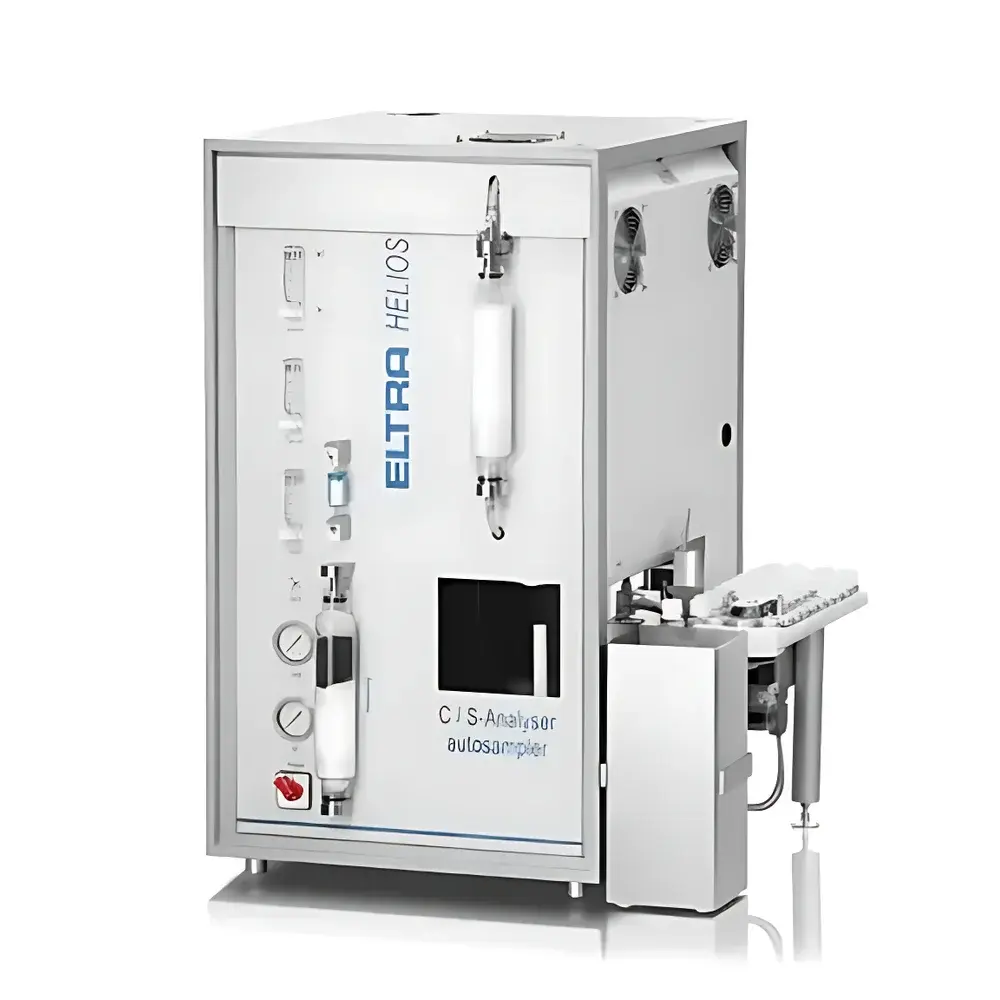
ELTRA CS-580A Automated Carbon-Sulfur Analyzer with Vertical Resistance Furnace and Dual IR Detection Cells
| Brand | ELTRA |
|---|---|
| Origin | Germany |
| Model | CS-580A |
| Measurement Principle | Non-Dispersive Infrared (NDIR) Absorption |
| Heating System | Vertical Resistance Furnace with Ceramic Tube |
| Max. Furnace Temperature | 1550 °C (adjustable in 1 °C increments) |
| Sample Weight Capacity | Up to 500 mg |
| Analysis Time | 60–120 s per sample |
| Combustion Power Output | Up to 2000 W |
| Carbon Range | 0.005–100 wt% (customizable) |
| Sulfur Range | 0.005–20 wt% (customizable) |
| Detector Configuration | Up to four gold-coated NDIR cells |
| Autosampler Options | 36-position or 130-position ceramic crucible carousel |
| Compliance | Designed for ISO 9556 (steel), ISO 4935 (ferrous alloys), ASTM E1019, and USP <231> elemental impurity testing workflows |
Overview
The ELTRA CS-580A is a high-precision, fully automated carbon-sulfur analyzer engineered for quantitative determination of total carbon (C) and total sulfur (S) in solid inorganic and organic matrices using non-dispersive infrared (NDIR) absorption spectroscopy. Unlike horizontal furnace configurations, the CS-580A employs a vertically oriented resistance-heated ceramic tube furnace—optimized for uniform thermal distribution and complete combustion of heterogeneous samples, including polymers, coal, coke, catalysts, pharmaceutical excipients, and metallurgical alloys. Combustion occurs under controlled oxygen flow at temperatures up to 1550 °C (adjustable in 1 °C steps), ensuring quantitative oxidation of refractory carbon species (e.g., carbides, graphite) and sulfur compounds (e.g., sulfides, sulfates). Gaseous CO₂ and SO₂ generated during combustion are swept through temperature-stabilized, gold-coated infrared detection cells, where absorbance at characteristic wavelengths (4.26 µm for CO₂; 7.35 µm for SO₂) is measured with high linearity and low cross-sensitivity. The instrument’s modular detector architecture supports up to four independent NDIR cells—enabling simultaneous dual-range measurement (e.g., low-ppm and high-% ranges) without manual cell switching or dilution.
Key Features
- Vertical resistance furnace with ceramic combustion tube: Ensures reproducible, ash-free combustion of samples up to 500 mg—including irregular, high-moisture, or high-volatile organic materials.
- Gold-coated infrared optical path: Extends detector cell lifetime and improves stability when analyzing halogen-containing or acidic samples (e.g., PVC, fluoropolymers, sulfuric acid-treated catalysts).
- Automated dual-capacity sample introduction: Selectable 36-position or 130-position ceramic crucible autosampler enables unattended overnight operation and full traceability via sample ID logging.
- Multi-point calibration support: Implements bracketing, linear, and quadratic calibration models compliant with ASTM E1019 Annex A1 for certified reference material (CRM) validation.
- Robust mechanical architecture: All critical components—including gas handling valves, IR detectors, and furnace control electronics—are housed in a thermally isolated, vibration-damped chassis suitable for QC labs and production floor environments.
- No routine maintenance required: Solid-state oxygen sensor, self-diagnostic gas flow control, and sealed optical compartments eliminate daily purging or alignment procedures.
Sample Compatibility & Compliance
The CS-580A accommodates diverse sample forms—powders, granules, chips, pressed pellets, and even non-homogeneous composites—without pre-treatment. Its high-temperature vertical furnace reliably combusts carbon-rich organics (e.g., rubber, resins, biomass) and sulfur-laden inorganics (e.g., pyrite, gypsum, desulfurized flue gas residues). Method development aligns with internationally recognized standards: ISO 9556 (carbon in iron and steel), ISO 4935 (sulfur in ferrous metals), ASTM E1019 (standard test method for determination of C, S, N, O, and H in steel and iron), and USP for elemental impurities in pharmaceutical substances. Data integrity meets FDA 21 CFR Part 11 requirements through audit-trail-enabled software, electronic signatures, and user-access-level controls—fully supporting GLP and GMP-regulated laboratories.
Software & Data Management
The CS-580A operates via ELTRA’s proprietary WinCS software—a Windows-based platform supporting multilingual UI (English, German, French, Chinese, Japanese), customizable report templates (PDF, CSV, XML), and direct LIMS integration via ASTM E1382-compliant data export. Real-time spectral monitoring, drift compensation algorithms, and automatic baseline correction ensure measurement consistency across shifts. Calibration curves store metadata (CRM lot numbers, uncertainty values, date/time stamps), while analysis logs record furnace temperature profiles, gas pressures, and detector signal-to-noise ratios for full forensic traceability. Software updates are delivered via secure HTTPS channel with version-controlled release notes.
Applications
- Metallurgy: Rapid quality control of carbon and sulfur in cast iron, stainless steel, and superalloys—critical for machinability, weldability, and corrosion resistance.
- Energy & Mining: Quantification of total organic carbon (TOC) in coal, coke reactivity index (CRI), and sulfur content in limestone used for flue gas desulfurization.
- Pharmaceuticals: Elemental impurity screening per ICH Q3D guidelines—especially for sulfur-containing APIs and carbon residue in excipients.
- Polymers & Composites: Verification of carbon black loading in elastomers and sulfur crosslink density in vulcanized rubbers.
- Environmental Testing: Total carbon/sulfur in soil, fly ash, and waste incineration residues for regulatory reporting (e.g., EPA Method 5050).
FAQ
What types of calibration standards are supported?
Certified reference materials (CRMs) traceable to NIST, BAM, or IRMM are recommended; the system supports single-point, multi-point, and bracketing calibrations with uncertainty propagation reporting.
Can the CS-580A analyze liquid or paste samples?
No—only solid samples compatible with crucible-based combustion are supported. Liquids require prior evaporation or adsorption onto inert carriers (e.g., tungsten trioxide), validated per ASTM E1019 Section 8.3.
Is oxygen purity critical for accurate results?
Yes: ≥99.995% pure oxygen (dew point ≤ –70 °C) is required to prevent interference from water vapor and hydrocarbons in the IR path.
How is carryover minimized between high- and low-concentration samples?
The system implements programmable post-analysis purge cycles (up to 120 s) with heated transfer lines and catalytic scrubbers to remove residual SO₂ and CO₂ from the gas pathway.
Does the instrument support remote diagnostics?
Yes—via optional Ethernet-connected service port enabling secure remote access for firmware updates, log retrieval, and real-time performance monitoring by ELTRA technical support engineers.





