
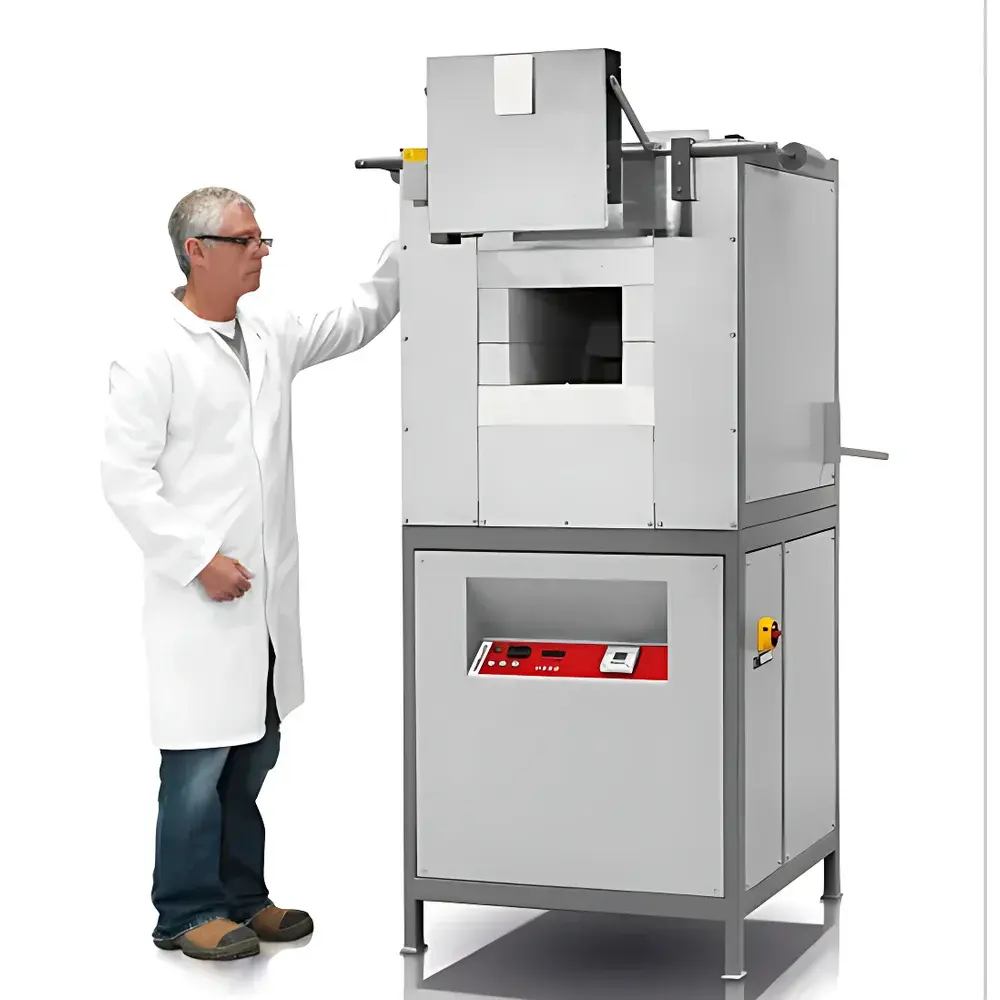
Carbolite Gero CF24 Precious Metals Cupellation Furnace
| Brand | Carbolite Gero |
|---|---|
| Origin | United Kingdom |
| Model | CF24 |
| Instrument Type | Box-Type Muffle Furnace |
| Maximum Temperature | 1200 °C |
| Temperature Uniformity | ±1 °C (at 1000 °C, per ISO 11426) |
| Rated Power | 9000 W |
| Internal Chamber Dimensions | 125 × 220 × 350 mm (L × W × H) |
| Chamber Volume | 9.6 L |
| Heating Elements | Silicon Carbide (SiC) Rods, Top & Bottom Mounted |
| Airflow Control | Adjustable Preheated Air Inlet Valve |
| Exhaust System | Insulated Vertical Flue with Condensate-Collecting Removable Trap |
| Compliance | ISO 11426:1997, Assay Standards for Precious Metals by Cupellation |
| Timer Function | 7-Day Programmable Cycle Controller |
Overview
The Carbolite Gero CF24 Precious Metals Cupellation Furnace is a purpose-engineered thermal system designed exclusively for standardized cupellation and fire assay procedures in precious metals analysis. It operates on the fundamental principle of selective oxidation—where base metals (e.g., lead, copper, zinc) in an alloy sample are oxidized and absorbed into a porous bone-ash or magnesia cupel, while noble metals (gold, silver, platinum group elements) remain as a coherent metallic bead. This gravimetric method forms the internationally recognized reference technique for assaying gold and silver content in bullion, jewelry alloys, and refinery feedstocks. The CF24 meets the stringent spatial, thermal, and atmospheric control requirements defined in ISO 11426:1997, ensuring traceable, reproducible results required by assay offices, national mint laboratories, and accredited precious metals refiners.
Key Features
- High-stability silicon carbide (SiC) heating elements mounted both above and below the chamber deliver uniform radiant heat distribution across the entire working zone—critical for consistent cupel temperature profiles during extended cupellation cycles.
- Preheated air inlet with calibrated flow valve enables precise regulation of oxidative atmosphere; air is heated to ~300 °C prior to entering the furnace chamber, minimizing thermal shock to cupels and promoting controlled lead oxide volatilization.
- Vertically oriented, insulated flue system directs fumes upward through a thermally shielded exhaust duct, terminating in a removable condensate trap positioned beneath the chimney base—designed specifically to capture condensed litharge (PbO) without compromising operator safety or laboratory ventilation integrity.
- Refractory chamber lining comprises sintered silicon carbide tiles on floor, ceiling, and sidewalls—providing exceptional resistance to corrosive cupellation vapors (e.g., PbO, CuO, SOx) and extending service life under repeated high-temperature cycling.
- Front-loading vertical lift door incorporates a borosilicate observation window, allowing real-time visual monitoring of cupel condition and bead formation without interrupting thermal equilibrium or exposing personnel to radiant heat.
- Integrated 7-day programmable timer supports unattended operation across multi-stage protocols—including preheating, cupellation, annealing, and cooling phases—with configurable hold times and ramp rates.
Sample Compatibility & Compliance
The CF24 accommodates standard cupels (typically 30–40 mm diameter, 10–15 mm height) placed on refractory trays within its 9.6 L chamber. It is validated for use with lead-based, silver-rich, and platinum-group metal-bearing samples up to 500 g nominal mass per assay batch. As a dedicated cupellation furnace, it conforms to ISO 11426:1997 (“Gold and silver — Determination of gold and silver in bullion by cupellation”), which specifies permissible temperature gradients (±5 °C over cupel zone), minimum airflow rates, and cupel positioning criteria. Its design also aligns with UK Assay Office requirements for hallmarking certification and satisfies GLP documentation prerequisites when paired with compliant data loggers and audit-trail-capable controllers.
Software & Data Management
While the base CF24 operates via analog/digital front-panel controls, optional digital controller upgrades support RS485 Modbus RTU or Ethernet TCP/IP interfaces for integration into centralized laboratory information management systems (LIMS). These configurations enable automated logging of setpoint temperatures, actual chamber readings, airflow status, cycle timestamps, and door-open events—meeting FDA 21 CFR Part 11 and EU Annex 11 expectations for electronic record integrity. All firmware versions undergo factory calibration traceable to NPL (National Physical Laboratory, UK) standards, with full calibration certificates available upon request.
Applications
- Primary fire assay of gold and silver ores, concentrates, and doré bars in mining and refining laboratories.
- Quality assurance testing of jewelry alloys prior to hallmarking under national assay office mandates.
- Reference material certification and inter-laboratory proficiency testing programs coordinated by BIPM or EURAMET.
- Research into alternative cupel materials (e.g., MgO-based, synthetic ash) requiring tightly controlled oxidizing atmospheres.
- Development and validation of modified cupellation protocols for PGM recovery from electronic scrap and catalytic converters.
FAQ
Does the CF24 comply with ISO 11426:1997?
Yes—the furnace’s thermal uniformity, airflow delivery system, and exhaust configuration are engineered to meet all mandatory physical and operational clauses of ISO 11426:1997.
Can the CF24 be used for non-precious metal assays?
No—it is not validated for general-purpose ashing or calcination; its thermal profile, gas dynamics, and chamber geometry are optimized exclusively for cupellation chemistry.
Is the removable condensate trap supplied as standard?
Yes—the PbO collection trap is integral to the exhaust assembly and included with every CF24 unit.
What maintenance intervals are recommended for SiC heating elements?
Under typical assay lab usage (≤4 cycles/day), SiC rods require inspection every 6 months and replacement only after measurable resistance drift (>10%) or visible cracking is observed.
Is external fume hood connection mandatory?
Yes—while the internal trap captures condensed litharge, gaseous effluents (e.g., NOx, SO2) must be vented externally via ductwork compliant with local occupational health regulations (e.g., OSHA 1910.1200, COSHH).



