
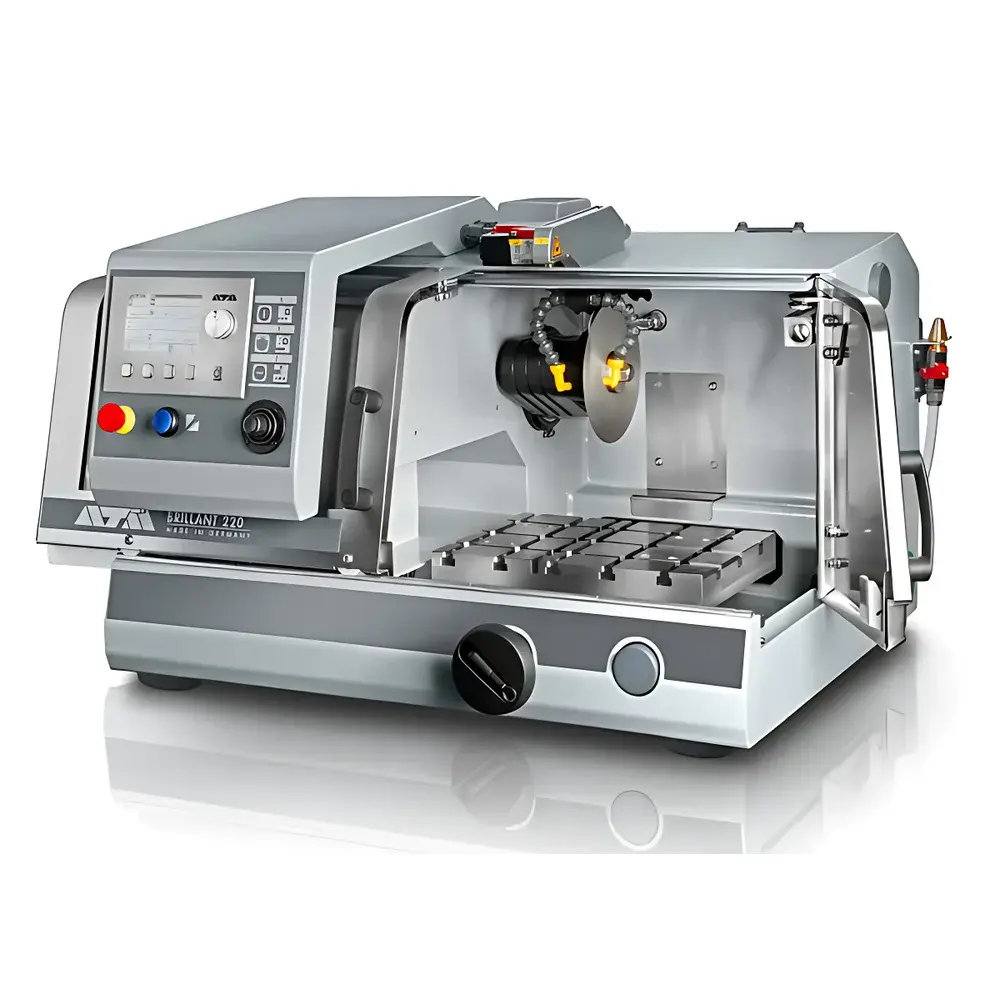
QATM Qcut 200A Automatic Precision Wet Cutting Machine (Original ATM Brillant 220)
| Brand | QATM |
|---|---|
| Origin | Germany |
| Model | Qcut 200A (formerly ATM Brillant 220) |
| Cutting Wheel Diameter | 203 mm (8") |
| Max. Cutting Height (Y-axis) | 75 mm |
| Y-axis Travel (Auto Mode) | 80 mm |
| Z-axis Feed Travel | 80 mm |
| Stage Dimensions (w × d, excl. Z) | 300 × 210 mm |
| Stage Dimensions (w × d, incl. Z) | 280 × 210 mm |
| T-slot Width | 8 mm |
| Power Supply | 2.3 kVA |
| Rated Motor Power (S1) | 0.75 kW |
| Adjustable Speed Range | 300–5000 rpm |
| Overall Dimensions (w × h × d) | 710 × 485 × 570 mm |
| Cutting Chamber Dimensions (w × d) | 405 × 500 mm |
| Weight | ~82 kg |
Overview
The QATM Qcut 200A Automatic Precision Wet Cutting Machine—originally engineered as the ATM Brillant 220—is a compact, CE-compliant, high-precision wet-sectioning system designed for reproducible metallographic and materials science sample preparation. It operates on the principle of controlled abrasive cutting under continuous coolant flow, ensuring minimal thermal distortion, reduced mechanical damage, and superior edge integrity in cross-sectional specimens. Engineered for laboratories requiring high repeatability in serial sectioning of small or geometrically complex components—including thin foils, non-mounted specimens, and miniature castings—the Qcut 200A integrates modular mechanics, programmable motion control, and vacuum-assisted clamping to deliver micron-level positional accuracy (±0.001 mm) without reliance on hot mounting or epoxy embedding.
Key Features
- Three-axis automated motion control (X, Y, Z) with electronic positioning feedback and programmable feed rates
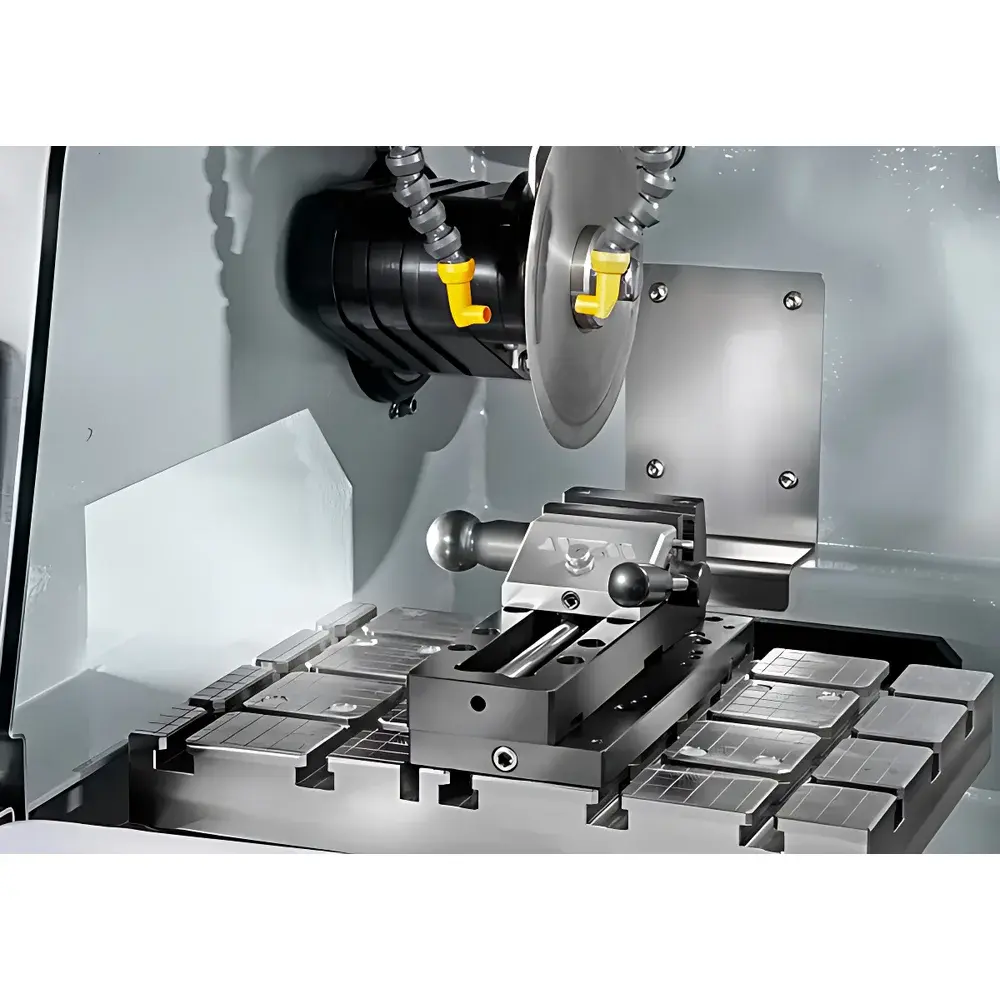
- Large cutting chamber (405 × 500 mm) and expansive stage (300 × 210 mm) accommodating extended or irregularly shaped samples
- Dual-access side openings enabling longitudinal sectioning of rods, wires, or extrusions up to 500 mm in length
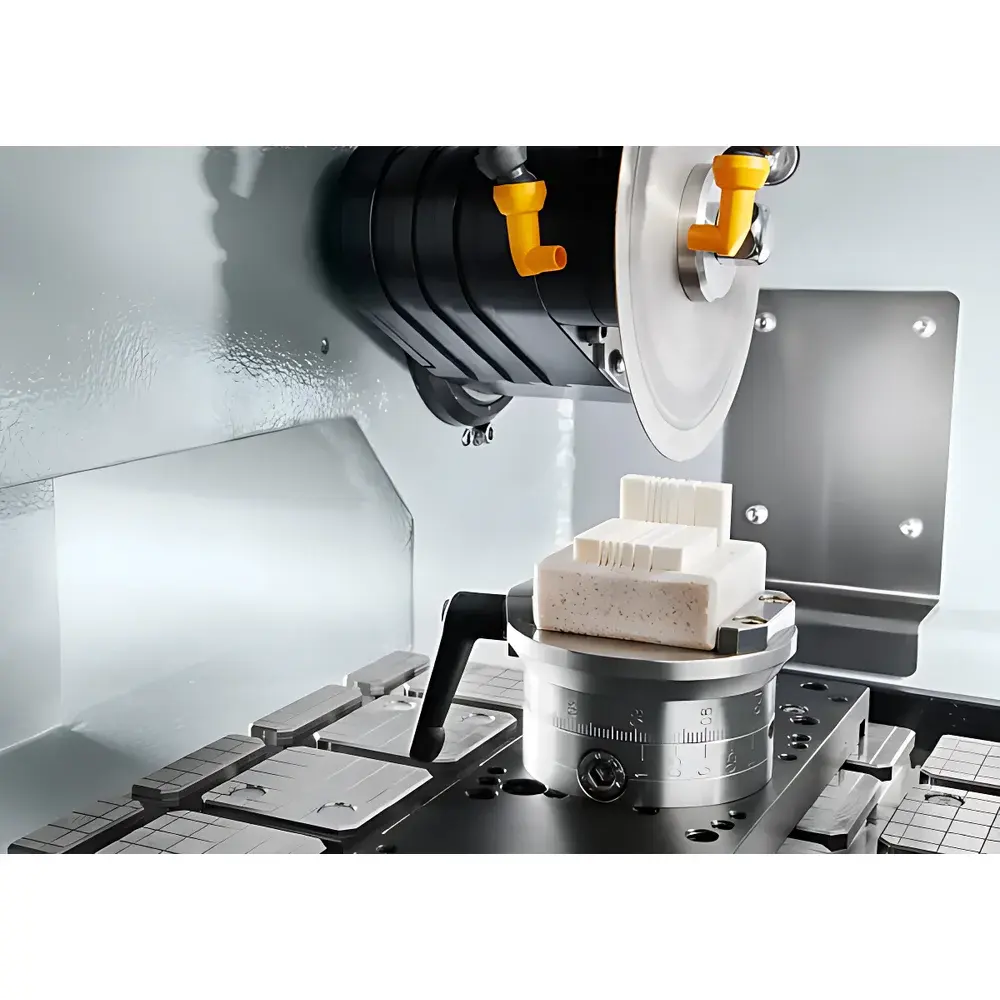
- Vacuum sample holding system compatible with unmounted, fragile, or low-profile specimens (e.g., thin wafers, coatings, layered composites)
- Motorized Z-axis feed with adjustable depth-of-cut increments and real-time progress monitoring via LCD interface
- Integrated LED illumination within the cutting chamber for enhanced visibility during alignment and operation
- Interlocked safety door with ISO 13857-compliant guarding and automatic motor shutdown upon opening
- Powder-coated aluminum chassis offering corrosion resistance, structural rigidity, and long-term dimensional stability
- Intuitive joystick-based manual axis control (X/Y/Z) during setup and alignment phases
- Onboard memory for storing and recalling up to 20 user-defined cutting protocols with parameter sets (speed, feed rate, coolant flow, dwell time)
Sample Compatibility & Compliance
The Qcut 200A is validated for use across diverse material classes: ferrous and non-ferrous metals, sintered carbides, ceramics, polymers, and composite laminates. Its vacuum chucking system eliminates mechanical stress on brittle or low-adhesion specimens, while the wet-cutting architecture suppresses airborne particulate generation—supporting compliance with OSHA 1910.1000 and EU Directive 2004/37/EC (CARCINOGENS AND MUTAGENS). The instrument meets EN 61000-6-2 (EMC immunity) and EN 61000-6-4 (EMC emission) standards. All firmware and motion logic adhere to IEC 61508 SIL 2 functional safety requirements for industrial machinery. Optional documentation packages support GLP/GMP audit readiness per ISO/IEC 17025:2017 Annex A.2.
Software & Data Management
While the Qcut 200A operates primarily via its embedded microcontroller and front-panel interface, it supports optional RS-232/USB data export for protocol archiving and traceability. Cutting programs—including spindle speed (300–5000 rpm), Z-feed rate (µm/s), total stroke, coolant activation timing, and pause points—are timestamped and stored with operator ID fields. Audit trail logs (enabled via optional firmware upgrade) comply with FDA 21 CFR Part 11 requirements for electronic records and signatures when integrated into regulated QA/QC environments. No proprietary cloud platform is required; all configuration files are exported as plain-text CSV for integration into LIMS or ELN systems.
Applications
- Preparation of cross-sections for optical microscopy (OM), scanning electron microscopy (SEM), and energy-dispersive X-ray spectroscopy (EDS) analysis
- Serial sectioning of additively manufactured parts for porosity and layer-bond evaluation per ASTM E1245
- Cutting of coated substrates (e.g., PVD/CVD layers) for interface integrity assessment
- Sectioning of electronic components (PCBs, solder joints, wafer dice) without delamination or thermal cracking
- Routine QC sampling in automotive, aerospace, and medical device manufacturing per ISO 148-1 and ASTM E3
- Research-grade specimen preparation for tensile bar extraction, fatigue crack initiation studies, and microstructural gradient mapping
FAQ
What types of cutting wheels are compatible with the Qcut 200A?
Standard 203 mm (8″) diamond-impregnated or silicon-carbide bonded wheels with ISO 40/42 arbor fitment are supported. Optional wheel flanges enable use of segmented or turbo-profile blades for specific material families.
Is vacuum chucking suitable for porous or powder-metallurgy samples?
Yes—vacuum pressure is adjustable (typically 0.4–0.7 bar) and can be optimized for low-density sintered compacts. Optional perforated adapter plates improve suction distribution across heterogeneous surfaces.
Can the machine be integrated into an automated lab workflow?
Via optional digital I/O expansion module (part no. QIO-200A), the Qcut 200A supports external start/stop signals, status output (ready/error), and synchronization with robotic sample handlers or conveyor interfaces.
Does the system include coolant filtration or recycling capability?
The base configuration includes a 5-L recirculating reservoir with coarse mesh pre-filter. Closed-loop filtration kits (with 10-µm cartridge filters and level sensors) are available as field-installable accessories.
What maintenance intervals are recommended for long-term reliability?
Lubrication of linear guides every 500 operating hours; spindle bearing inspection every 3,000 hours; coolant pH and biocide concentration monitoring weekly in high-utilization labs.



