
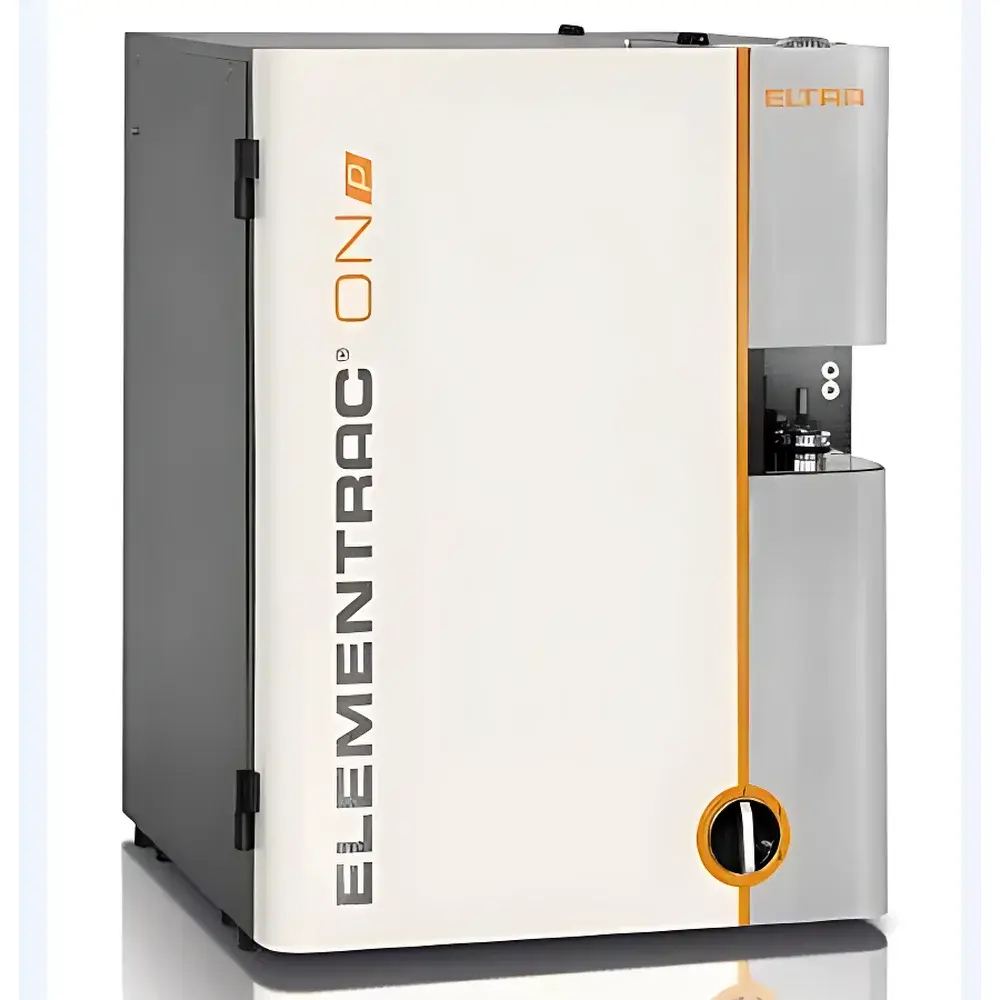
ELTRA ELEMENTRAC ON-p Oxygen and Nitrogen Analyzer
| Brand | ELTRA |
|---|---|
| Origin | Germany |
| Model | ON-p |
| Instrument Type | Oxygen and Nitrogen Analyzer |
| Analysis Range | 0.1 ppm – 2% |
| Analysis Time | 90 s |
| Detection Limit (N) | 0.01 ppm |
| Furnace Max Temperature | 3000 °C |
| Furnace Power | 8.5 kW |
| Detection Principle | Inert Gas Fusion Coupled with IR Absorption (O) and Thermal Conductivity (N) |
| Carrier Gas Options | He or Ar |
| Software | ELTRA Analytical Software (Supports CFR 21 Part 11 Compliance, Audit Trail, Multi-Point Calibration, Report Export, Comment Annotation) |
Overview
The ELTRA ELEMENTRAC ON-p is a high-performance inert gas fusion analyzer engineered for the precise and simultaneous determination of oxygen and nitrogen in inorganic solid materials. It operates on the principle of high-temperature pulse furnace fusion under ultra-pure inert atmosphere (He or Ar), enabling quantitative release of interstitial and bound O/N species from refractory matrices. During analysis, samples are heated to up to 3000 °C in a graphite crucible mounted on water-cooled electrodes, ensuring thermal stability and minimizing background contamination. Released oxygen reacts with graphite to form CO, which is subsequently catalytically oxidized to CO₂ in a temperature-controlled CuO furnace; CO₂ concentration is measured via dual-range infrared absorption cells—automatically selected based on expected O content. Nitrogen is quantified as elemental N₂ using two high-sensitivity thermal conductivity detectors (TCD), offering sub-ppm resolution. The system’s closed-loop gas path architecture, electromagnetic valve sequencing, and real-time pressure monitoring ensure exceptional reproducibility (<1.5% RSD for certified reference materials) and compliance with ISO 14284, ASTM E1019, and USP .
Key Features
- 8.5 kW high-power pulse furnace with precise temperature control up to 3000 °C, optimized for complete liberation of O/N from alloys, ceramics, and refractory metals
- Water-cooled sample introduction port prevents external air ingress and maintains thermal isolation during loading
- Dual-length infrared detection cells (high- and low-range) for oxygen—automatically selected to maximize signal-to-noise ratio across 0.1 ppm–2% concentration range
- Two independent thermal conductivity detectors for nitrogen analysis, achieving a detection limit of 0.01 ppm and linear dynamic range spanning four orders of magnitude
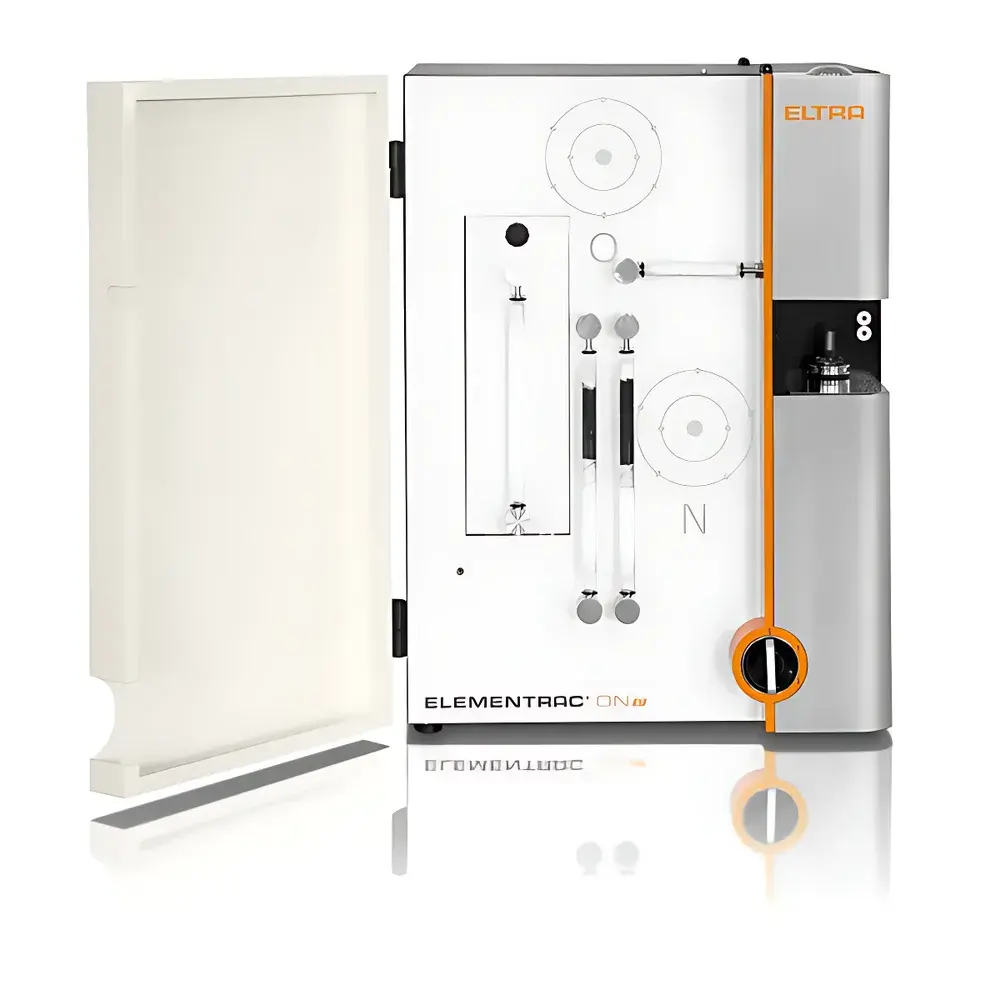
- Modular reagent and filter compartment behind removable front panel—enabling visual inspection, rapid replacement, and maintenance without system shutdown
- Segmented leak detection protocol integrated into gas path logic, verifying integrity at each stage (furnace, catalyst, detector) prior to analysis
- Configurable carrier gas support: fully validated operation with both helium and argon, reducing operational cost without compromising accuracy
- Adjustable catalytic furnace temperature (600–900 °C), allowing optimization of CO oxidation efficiency for diverse sample types and matrix effects
Sample Compatibility & Compliance
The ELEMENTRAC ON-p accommodates a broad spectrum of inorganic solids including ferrous and non-ferrous metals (steels, cast iron, copper, titanium, nickel superalloys), ceramics (Al₂O₃, Si₃N₄, ZrO₂), carbides, nitrides, and geological refractories. Sample forms include chips, turnings, powders, and pellets—typically introduced in nickel baskets or capsules; granular or rod-shaped steel samples may be loaded directly. Optional fluxes (e.g., tin, nickel, or cobalt) are added to enhance decomposition kinetics in oxide-rich or low-conductivity matrices. All hardware and software modules comply with GLP and GMP requirements: the analytical software provides full 21 CFR Part 11 compliance—including electronic signatures, immutable audit trail, user access levels, and data integrity validation. Instrument performance is verifiable against certified reference materials traceable to NIST and BAM, and routine calibration adheres to ISO/IEC 17025-accredited laboratory practices.
Software & Data Management
ELTRA Analytical Software serves as the central interface for method development, instrument control, and regulatory reporting. It supports single-point and multi-point linear regression calibration with automatic weighting and outlier rejection. Real-time visualization includes IR cell voltage outputs, TCD bridge balance, furnace temperature profile, gas flow rates, and pressure differentials—all synchronized and timestamped. Measurement data—including raw signals, processed concentrations, calibration curves, and operator annotations—are stored in an encrypted SQL database with version-controlled backups. Reporting templates conform to ISO 17025 and internal QA protocols; export formats include PDF, CSV, XML, and LIMS-compatible ASTM E1382-compliant files. Comment fields allow contextual notes per analysis (e.g., “sample surface oxidized”, “flux excess observed”), supporting root cause investigation during out-of-specification (OOS) reviews.
Applications
The ON-p delivers critical quality control data across metallurgical production, advanced materials R&D, and third-party testing laboratories. Typical use cases include: verification of interstitial O/N levels in aerospace-grade titanium alloys to prevent embrittlement; monitoring nitrogen pickup during stainless steel ladle refining; quantifying residual oxygen in silicon carbide ceramics for semiconductor substrate qualification; determining nitrogen solubility limits in zirconium cladding materials for nuclear applications; and validating purity specifications for additive manufacturing feedstock powders. Its robustness and repeatability make it suitable for ISO 9001-certified production environments where daily throughput exceeds 40 samples with <2% relative standard deviation across shifts.
FAQ
What carrier gases are supported, and how does argon substitution affect accuracy?
The ON-p is fully validated for both helium and argon. Argon operation introduces no statistically significant bias when calibrated with matrix-matched CRMs; detection limits and precision remain within specification due to optimized TCD referencing and IR background compensation algorithms.
Can the system analyze samples containing hydrogen or carbon?
No—the ON-p is dedicated to O/N only. Hydrogen and carbon require separate instrumentation (e.g., ELTRA CS-i or HPC analyzers) due to fundamental differences in release chemistry and detection physics.
Is remote diagnostics or service support available?
Yes—via secure TLS-encrypted connection, ELTRA engineers can perform firmware updates, parameter diagnostics, and sensor health assessment while preserving data sovereignty and network isolation per customer IT policy.
How often must the CuO catalyst be replaced?
Under normal operation (≤200 analyses/week), the catalytic furnace requires replacement every 12–18 months; lifetime is extended by pre-fusion graphite crucible conditioning and regular dust filter maintenance.
Does the software support automated report generation for regulatory submission?
Yes—customizable report templates include instrument ID, analyst signature, calibration history, CRM traceability, uncertainty budget (per GUM), and electronic approval workflows aligned with FDA and EMA expectations.




