
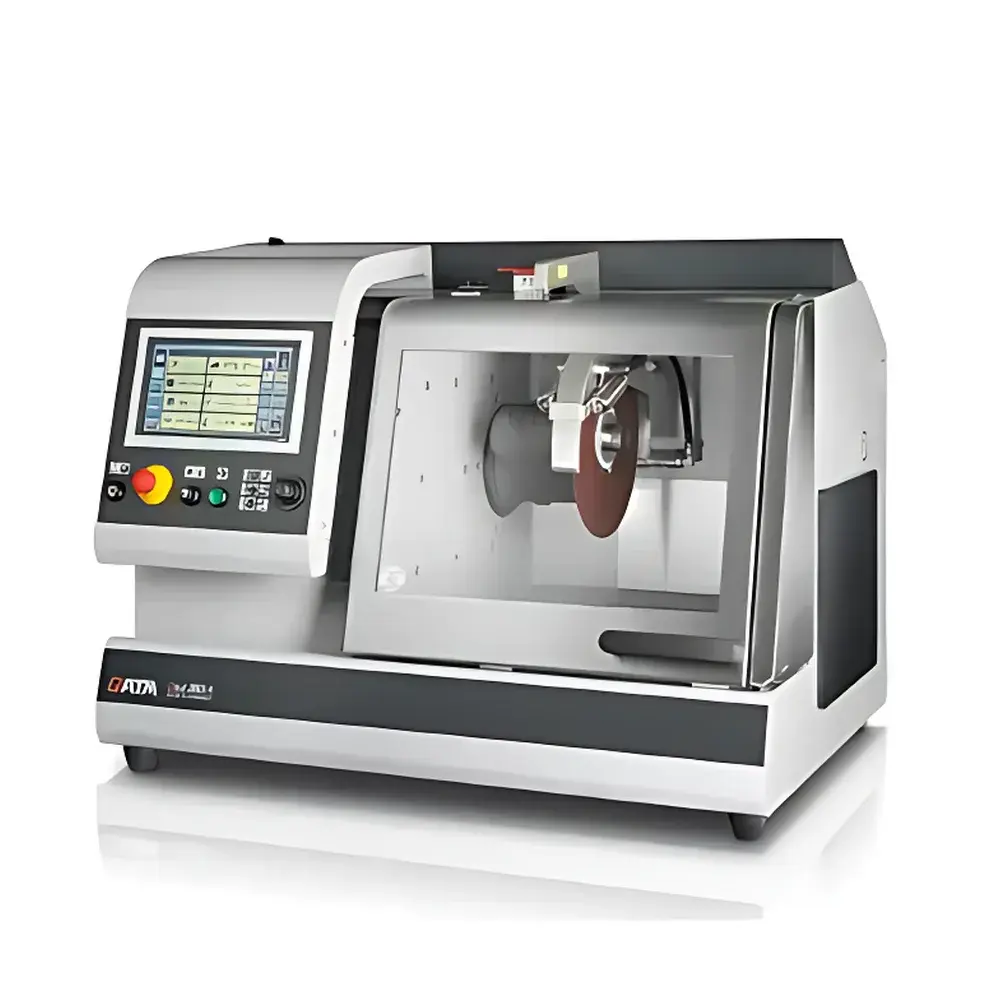
QATM Qcut 350A Automatic Wet Abrasive Cutting Machine (Formerly Brillant 250)
| Brand | QATM |
|---|---|
| Origin | Germany |
| Model | Qcut 350A |
| Instrument Type | Metallographic Cutting Machine |
| Maximum Sample Diameter | Ø135 mm |
| Cutting Wheel Diameter | Up to Ø356 mm (14") |
| Flange Size | Ø32 mm |
| Auto X-Axis Travel | 260 mm |
| Auto Y-Axis Travel | 180 mm |
| Optional Z-Axis Travel | 140 mm |
| Z-Axis Positioning Accuracy | 0.1 mm |
| Stage Dimensions (without Z) | 500 × 300 mm, Stainless Steel |
| Stage Dimensions (with Z) | 400 × 300 mm, Stainless Steel |
| T-Slot Width | 12 mm |
| Variable Speed Range | 800–3400 rpm |
| Power Supply | 9.5 kVA |
| Rated Output (S1) | 4 kW |
| Rated Output (S3) | 5.5 kW |
| Dimensions (W×H×D) | 1015 × 760 × 810 mm |
| Weight | ~200 kg |
Overview
The QATM Qcut 350A is a fully automated, water-cooled abrasive cutting machine engineered for precision sample sectioning in metallographic, materials science, and geological laboratories. Designed on the foundation of the legacy Brillant 250 platform and enhanced with QATM’s proprietary Low Contact Cutting (LCC) technology, it delivers controlled, low-stress material removal by dynamically regulating feed force and wheel engagement depth—critical for preserving microstructural integrity in brittle, heterogeneous, or multi-phase specimens. Its robust cast-iron frame, stainless-steel stage, and sealed drive system ensure long-term dimensional stability and resistance to coolant-induced corrosion. The machine operates under ISO 9001-certified manufacturing protocols and complies with EN 61000-6-2 (EMC immunity) and EN 61000-6-4 (EMC emission) standards, meeting baseline requirements for integration into GLP-compliant and ISO/IEC 17025-accredited laboratory environments.
Key Features
- Low Contact Cutting (LCC) algorithm: Enables adaptive force modulation during approach and cutting phases, minimizing thermal damage and edge chipping in sensitive materials such as sintered carbides, fiber-reinforced composites (CFC/PMC/MMC), and printed circuit boards (PCBs).
- Dual-axis automated positioning: Motorized X- and Y-axis translation (260 mm × 180 mm travel) with programmable start/end coordinates supports repeatable multi-position cutting sequences without manual repositioning.
- Optional motorized Z-axis (140 mm travel, 0.1 mm resolution): Facilitates precise vertical alignment for angled cuts, sequential layer removal, or height-compensated sectioning across non-planar samples.
- Variable-speed spindle (800–3400 rpm): Synchronized with feed rate and torque feedback to maintain optimal wheel-to-sample kinematics across abrasive types (e.g., silicon carbide, diamond-impregnated, resin-bonded) and material hardness ranges (HV 50–2500).
- Integrated coolant management system: High-flow, temperature-stabilized recirculation with particle filtration ensures consistent thermal control and extends wheel service life; compatible with biocide-treated aqueous coolants per ASTM D4627 guidelines.
- Programmable process memory: Stores up to 99 user-defined cutting protocols—including speed, force limits, dwell times, and axis trajectories—with password-protected access levels for operator, supervisor, and administrator roles.
Sample Compatibility & Compliance
The Qcut 350A accommodates diverse specimen geometries—from cylindrical rods (Ø ≤ 135 mm) and irregular mineral aggregates to laminated electronic assemblies and additively manufactured metal parts. Its large chamber volume (W × D × H ≈ 450 × 400 × 300 mm), right-side open configuration, and modular T-slot stage (12 mm groove width) enable secure mounting of custom fixtures, vacuum chucks, and multi-sample holders. All cutting parameters are traceable via timestamped audit logs compliant with FDA 21 CFR Part 11 Annex 11 requirements when paired with optional QATM LabSuite software. The system conforms to ISO 3040 (metallographic specimen preparation), ASTM E3 (standard guide for preparation of metallographic specimens), and EN ISO 148-1 (impact testing specimen machining) for certified lab workflows.
Software & Data Management
Controlled via the QATM TouchControl interface—a 10.1″ capacitive touchscreen running real-time Linux OS—the Qcut 350A supports intuitive graphical programming of cutting paths, force profiles, and safety interlocks. Optional LabSuite Connect enables networked data export (CSV, XML) to LIMS platforms, automatic report generation (PDF with embedded metadata), and remote diagnostics via encrypted HTTPS. Process logs include spindle current, Z-axis load, coolant flow rate, and positional deviation—enabling root-cause analysis for QA/QC investigations and supporting ISO/IEC 17025 clause 7.7 (result reporting) and clause 8.9 (nonconforming work) documentation.
Applications
- Metallography: Sectioning of ferrous/non-ferrous alloys, weld joints, and heat-affected zones for subsequent grinding, polishing, and microscopic analysis per ASTM E407 and ISO 643.
- Advanced materials: Precision slicing of ceramic matrix composites (CMCs), carbon-fiber laminates, and metal-matrix composites without delamination or fiber pull-out.
- Geoscience & mineralogy: Preparation of thin sections from rock cores, meteorites, and ore samples while preserving textural relationships and cleavage planes.
- Electronics failure analysis: Controlled dicing of PCBs, semiconductor packages, and MEMS devices for cross-sectional SEM/EDS examination.
- Research & development: Reproducible serial sectioning for 3D reconstruction (e.g., FIB-SEM correlation) and microstructure quantification using stereological methods.
FAQ
Is the Qcut 350A suitable for cutting hardened tool steels (e.g., H13, M2)?
Yes—when equipped with diamond-impregnated wheels and operated within the recommended force/speed envelope (typically 1200–2200 rpm, 2–8 N feed force), it achieves clean, low-distortion cuts with minimal white-layer formation.
Can existing Brillant 250 accessories be used on the Qcut 350A?
Most mechanical fixtures, clamping systems, and coolant nozzles are dimensionally compatible; however, firmware-dependent modules (e.g., advanced force sensors, Z-axis controllers) require QATM validation prior to retrofitting.
What maintenance intervals are recommended for daily operation?
Daily: Coolant level and filter inspection; weekly: Spindle bearing lubrication and T-slot debris clearance; annually: Encoder calibration verification and servo drive performance diagnostics per QATM Service Manual SM-QC350A-Rev.4.
Does the system support external PLC integration for factory-floor automation?
Yes—via standard Ethernet/IP and Modbus TCP interfaces, enabling synchronization with robotic loaders, barcode scanners, and MES systems in Industry 4.0 environments.
Is CE marking valid for use in North American laboratories?
CE marking confirms compliance with EU Machinery Directive 2006/42/EC; for U.S./Canada deployment, UL 61010-1 and CSA C22.2 No. 61010-1 certification kits are available as factory-installed options.
Related Products



