
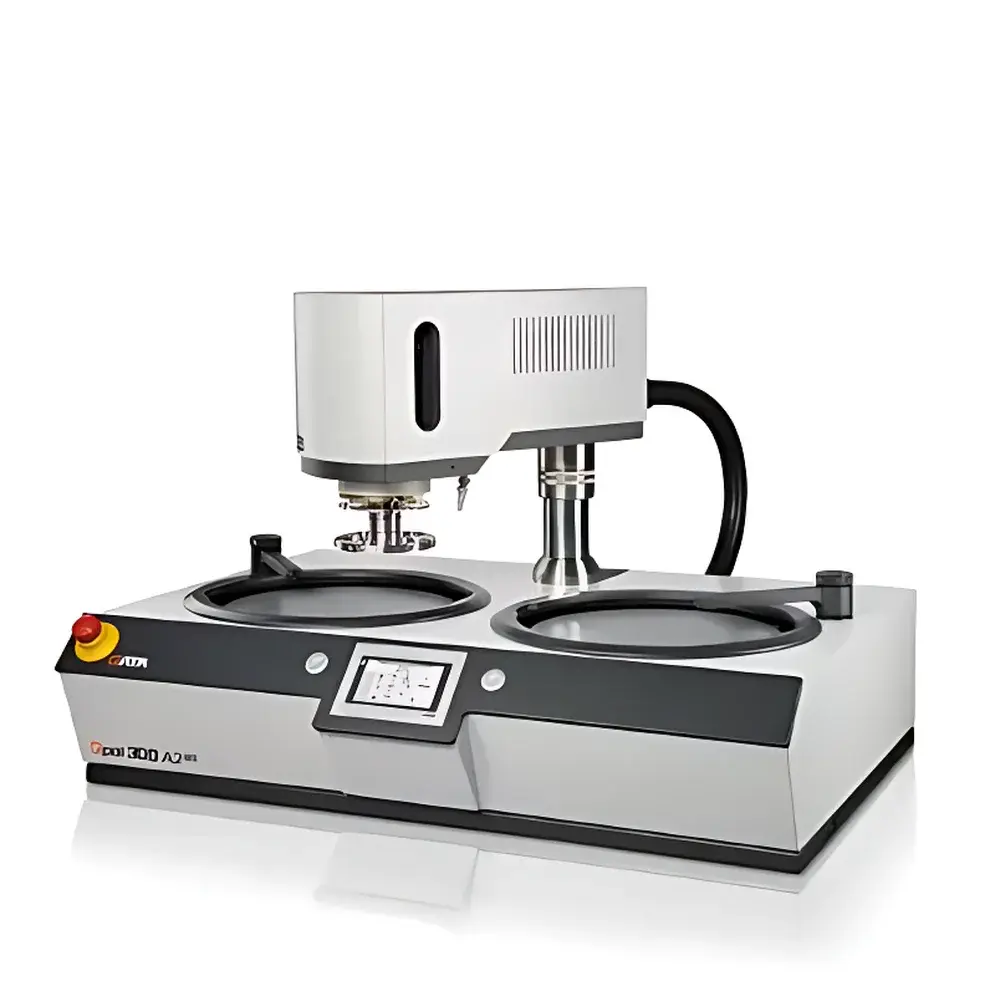
QATM QPOL 300 A2-ECO+ Automatic Dual-Disc Grinding and Polishing System
| Brand | QATM |
|---|---|
| Origin | Germany |
| Model | QPOL 300 A2-ECO+ |
| Disc Diameter | 250/300 mm |
| Number of Discs | 2 |
| Rotational Speed (Platen) | 30–600 min⁻¹ |
| Rotational Speed (Head) | 30–160 min⁻¹ |
| Platen Cleaning Spin Speed | 750 min⁻¹ (3 s) |
| Sample Capacity (per station) | 1–6 pcs (Ø50 mm) |
| Central Load Range | 20–350 N |
| Single-Point Load Range | 5–80 N |
| Power Supply | 3.3 kVA |
| Motor Power (Platen) | 0.75 kW (S1) |
| Motor Power (Head) | 0.18 kW (S1) |
| Dimensions (L×W×H) | 901 × 530–610 × 710 mm |
| Weight | ~78 kg |
| Water Inlet | R½", max. 6 bar |
| Optional Dosing System | Qdoser ECO / Qdoser ONE |
Overview
The QATM QPOL 300 A2-ECO+ is a fully automated, dual-disc grinding and polishing system engineered for high-precision metallographic sample preparation in industrial quality control laboratories and academic research facilities. Based on the principle of controlled mechanical material removal via rotational shear and abrasive interaction between rotating platens and specimen-holding heads, this system delivers reproducible surface finish across diverse metallic, ceramic, and composite materials. Its dual-platen architecture enables simultaneous or sequential operation—ideal for optimizing throughput in multi-step preparation workflows (e.g., coarse grinding → fine grinding → pre-polishing → final polishing). Designed and manufactured in Germany, the QPOL 300 A2-ECO+ integrates precision electromechanical actuation, closed-loop pressure regulation, and programmable rotational dynamics to ensure compliance with international metallographic standards including ISO 14976, ASTM E3, and EN 10365.
Key Features
- Automated dual-disc configuration with independently controllable 250 mm and 300 mm platens—enabling flexible method development for varying specimen sizes and material classes.
- 4.3-inch high-resolution capacitive touchscreen interface running QATM’s proprietary embedded software, supporting intuitive navigation, real-time parameter monitoring, and multilingual UI (English, German, French, Spanish, Chinese).
- Integrated platen dehydration spin function: at process completion, the platen accelerates to 750 min⁻¹ for exactly 3 seconds to centrifugally expel residual coolant and abrasive slurry—reducing cross-contamination and accelerating cleanup.
- Modular head design with adjustable vertical travel and dynamic load compensation; supports both central loading (20–350 N) and single-point loading (5–80 N) with ±0.5 N repeatability.
- Full bidirectional rotation control: platens and specimen heads operate independently in clockwise or counterclockwise direction—critical for minimizing edge rounding and improving planarity in soft or layered materials.
- Rugged aluminum housing with powder-coated finish and impact-resistant polymer interior basin; integrated LED lighting (energy-efficient, cool-running, uniform illumination).
- Lift-assist mechanism allows full access to the platen basin for rapid rinsing and maintenance without tooling or disassembly.
Sample Compatibility & Compliance
The QPOL 300 A2-ECO+ accommodates standard metallographic specimens up to Ø50 mm per station, with capacity for 1–6 samples simultaneously depending on mounting configuration (e.g., cold-mounting resin blocks, hot-pressed mounts, or direct-clamp fixtures). It supports all common abrasive media—including silicon carbide papers (P80–P2500), diamond suspensions (0.25–9 µm), and colloidal silica (0.02–0.06 µm)—and is compatible with aqueous and oil-based lubricants. The system meets CE marking requirements under the Machinery Directive 2006/42/EC and Electromagnetic Compatibility Directive 2014/30/EU. When paired with optional Qdoser ECO or Qdoser ONE volumetric dosing units, it supports traceable, repeatable reagent delivery aligned with GLP/GMP documentation practices and audit-ready calibration logs.
Software & Data Management
The onboard control software stores up to 200 user-defined preparation methods, each comprising time-controlled sequences of speed, load, rotation direction, and dwell duration per step. Methods are secured via role-based user accounts (administrator, technician, trainee) with password protection and configurable access levels. All process executions generate timestamped audit trails—including parameter values, operator ID, start/stop times, and error codes—exportable via USB to CSV format for integration into LIMS or QA documentation systems. Software updates are delivered via secure firmware packages validated against SHA-256 checksums, ensuring integrity and version traceability.
Applications
- Metallographic evaluation of ferrous and non-ferrous alloys in foundries, aerospace component manufacturing, and automotive powertrain QA labs.
- Preparation of weld cross-sections, heat-affected zones (HAZ), and clad materials for microstructural analysis by optical microscopy or SEM-EDS.
- Surface conditioning of ceramic matrix composites (CMCs) and tungsten carbide tooling prior to hardness testing (Vickers, Knoop).
- Standardized specimen prep for interlaboratory round-robin studies compliant with ISO/IEC 17043 proficiency testing protocols.
- Teaching laboratories requiring robust, safe, and method-reproducible equipment for undergraduate metallurgy and materials science curricula.
FAQ
What safety certifications does the QPOL 300 A2-ECO+ hold?
It complies with EU Machinery Directive 2006/42/EC, Low Voltage Directive 2014/35/EU, and EMC Directive 2014/30/EU, and carries the CE mark. Emergency stop circuitry meets Category 3 / PL e per ISO 13850.
Can the system be integrated into a laboratory automation network?
Yes—via optional RS-485 Modbus RTU or Ethernet/IP interfaces (hardware module required), enabling remote status polling, method triggering, and alarm reporting within SCADA or MES environments.
Is the platen cleaning spin function programmable?
The 750 min⁻¹, 3-second dehydration spin executes automatically at the end of every method unless explicitly disabled in the final step configuration.
What maintenance intervals are recommended?
Platen bearing inspection every 12 months or 2,000 operating hours; coolant filter replacement every 6 months; touchscreen calibration annually or after physical impact.
Does QATM provide method validation support for ISO 17025-accredited labs?
Yes—application engineers offer on-site or remote method qualification packages, including uncertainty budgeting, Gage R&R studies, and documented evidence for accreditation body submissions.



