
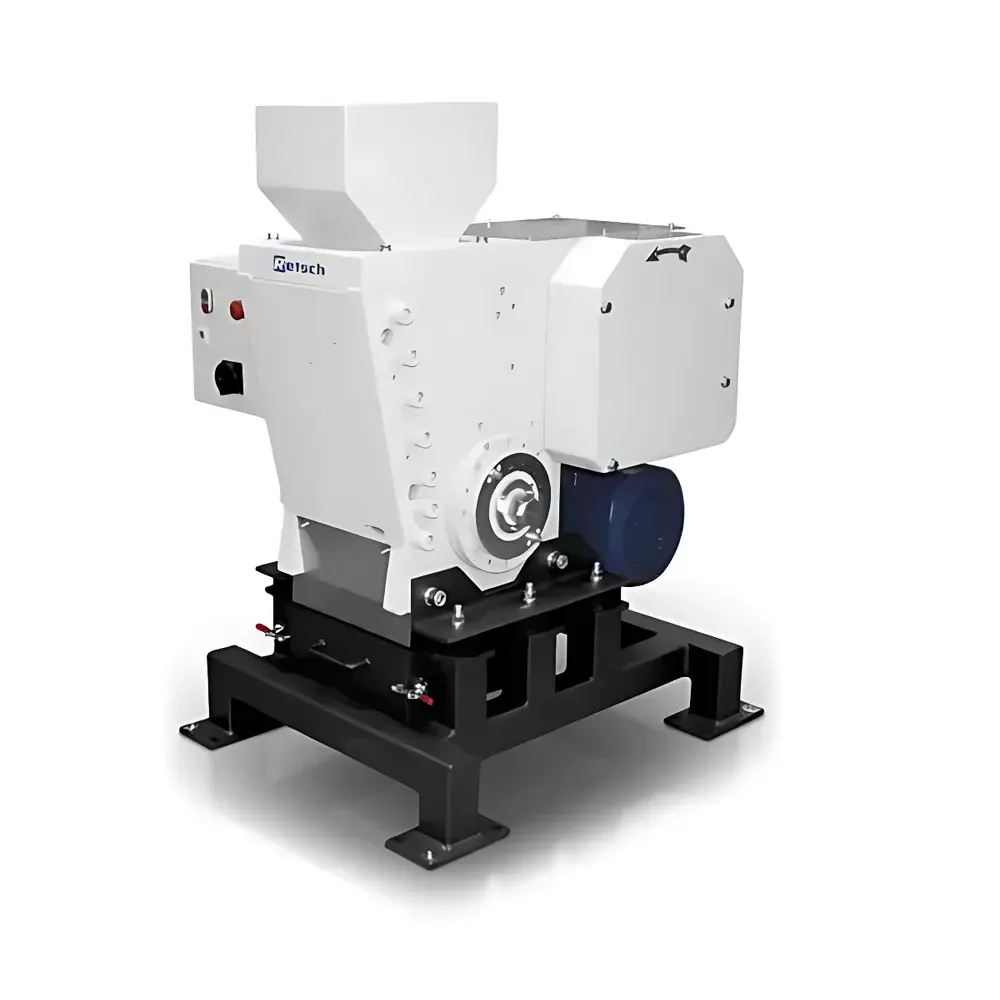
RETSCH BB500 Jaw Crusher
| Brand | RETSCH |
|---|---|
| Origin | Germany |
| Model | BB500 |
| Crusher Type | Jaw Crusher |
| Sample Hardness | Medium-hard to Hard, Brittle |
| Max Feed Size | < 110 mm |
| Adjustable Jaw Gap | 0–11 mm (graduated scale) |
| Final Particle Size | 90% < 0.5 mm |
| Throughput Capacity | up to 500 kg/h |
| Batch Collection Volume | 15 L |
| Jaw Plate Dimensions | 250 × 130 mm |
| Grinding Set Material | Manganese Steel or NiHard 4 |
| Drive | 7.5 kW Three-phase Motor |
| Power Supply | Configurable Three-phase Voltage |
| Protection Class | IP 55 |
| Dimensions (W×H×D) | 930 × 1400 × 1080 mm |
| Net Weight | ~1000 kg |
| Compliance | CE Marked |
| Optional Accessories | Dust Extraction Interface, Flip-up Hopper, Central Lubrication System |
Overview
The RETSCH BB500 Jaw Crusher is a high-capacity, industrial-grade laboratory crusher engineered for reliable primary size reduction of medium-hard to hard and brittle materials. Operating on the principle of compressive force—where material is fed between two rigid jaws (one fixed, one moving in an oscillating motion)—the BB500 delivers consistent, reproducible coarse crushing with minimal sample degradation. Its steeply angled crushing chamber, optimized jaw kinematics, and high-frequency jaw movement enable single-pass reduction of feed particles up to 110 mm in size, achieving a typical crushing ratio of up to 220:1. Designed for robust daily use in demanding analytical workflows, the BB500 meets structural and safety requirements per EU Machinery Directive 2006/42/EC and carries full CE marking. It serves as a critical preprocessing step prior to downstream analysis—including XRF, XRD, ICP-OES/MS, sieve analysis, and thermal testing—where representative, contamination-controlled particle size distribution is essential.
Key Features
- Adjustable jaw gap (0–11 mm) with precision graduated scale for repeatable control over final particle size distribution
- High-throughput capability: up to 500 kg/h, suitable for both routine batch processing and preparatory work for bulk sample homogenization
- Flip-up hopper with splash guard enables rapid, tool-free loading and cleaning; integrated dust extraction port (ISO 5801-compliant interface) minimizes airborne particulate exposure
- Modular crushing chamber with easily replaceable manganese steel or NiHard 4 jaw plates and wear liners—designed for extended service life under abrasive conditions
- Three-phase 7.5 kW motor with IP 55-rated enclosure ensures stable performance in variable ambient conditions and compatibility with standard industrial power supplies
- Overload protection system prevents mechanical damage during accidental feed blockage or excessive load
- 15 L removable collection container with ergonomic handling features supports efficient batch transfer and traceability
Sample Compatibility & Compliance
The BB500 is validated for use with inorganic and organic solids exhibiting medium-hard to hard mechanical resistance and brittle fracture behavior—including ores, slag, concrete aggregates, ceramics, glass frits, sintered metals, polymers, and composite materials. It is not recommended for fibrous, elastic, or highly ductile samples. The instrument complies with ISO 17025:2017 general requirements for competence of testing and calibration laboratories when operated within specified parameters and maintained per RETSCH’s documented service protocol. All electrical components conform to IEC 60204-1 (Safety of machinery – Electrical equipment of machines), and the unit satisfies EN 61000-6-2/-6-4 for electromagnetic compatibility. Dust control integration supports compliance with OSHA 1910.1200 (Hazard Communication) and EU Directive 2004/37/EC (carcinogens and mutagens), particularly in occupational hygiene-critical environments.
Software & Data Management
The BB500 is a stand-alone mechanical instrument without embedded firmware or digital control interface. However, its operational parameters—including jaw gap setting, batch number, feed size estimation, and collection volume—are intended to be recorded manually or integrated into laboratory information management systems (LIMS) via standardized SOP documentation. For GLP- and GMP-regulated environments, users may implement audit-trail-enabled electronic notebooks (e.g., LabArchives, Benchling) to log maintenance history, calibration events (jaw gap verification using certified gauge blocks), and usage logs. RETSCH provides comprehensive technical documentation—including CE Declaration of Conformity, EC Type Examination Certificate, and maintenance manuals—in English and German, supporting FDA 21 CFR Part 11 readiness when paired with compliant data capture workflows.
Applications
- Geochemical and metallurgical labs: Crushing of drill core fragments, blast furnace slag, and refractory raw materials prior to fusion bead preparation or acid digestion
- Cement and construction materials testing: Size reduction of clinker, limestone, and recycled concrete aggregates for Blaine fineness or particle size distribution analysis
- Environmental remediation labs: Preprocessing of contaminated soils, fly ash, and incinerator residues for leaching tests (e.g., TCLP, EN 12457)
- Electronics recycling R&D: Controlled fragmentation of printed circuit boards and ceramic substrates for metal recovery feasibility studies
- Ceramics and glass development: Homogenization of raw batch materials (e.g., feldspar, silica sand) before milling and sintering trials
FAQ
What materials are incompatible with the BB500?
Materials exhibiting high elasticity (e.g., rubber, certain thermoplastics), fibrous structure (e.g., wood chips, cellulose), or extreme ductility (e.g., pure aluminum, lead) are unsuitable due to risk of jamming, incomplete fracture, or excessive wear.
Is the BB500 suitable for regulated pharmaceutical QC environments?
While the BB500 itself is not designed for direct GMP manufacturing use, it is routinely employed in pharmaceutical R&D and stability testing labs for preparatory crushing of excipients or solid dosage forms—provided that cleaning validation, material compatibility assessments, and documented parameter controls are implemented per internal SOPs.
How often should jaw plates be replaced?
Replacement frequency depends on cumulative throughput, material abrasivity, and gap setting; RETSCH recommends visual inspection after every 200–500 kg of abrasive feedstock and dimensional verification using calibrated gauges at scheduled maintenance intervals.
Can the BB500 be integrated with automated sample handling systems?
Yes—its mechanical design allows for integration with vibratory feeders, conveyor interfaces, and robotic sample transfer arms, provided physical mounting space, vibration isolation, and interlocked safety circuits are engineered per EN ISO 13857.
Does RETSCH provide calibration services for the jaw gap scale?
RETSCH-certified service technicians can perform traceable verification of the graduated jaw gap scale using NIST-traceable depth gauges; this service is available globally through authorized RETSCH service partners.



