
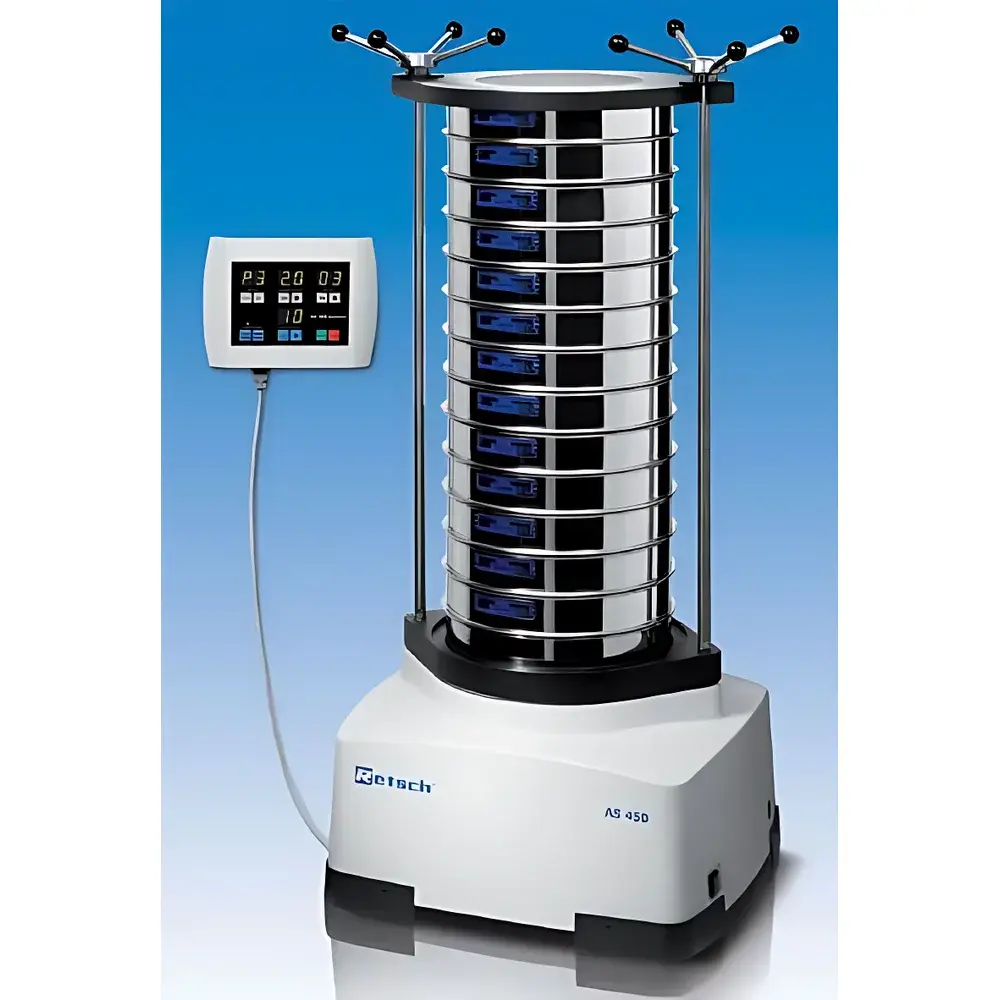
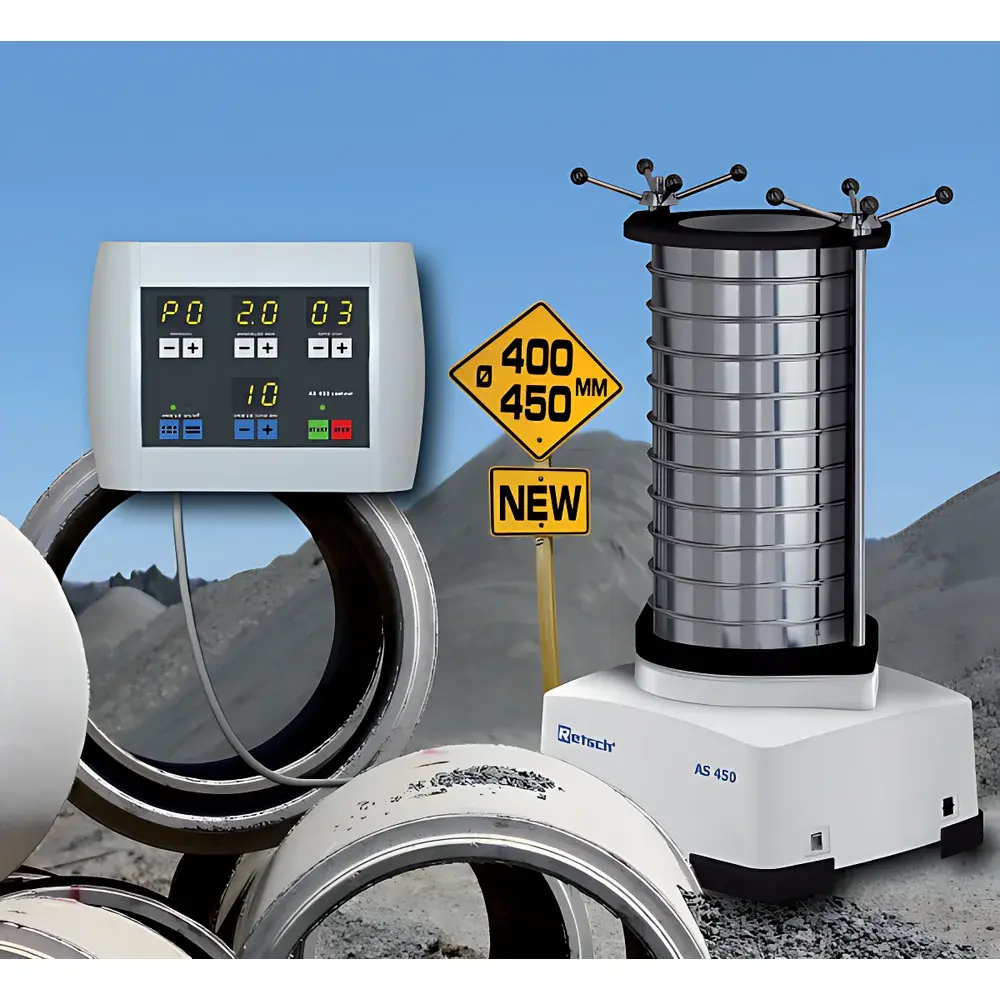
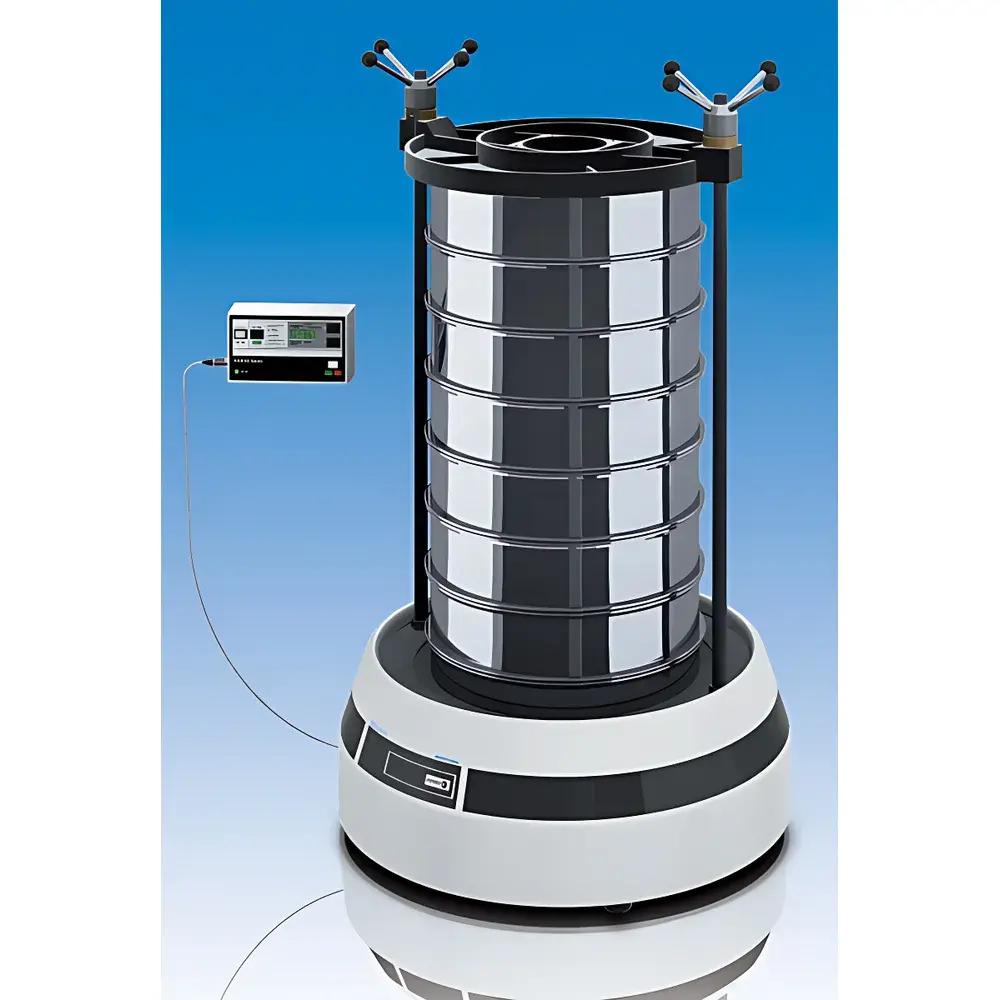
Retsch AS450 Electromagnetic Sieve Shaker
| Brand | Retsch |
|---|---|
| Origin | Germany |
| Model | AS450 |
| Maximum Sample Load | 20 kg |
| Max. Sieve Stack Mass | 50 kg |
| Sieve Diameter Compatibility | 400 mm / 450 mm |
| Amplitude Range | 0–2.2 mm (digitally adjustable) |
| Oscillation Mode | Three-dimensional throw motion |
| Drive Type | Electromagnetic, intermittent |
| Programmable Methods | 9 stored parameter sets |
| Measurement Range | 20 µm to 125 mm |
| Max. Number of Sieves | 11 (standard) / 14 (with extension kit) |
| Sieve Stack Height | up to ~940 mm |
| Dimensions (W × H × D) | 714 × 435 × 629 mm |
| Net Weight | ~220 kg |
| Compliance | ISO 2591-1, ISO 9276-1, ASTM E11, USP <786> |
Overview
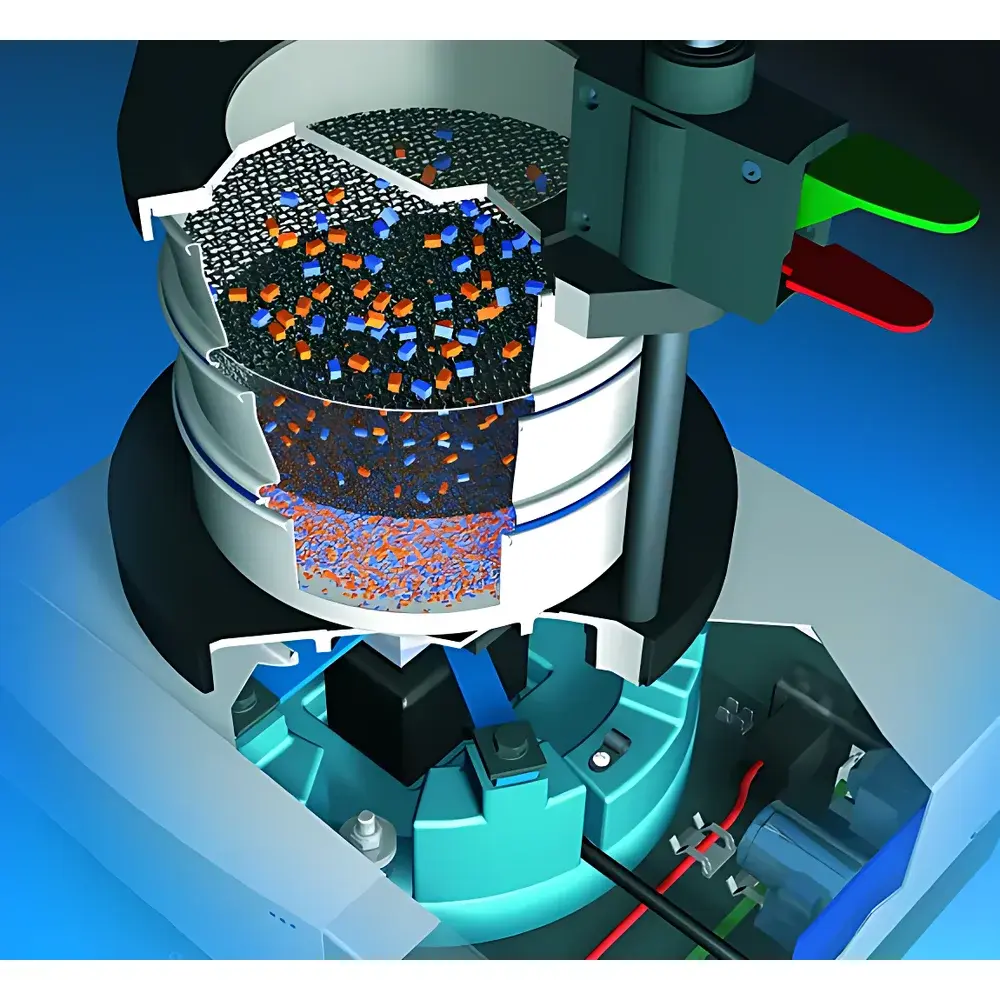
The Retsch AS450 Electromagnetic Sieve Shaker is a high-precision, laboratory-grade mechanical sieving instrument engineered for reproducible particle size distribution analysis of dry and wet granular materials. It operates on the principle of controlled three-dimensional throw motion generated by a high-efficiency electromagnetic drive system—eliminating mechanical wear associated with cam or eccentric drives. Unlike conventional vibratory shakers, the AS450 decouples amplitude control from load-dependent dynamics: its digitally adjustable amplitude (0–2.2 mm) remains stable regardless of sieve stack mass or sample weight, ensuring consistent energy transfer across all sieve levels. This architecture delivers superior fractionation fidelity, particularly critical for QA/QC in pharmaceuticals, minerals processing, construction aggregates, ceramics, and food ingredient manufacturing. The instrument conforms to internationally recognized sieving standards including ISO 2591-1 (determination of particle size distribution by sieving), ISO 9276-1 (representation of results of particle size analysis), ASTM E11 (specification for wire cloth and sieves), and USP (particle size distribution for solid dosage forms).
Key Features
- Electromagnetic drive system enabling precise, maintenance-free oscillation without mechanical backlash or lubrication requirements
- Digitally adjustable amplitude (0–2.2 mm) with real-time feedback—fully independent of sieve stack mass or sample load
- Three-dimensional throw motion ensures uniform lateral and vertical particle agitation, minimizing segregation and channeling effects
- High-capacity design supports up to 20 kg sample load and 50 kg total sieve stack mass—ideal for bulk industrial powders and coarse aggregates
- Modular tower configuration accommodates up to 11 standard sieves (14 with optional extension kit) and stacks up to ~940 mm tall
- Compatible with standardized 400 mm and 450 mm diameter test sieves per ISO/ASTM specifications
- Detachable, ergonomically positioned control panel with intuitive interface for method setup and real-time monitoring
- Onboard memory stores up to nine user-defined sieve programs—including time, amplitude, and pause intervals—for rapid method recall
Sample Compatibility & Compliance
The AS450 is validated for both dry and wet sieving applications, supporting aqueous and solvent-based suspensions when used with appropriate liquid-tight sieve frames and drainage accessories. Its robust frame and vibration-damping base minimize transmission of kinetic energy to adjacent instrumentation, meeting GLP-compliant laboratory layout requirements. All operational parameters—including start/stop timestamps, amplitude setting, duration, and method ID—are logged internally and exportable for audit trails. When integrated with validated software environments, the system supports 21 CFR Part 11 compliance for electronic records and signatures in regulated industries. Routine performance verification follows ISO 21648 (vibrational sieving equipment calibration) and manufacturer-recommended traceable reference standards.
Software & Data Management
The AS450 interfaces seamlessly with Retsch’s EasySieve software—a dedicated Windows-based application for automated sieve analysis workflow management. EasySieve enables digital method creation, real-time visualization of sieve residue distribution, statistical reporting (D10, D50, D90, span, % retained), and customizable PDF/CSV export compliant with internal SOPs or regulatory submissions. Data integrity safeguards include user access levels, electronic signature prompts, and immutable audit logs tracking every parameter change, result modification, or report generation event. For enterprise integration, EasySieve supports OPC UA connectivity and can feed raw mass-per-sieve data into LIMS or MES platforms via configurable API endpoints.
Applications
- Pharmaceutical: Granule and excipient sizing per USP , blend uniformity assessment, and tablet formulation development
- Minerals & Mining: Crushed ore classification, flotation feed optimization, and tailings characterization
- Construction Materials: Aggregate gradation testing per ASTM C136/C136M and EN 933-1
- Ceramics & Refractories: Raw material particle distribution control for green strength and sintering consistency
- Food & Feed: Flour, sugar, starch, and premix particle homogeneity validation under GMP conditions
- Recycling & Waste Processing: Sorting efficiency evaluation of shredded plastics, e-waste fractions, and compost feedstock
FAQ
What sieve diameters does the AS450 support?
The AS450 is mechanically configured for standard 400 mm and 450 mm diameter test sieves conforming to ISO 3310-1 and ASTM E11 specifications.
Can the AS450 perform wet sieving?
Yes—when equipped with optional liquid-tight sieve frames, drain trays, and splash guards, it supports standardized wet sieving procedures per ISO 2591-2.
Is amplitude calibration traceable to national standards?
Amplitude verification is performed using certified laser vibrometry or accelerometer-based metrology; Retsch provides factory calibration certificates traceable to PTB (Physikalisch-Technische Bundesanstalt).
How is data integrity ensured during regulatory audits?
All method parameters, run logs, and residue weights are timestamped and stored with cryptographic hash verification; EasySieve supports ALCOA+ principles (Attributable, Legible, Contemporaneous, Original, Accurate, Complete, Consistent, Enduring, Available).
What maintenance is required for long-term operational reliability?
The electromagnetic drive requires no routine lubrication or belt replacement; recommended annual verification includes amplitude linearity check, level calibration, and electrical safety testing per IEC 61000-4 series.



