
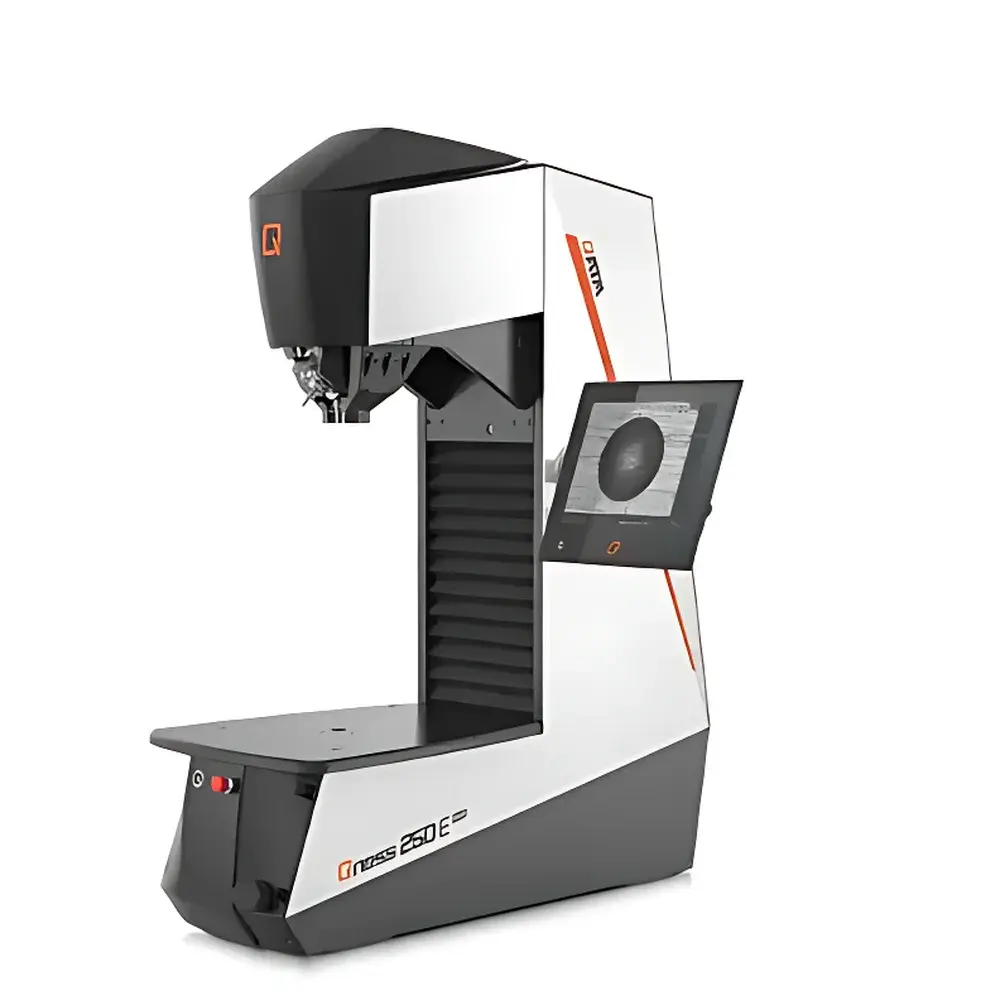
QATM QNESS 250 / 750 / 3000 E EVO Universal Hardness Tester
| Brand | QATM |
|---|---|
| Origin | Austria |
| Model | QNESS 250 E EVO / QNESS 750 E EVO / QNESS 3000 E EVO |
| Test Force Range | QNESS 250 E EVO: 1–250 kgf (9.81–2450 N) |
| QNESS 750 E EVO | 0.3–750 kgf (2.94–7358 N) |
| QNESS 3000 E | 0.3–3000 kgf (2.94–29,430 N) |
| Maximum Test Height | 510 mm |
| Throat Depth | 320 mm |
| Anvil Dimensions | 584 × 450 mm |
| Weight Capacity | ≤ 3500 kg |
| Turret Configuration | 2-position standard or 8-position optional |
| Imaging System | 5 MP industrial camera, Ethernet interface, up to 270 fps |
| Optical Magnification | XLED 1 to 100× (FOV: 0.113 × 0.084 mm at 100× up to 7.98 × 5.97 mm at XLED 1) |
| Control Interface | 12″ capacitive touchscreen |
| Operating System | Windows 10 IoT Enterprise |
| Storage | 128 GB SSD |
| Power Supply | 230 V ~1/N/PE or 110 V ~1/N/PE |
| Max. Power Consumption | ~1230 W |
Overview
The QATM QNESS 250 / 750 / 3000 E EVO series represents a generation of fully automated, electromechanically driven universal hardness testers engineered for metrological precision and operational robustness across diverse industrial and laboratory environments. Based on the fundamental principles of static indentation hardness testing—compliant with ISO 6506 (Brinell), ISO 6507 (Vickers), ISO 6508 (Rockwell), ISO 4545 (Knoop), and ISO 2039 (plastics)—these instruments integrate closed-loop electronic force control, motorized Z-axis positioning, and high-resolution digital imaging to ensure repeatable, traceable, and operator-independent measurement outcomes. Designed and manufactured in Austria, the E EVO platform eliminates mechanical load-dialing and manual turret indexing, replacing them with programmable test sequences, real-time force feedback, and synchronized image capture—enabling full compliance with GLP, GMP, and FDA 21 CFR Part 11 requirements when configured with Qpix CONTROL 2 M software and audit-trail functionality.
Key Features
- Electromechanical force application via integrated asynchronous motor—ensuring precise, stepless load control across the full test range without hydraulic or pneumatic components.
- Motorized Z-axis with 510 mm maximum test height and 320 mm throat depth—accommodating large-format components including castings, forgings, weldments, and heavy-duty tooling.
- Reinforced anvil platform (584 × 450 mm) and structural base rated for workpieces up to 3500 kg—designed for stability under dynamic loading and vibration-prone production floor conditions.
- Dual-mode turret options: standard 2-position for rapid Brinell/Vickers switching or configurable 8-position turret supporting extended indenter and objective lens libraries.
- High-speed 5 MP industrial camera with Ethernet interface and frame rates up to 270 fps—optimized for real-time indentation imaging, edge detection, and automatic diagonal measurement per ISO 6507-2.
- Modular optical system with interchangeable objectives: XLED illumination modules (XLED 1, XLED 2, XLED 5) plus magnifications from 5× to 100×—enabling seamless transition between macro-indentation (Brinell, Rockwell) and micro-scale evaluation (Knoop, plastic hardness).
- 12″ capacitive touchscreen HMI running Windows 10 IoT Enterprise—supporting intuitive workflow navigation, multi-user access control, and embedded calibration logging.
Sample Compatibility & Compliance
The QNESS E EVO series supports specimens ranging from thin foils (<0.5 mm thickness, with appropriate backing) to massive structural components. Its open-frame architecture and oversized anvil permit testing of irregular geometries—including shafts, flanges, turbine blades, and rail sections—without requiring sample sectioning. The system complies with international standards for hardness verification and calibration, including ISO 6506-2 (Brinell reference blocks), ISO 6507-3 (Vickers reference blocks), ASTM E10, E384, E18, and E92. When equipped with Qpix CONTROL 2 M software and enabled audit-trail mode, the instrument meets data integrity requirements for regulated industries, including electronic signature support, user-level permissions, and immutable test record archiving aligned with FDA 21 CFR Part 11 and EU Annex 11.
Software & Data Management
Qpix T2 provides intuitive test setup, live image preview, and automated hardness calculation based on measured indentation dimensions. For advanced quality systems, Qpix CONTROL 2 M extends functionality with full SPC integration, customizable reporting (PDF/CSV/XML), database synchronization (ODBC), and automated pass/fail decision logic against user-defined tolerances. All software versions support direct export to LIMS environments and feature built-in calibration management, including scheduled reminders, certificate linkage, and drift compensation algorithms. Data interfaces include four rear-panel USB ports, dual Gigabit Ethernet (RJ45), front-facing USB, and HDMI output—facilitating integration into factory-wide MES or SCADA networks.
Applications
- Metallurgical QA/QC in foundries and forging plants—verifying heat treatment uniformity across large castings using Brinell and Rockwell scales.
- Aerospace component certification—performing Vickers microhardness mapping on turbine disk rims and Knoop hardness profiling of thermal barrier coatings.
- Automotive powertrain validation—measuring case-hardened gear teeth and bearing races under controlled load ramping and dwell profiles.
- Plastics and polymer R&D—applying ISO 2039-1/2 methodology for ball indentation hardness of thermoplastics and composites.
- Failure analysis laboratories—correlating hardness gradients with SEM/EDS data to identify decarburization, carburization, or hydrogen embrittlement zones.
- Third-party calibration labs—executing accredited hardness verification services traceable to national metrology institutes (e.g., PTB, NIST, NPL).
FAQ
What hardness scales does the QNESS E EVO support?
It supports Brinell (HBW), Vickers (HV), Rockwell (HRA, HRB, HRC, etc.), Knoop (HK), and Ball Indentation Hardness (ISO 2039) — all executed under standardized dwell times, loading rates, and optical evaluation protocols.
Is the system suitable for unattended operation in production environments?
Yes. With its IP54-rated enclosure option, anti-vibration base design, and automated test sequencing, the QNESS E EVO is certified for continuous operation in non-climate-controlled industrial settings.
Can the instrument be integrated into an Industry 4.0 infrastructure?
Absolutely. Native Ethernet connectivity, OPC UA compatibility (via optional add-on), and RESTful API support enable bidirectional communication with ERP, MES, and predictive maintenance platforms.
What maintenance is required for long-term accuracy?
Annual verification using certified reference blocks and periodic verification of Z-axis encoder linearity and force transducer calibration—both supported by QATM’s accredited service network and documented in accordance with ISO/IEC 17025.
Does the system support custom test methods beyond ISO/ASTM standards?
Yes. Qpix CONTROL 2 M allows creation of user-defined test routines—including multi-step loading profiles, variable dwell times, and conditional branching logic—validated and saved as proprietary method files.



