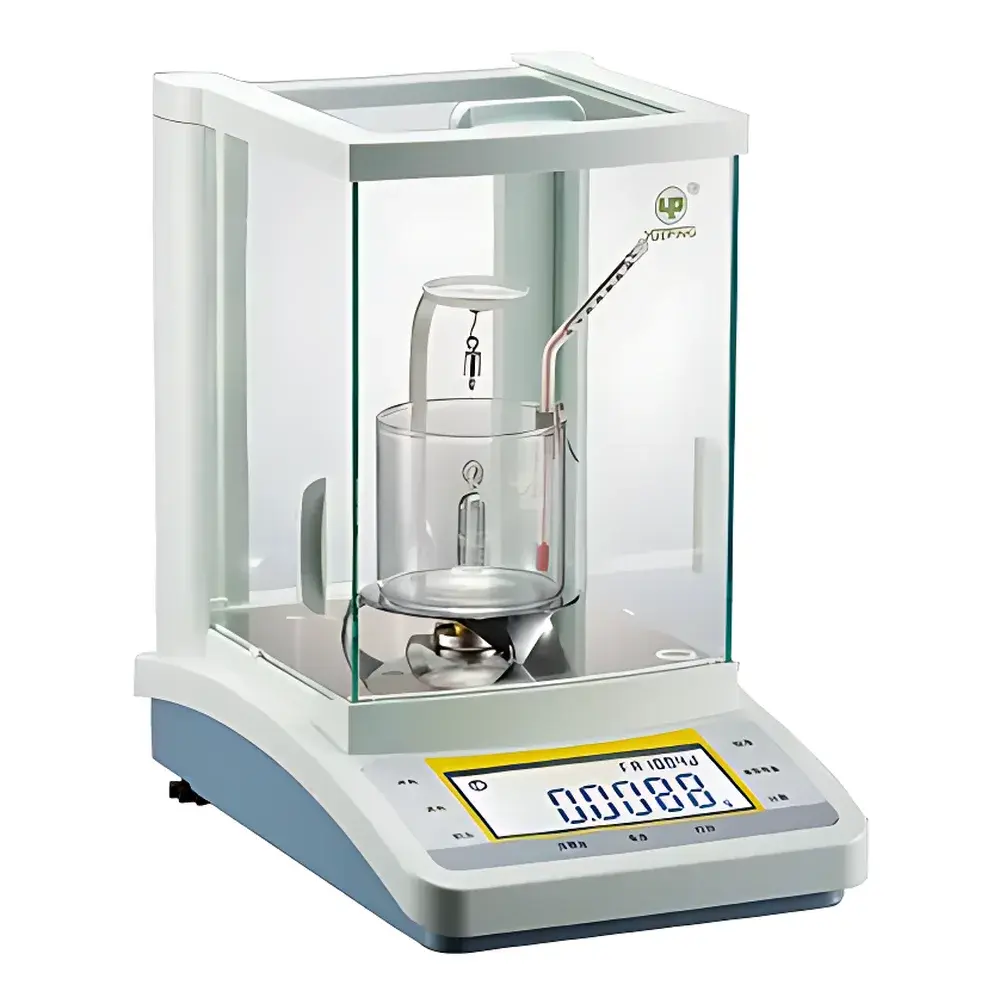
SHYP FA2004J Precision Density & Specific Gravity Analytical Balance
| Brand | SHYP |
|---|---|
| Origin | Shanghai, China |
| Model | FA2004J |
| Maximum Capacity | 200 g |
| Readability | 0.1 mg |
| Calibration | External |
| Density Range (Liquids) | 0.0001–2.0000 g/cm³ |
| Density Resolution | 0.0001 g/cm³ |
| Sample Volume Displacement (Sinkers) | 5 cm³ |
| Reference Standard | Deionized water at 20 °C (ρ = 0.998203 g/cm³, reported as 1.0000) |
| Display | Backlit LCD with 20-mm digit height |
| Interface | RS232C serial output |
| Dimensions (W×D×H) | 350 × 215 × 340 mm |
| Net Weight | 6.8 kg |
Overview
The SHYP FA2004J is a high-precision analytical balance engineered specifically for dual-mode density and specific gravity determination of both solid and liquid samples. Based on electromagnetic force compensation (EMFC) transduction technology, it integrates a microprocessor-controlled weighing system with dedicated density calculation algorithms compliant with ASTM D792, ISO 2811-1, and USP . Unlike conventional analytical balances, the FA2004J incorporates a calibrated sinker assembly (5 cm³ displacement volume), temperature-compensated density lookup tables, and automatic buoyancy correction routines—enabling direct digital readout of density (g/cm³) and specific gravity (dimensionless) without manual computation. Its 0.1 mg readability and 200 g maximum capacity meet Class I precision requirements per OIML R 76-1 for laboratory-grade mass metrology. The instrument operates under ambient conditions (15–30 °C, ≤80% RH non-condensing) and is designed for routine use in QC laboratories, materials science departments, and polymer formulation facilities where rapid, repeatable density profiling is critical.
Key Features
- Electromagnetic force compensation (EMFC) sensor with active thermal drift compensation and auto-zero tracking
- Five-sided transparent acrylic draft shield with ergonomic front door and anti-static coating
- Full-range tare, auto-zero tracking, and dynamic stability indicator with real-time convergence feedback
- Integrated below-balance suspension hook for submerged solid measurement (ASTM D891 method)
- Pre-programmed reference liquids: deionized water (20 °C), ethanol (20 °C), and user-definable custom standards
- Four-point linear internal calibration protocol with external weight verification (certified Class E2 or better required)
- Backlit 20-mm LCD display with adjustable contrast and screen-saver mode to reduce photodegradation of optical components
- RS232C serial interface supporting ASCII command protocol for integration with LIMS, Excel automation, or custom data acquisition software
Sample Compatibility & Compliance
The FA2004J supports density analysis of solids (metals, ceramics, plastics, composites) and liquids (aqueous solutions, organic solvents, oils, suspensions). Solid measurements follow the Archimedean principle using air-weight and submerged-weight acquisition; liquid measurements employ the sinker immersion method with temperature-stabilized bath compatibility (external thermostat recommended for ±0.1 °C control). All density calculations apply buoyancy correction per ISO 8655-5 and incorporate air density adjustment based on local barometric pressure and humidity inputs (user-entered or via optional external sensor). The balance complies with GLP documentation requirements through timestamped measurement logs and supports audit-ready operation when paired with validated RS232 data capture tools. It meets CE marking directives (2014/30/EU EMC, 2014/35/EU LVD) and conforms to IP42 ingress protection for lab bench environments.
Software & Data Management
No proprietary software is bundled; however, the RS232C port enables native communication with standard terminal emulators (e.g., Tera Term, PuTTY) and third-party platforms including LabArchives ELN, MATLAB Instrument Control Toolbox, and Python-based PySerial scripts. Each measurement event outputs a structured ASCII string containing date/time stamp, air weight (g), submerged weight (g), calculated density (g/cm³), specific gravity, temperature (°C), and operator ID field (if pre-configured). Data export supports CSV formatting for traceability and statistical process control (SPC) charting. For regulated environments, the balance supports 21 CFR Part 11-compliant workflows when integrated with validated middleware that enforces electronic signatures, audit trails, and role-based access control.
Applications
- Determination of polymer crystallinity index via density gradient column correlation
- Quality control of battery electrolyte solutions (LiPF₆ in EC/DMC) for consistency across batches
- Verification of metal alloy composition (e.g., brass, aluminum alloys) against certified reference materials
- Density profiling of pharmaceutical excipients (microcrystalline cellulose, lactose monohydrate) for compaction behavior prediction
- Specific gravity testing of geological core samples in exploration geochemistry labs
- Educational demonstrations of Archimedes’ principle and fluid statics in undergraduate physics laboratories
FAQ
What density standards are preloaded in the FA2004J firmware?
Deionized water at 20 °C (reference density = 0.998203 g/cm³, displayed as 1.0000 SG) and absolute ethanol at 20 °C (0.78924 g/cm³). Users may store up to three custom reference liquids with user-defined densities and temperature coefficients.
Is temperature compensation automatic during density measurement?
No. Ambient temperature must be manually entered prior to measurement; the instrument applies fixed thermal expansion coefficients for stainless steel sinkers and standard reference liquids. For high-accuracy work, external temperature stabilization of samples and sinker is recommended.
Can the FA2004J perform differential density measurements (e.g., Δρ between two liquids)?
Not natively. Density values are output as discrete scalar results. Differential analysis requires post-processing in spreadsheet or statistical software using exported CSV data.
Does the balance support internal calibration weights?
No. Calibration is external-only, requiring traceable Class E2 or better砝码 (e.g., 100 g or 200 g) per OIML R 111. Internal calibration routines verify linearity but do not replace physical weight verification.
What is the minimum sample volume required for reliable liquid density measurement?
A minimum of 15 mL is recommended to fully submerge the 5 cm³ sinker while maintaining ≥5 mm clearance from container walls and bottom—ensuring laminar flow and minimizing meniscus interference per ISO 1183-1.