
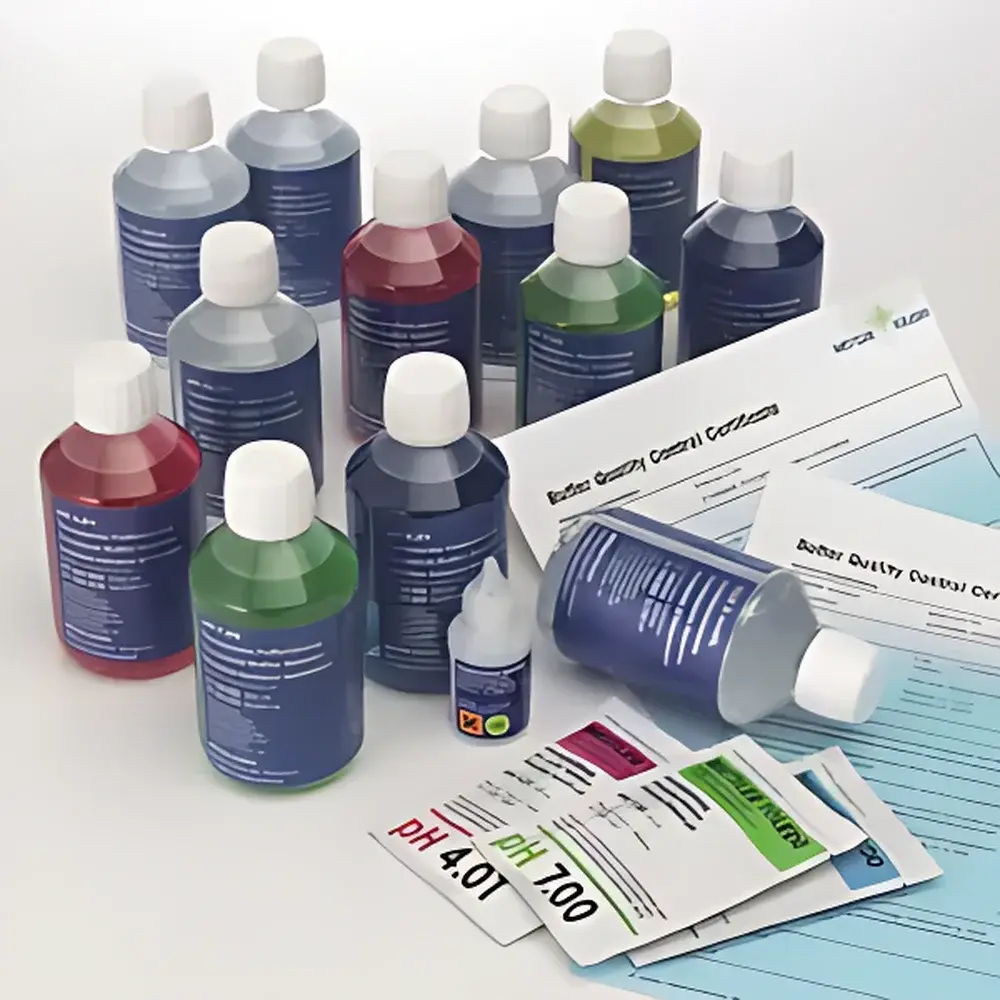
METTLER TOLEDO Certified Conductivity Standard Solutions (84 µS/cm, 1413 µS/cm, 12.88 mS/cm)
| Brand | METTLER TOLEDO |
|---|---|
| Origin | Shanghai, China |
| Model | 84 µS/cm / 1413 µS/cm / 12.88 mS/cm |
| Volume | 250 mL per bottle |
| Application | Calibration and Verification of Conductivity Meters |
| Certification | NIST-traceable, ISO/IEC 17025 accredited manufacturing |
| Packaging | Sealed amber glass bottle with tamper-evident cap |
| Storage | 15–25 °C, protected from light and contamination |
| Shelf Life | 24 months unopened, 6 months after opening (when stored properly) |
Overview
METTLER TOLEDO Certified Conductivity Standard Solutions are precision reference materials engineered for the accurate calibration and performance verification of laboratory and industrial conductivity meters. These standards are formulated in strict accordance with ISO 8665, ASTM D1125, and IEC 60746-3 to ensure metrological traceability to the International System of Units (SI) via NIST-traceable primary standards. Each batch undergoes rigorous inter-laboratory validation and is accompanied by a Certificate of Analysis (CoA) specifying certified conductivity values at 25 °C, expanded uncertainty (k = 2), temperature coefficient (α), and measurement uncertainty budget. The three-point calibration set—84 µS/cm (ultra-low range), 1413 µS/cm (mid-range, widely used for drinking water and environmental samples), and 12.88 mS/cm (high-range, suitable for saline solutions and process streams)—enables full-range linearity verification across common measurement domains.
Key Features
- Triple-certified conductivity values: 84.0 ± 0.5 µS/cm, 1413 ± 5 µS/cm, and 12.88 ± 0.05 mS/cm at 25 °C, with uncertainties stated per ISO/IEC 17025 requirements
- Manufactured under ISO 9001 and ISO/IEC 17025 accredited quality system in METTLER TOLEDO’s Shanghai facility
- Stabilized KCl-based electrolyte formulation with proven long-term chemical stability and minimal CO₂ absorption
- Amber glass bottles with PTFE-lined caps minimize evaporation, adsorption, and light-induced degradation
- Batch-specific CoA includes full uncertainty analysis, homogeneity data, and stability testing results over 24 months
- Compatible with all major conductivity sensor geometries—including 2-electrode, 4-electrode, and toroidal sensors—as well as benchtop, portable, and online instruments
Sample Compatibility & Compliance
These standards are validated for use with METTLER TOLEDO InLab® and SevenCompact™ conductivity sensors, as well as third-party platforms meeting IEC 60746-3 compliance. They meet the calibration requirements specified in USP , EP 2.2.38, and JP 2.07 for pharmaceutical water systems (Purified Water, Water for Injection). For environmental applications, they satisfy EPA Method 120.1 and ISO 7888 protocols. Each solution is free of microbial growth inhibitors, ensuring compatibility with sterile or low-bioburden workflows. No preservatives or stabilizers are added that could interfere with sensor surface chemistry or electrode polarization behavior.
Software & Data Management
When used with METTLER TOLEDO’s LabX™ software, these standards integrate seamlessly into automated calibration workflows. LabX records calibration events—including date/time, operator ID, instrument serial number, measured value, deviation from certified value, and pass/fail status—enabling full audit trail compliance with FDA 21 CFR Part 11 and EU Annex 11. All CoA data can be imported directly into LabX or exported in CSV/PDF format for LIMS integration. Traceability metadata (batch number, expiration date, certificate ID) is automatically linked to each calibration record, supporting GLP and GMP documentation requirements.
Applications
- Calibration and daily verification of benchtop conductivity meters in QC laboratories (e.g., pharmaceutical, food & beverage, environmental testing)
- Validation of inline conductivity sensors in purified water distribution systems (PW, WFI) per pharmacopeial guidelines
- Performance qualification (PQ) of conductivity modules during equipment commissioning and periodic requalification
- Uncertainty budgeting and measurement system analysis (MSA) in ISO/IEC 17025-accredited labs
- Training and method development for new analysts, including demonstration of temperature compensation effects (α = 2.0–2.2 %/°C typical for KCl solutions)
- Reference material for inter-laboratory comparison studies and proficiency testing programs
FAQ
Are these standards certified to ISO/IEC 17025?
Yes. Each batch is produced and tested in an ISO/IEC 17025 accredited facility, and the Certificate of Analysis includes statement of accreditation scope and uncertainty evaluation per ILAC P14.
What is the recommended storage temperature and shelf life?
Store unopened bottles at 15–25 °C, protected from direct sunlight. Unopened shelf life is 24 months; after opening, use within 6 months if kept tightly sealed and contamination-free.
Can I use these standards for temperature coefficient verification?
Yes. The CoA provides certified α-values and conductivity data at multiple temperatures (20 °C, 25 °C, 30 °C), enabling verification of instrument temperature compensation algorithms.
Do these solutions contain any biocides or preservatives?
No. They consist solely of high-purity potassium chloride and deionized water, meeting pharmacopeial purity requirements without additives.
Is there lot-to-lot variability in conductivity values?
Variability is controlled to <0.2% RSD across production lots, verified through statistical process control and quarterly inter-batch consistency testing.




