
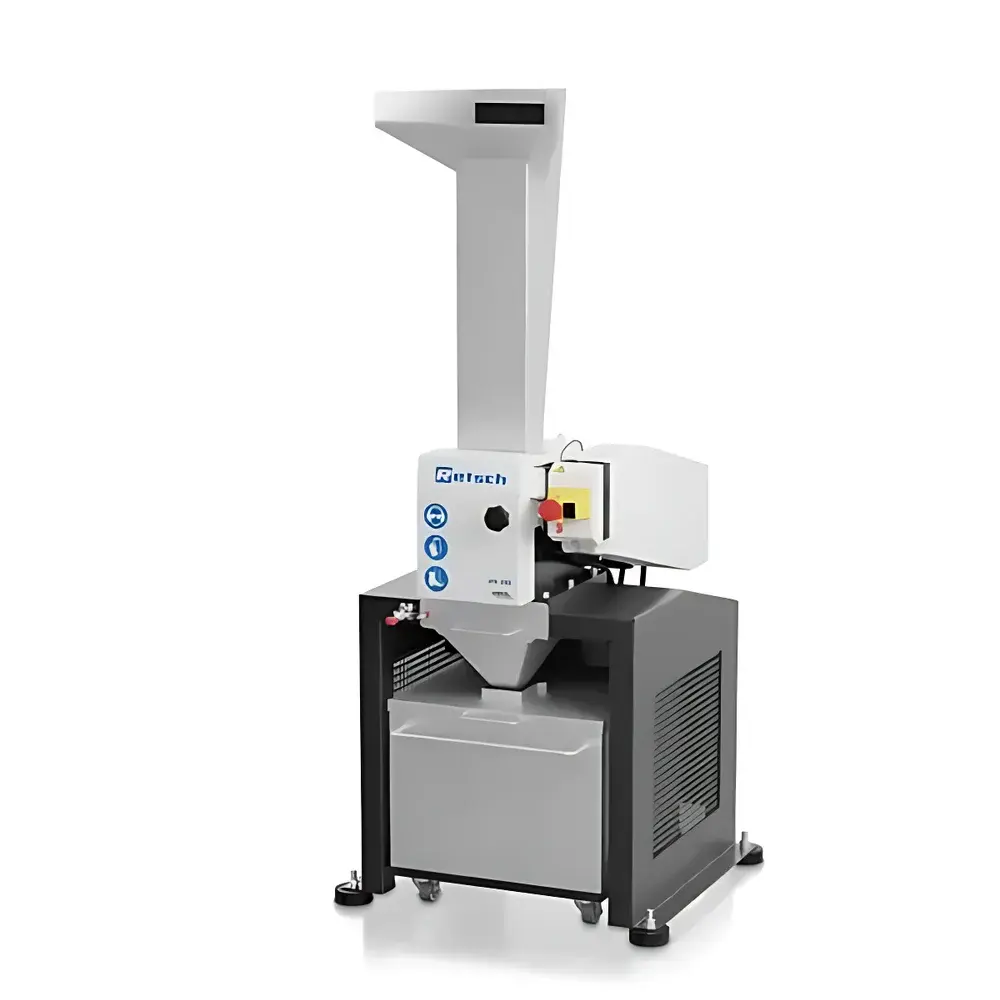
RETSCH HM 200 Hammer Mill Crusher
| Brand | RETSCH |
|---|---|
| Origin | Germany |
| Model | HM 200 |
| Instrument Type | Hammer Mill Crusher |
| Sample Applicability | Hard, Brittle, Fibrous, and Tough Materials |
| Feed Size | < 100 mm |
| Final Particle Size | < 0.8 mm |
| Throughput Capacity | 1500 kg/h |
| Sieve Aperture Range | 2–40 mm |
| Rotor Speed | 3000 min⁻¹ (50 Hz) / 3500 min⁻¹ (60 Hz) |
| Rotor Tip Speed | 31.4 m/s |
| Rotor Diameter | 200 mm |
| Hammer Type | 10 Swing Hammers |
| Grinding Chamber Material | Hardened Steel 1.0503 (hammers), Steel 1.0330 (sieves) |
| Drive | 1.5 kW Three-Phase Motor |
| Power Supply | Three-Phase, IP 54 Protection |
| Dimensions (W×H×D) | 320 × 960 × 800 mm |
| Net Weight | ~150 kg |
| Compliance | CE Marked |
| Batch Feeding Capacity | 0.6 L (with batch hopper) |
Overview
The RETSCH HM 200 Hammer Mill Crusher is an industrial-grade, high-throughput laboratory and pilot-scale crushing instrument engineered for coarse and pre-crushing applications. Based on the principle of high-velocity impact and shear force generation, the HM 200 employs a robust rotor assembly equipped with ten dynamically balanced swing hammers rotating at 3000 min⁻¹ (50 Hz) or 3500 min⁻¹ (60 Hz), delivering a tip speed of 31.4 m/s. This mechanical energy transfer enables efficient size reduction of heterogeneous, hard, brittle, fibrous, or tough materials—including minerals, ceramics, coal, feedstuffs, polymers, and construction aggregates—without thermal degradation or contamination. Designed for reliability under continuous operation, the HM 200 integrates a hardened steel grinding chamber, interchangeable sieve inserts (2–40 mm), and modular hopper configurations to support both batch and continuous feeding protocols. Its CE-compliant architecture, IP 54-rated enclosure, and dust extraction interface align with occupational health and safety requirements in regulated laboratory and pilot-plant environments.
Key Features
- High-capacity throughput of up to 1500 kg/h—optimized for large-volume sample preparation in quality control and process development labs
- Maximum feed size tolerance of < 100 mm, eliminating the need for upstream pre-sizing for many raw material streams
- Precise final particle size control via standardized sieve inserts (2, 3, 4, 5, 6, 8, 10, 15, and 40 mm), enabling reproducible classification down to < 0.8 mm
- Swing-hammer rotor design ensures self-adjusting impact geometry, minimizing wear asymmetry and extending service life of consumables
- Tool-free access to the grinding chamber and rapid-swap sieve system facilitate cleaning and cross-sample changeover in under five minutes
- Integrated dust extraction port compatible with standard industrial vacuum systems (e.g., HEPA-filtered units), supporting ISO 14001 and OSHA PEL compliance
- Three-phase 1.5 kW motor with thermal overload protection and stable speed regulation across voltage fluctuations
Sample Compatibility & Compliance
The HM 200 accommodates a broad spectrum of sample matrices: hard rocks (e.g., quartz, basalt), sintered ceramics, granulated feed pellets, dried biomass, composite circuit board fragments, and recycled construction rubble. It is not suitable for wet, sticky, or highly elastic materials without prior drying or conditioning. All wetted parts conform to EU Directive 2002/72/EC for food-contact materials when configured with optional stainless-steel sieves (not standard). The unit complies with Machinery Directive 2006/42/EC, Low Voltage Directive 2014/35/EU, and Electromagnetic Compatibility Directive 2014/30/EU. CE marking verifies conformity with essential health and safety requirements. For GLP/GMP-aligned workflows, audit-ready documentation—including factory calibration certificates and traceable material declarations—is available upon request.
Software & Data Management
The HM 200 operates as a standalone electromechanical system with no embedded microprocessor or digital interface. Process parameters—including feed rate, residence time, and sieve selection—are manually controlled and documented per SOP. For integration into automated lab information management systems (LIMS), external sensors (e.g., load cells, vibration monitors, or inline laser diffraction analyzers) may be deployed upstream or downstream. RETSCH provides full technical documentation packages compliant with ISO/IEC 17025 clause 7.6 (equipment verification) and FDA 21 CFR Part 11 readiness guidance (when paired with validated electronic record systems).
Applications
- Pre-crushing of geological core samples prior to XRF, XRD, or ICP-MS digestion
- Size reduction of animal feed and cereal grains for proximate analysis (AOAC 991.22, ISO 6496)
- Homogenization of metallurgical slags and ferroalloys for spectrographic assay
- Fragmentation of spent catalysts and battery black mass in recycling R&D
- Particle size conditioning of glass cullet and ceramic scrap for sintering trials
- Batch preparation of reference materials for interlaboratory proficiency testing (ISO/IEC 17043)
FAQ
Is the HM 200 suitable for cryogenic or temperature-controlled grinding?
No. The HM 200 is designed exclusively for ambient-temperature dry grinding. It lacks cooling jackets, liquid nitrogen ports, or temperature monitoring systems.
Can it process abrasive materials like silicon carbide or tungsten carbide?
Yes—provided appropriate wear-resistant sieve inserts (e.g., hardened steel 1.0503 or optional tungsten-carbide-coated variants) are installed and maintenance intervals are adjusted per ASTM B611 abrasion testing protocols.
What safety certifications does the HM 200 hold?
It carries CE marking per Machinery Directive 2006/42/EC and meets EN 61000-6-2 (immunity) and EN 61000-6-4 (emissions) standards. Full type-examination reports are available from RETSCH’s authorized technical documentation portal.
Does RETSCH supply validation protocols for IQ/OQ/PQ?
Yes. Standardized Installation Qualification (IQ) and Operational Qualification (OQ) templates are provided with delivery. Performance Qualification (PQ) must be conducted using user-defined reference materials and acceptance criteria aligned with internal SOPs or ISO 13320.
Is remote monitoring or IoT connectivity supported?
Not natively. However, third-party PLC integration is feasible via the machine’s auxiliary contact outputs and emergency stop circuit interface, enabling status logging in SCADA or MES platforms.



