
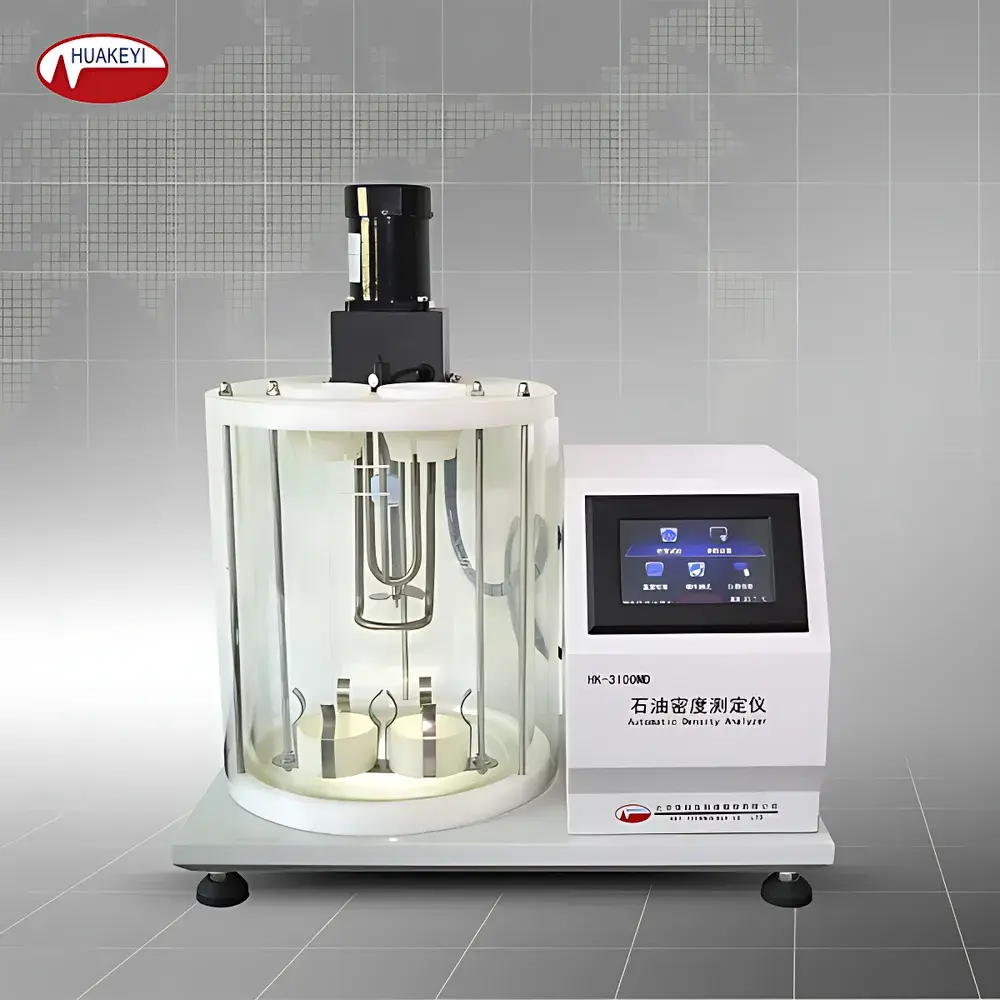
Huake Instrument HK-3100MD Petroleum Density Analyzer
| Brand | Huake Instrument |
|---|---|
| Origin | Beijing, China |
| Manufacturer Type | Authorized Distributor |
| Origin Category | Domestic (China) |
| Model | HK-3100MD |
| Price Range | USD 1,400 – 7,000 |
| Application Field | Petroleum & Liquid Hydrocarbon Density Testing |
| Instrument Type | Buoyancy-Based Density Meter |
| Form Factor | Benchtop Laboratory Instrument |
| Sample Phase | Liquid Only |
| Density Measurement Range | 0–2 g/cm³ |
| Density Resolution | 0.001 g/cm³ |
| Temperature Control Range | Ambient to 100 °C (user-selectable, ±0.2 °C stability) |
| Minimum Sample Volume | 50 mL |
| Dual-Bath Capacity | 2 independent test positions |
| Stirring Speed | 1250 rpm |
| Power Supply | AC 220 V ±10%, 50/60 Hz |
| Heating Power | Main Heater 800 W + Auxiliary Heater 300 W |
| Dimensions (L×W×H) | 500 × 305 × 550 mm |
| Weight | 25 kg |
| Interface Options | RJ45 Ethernet, USB 2.0 |
| Compliance | GB/T 1884–2000 |
Overview
The Huake Instrument HK-3100MD Petroleum Density Analyzer is a benchtop buoyancy-based density measurement system engineered for precise, standardized determination of density in crude oil, refined petroleum products, and hydrocarbon-containing liquid mixtures. It operates in strict accordance with the Chinese national standard GB/T 1884–2000, which aligns methodologically with ASTM D1298 and ISO 3675 for laboratory density determination using calibrated glass hydrometers. The instrument implements a temperature-controlled water bath immersion method—where a certified glass hydrometer is suspended vertically in a thermostatically stabilized sample within a precision-machined cylindrical vessel—and leverages Archimedean buoyancy principles to derive density at a defined reference temperature. Its dual-bath design enables parallel testing or sequential calibration verification, supporting high-throughput workflows in quality control laboratories across upstream, midstream, and downstream petroleum operations.
Key Features
- High-resolution color touchscreen interface with switchable English/Chinese menu navigation and context-sensitive prompts for intuitive operation
- Dual-zone heating architecture: primary (800 W) and auxiliary (300 W) heaters ensure rapid thermal equilibration and ±0.2 °C temperature stability across the full ambient–100 °C range
- PID-based digital temperature control with user-defined setpoint programming and real-time deviation monitoring
- Integrated fault detection and self-diagnostic logic, delivering actionable alerts for heater failure, low water level, dry-run conditions, or stirrer stall
- LED-illuminated bath chamber for enhanced visual clarity during hydrometer reading and meniscus alignment
- Automatic water-level sensing with anti-dry-burn protection and audible/visual alarm escalation
- Precise electromechanical timing module synchronized with test initiation for adherence to standard immersion duration requirements
- Modular mechanical design featuring pre-drilled mounting points for optional immersion-type refrigeration units (sold separately), enabling sub-ambient testing down to 5 °C when paired with external chillers
- RJ45 Ethernet and USB 2.0 ports support firmware updates, time-stamped data export (CSV/Excel-compatible), and remote configuration via LAN-connected lab management systems
Sample Compatibility & Compliance
The HK-3100MD is validated for use with Newtonian and mildly non-Newtonian liquid hydrocarbons—including gasoline, diesel, kerosene, lubricating oils, naphthas, and blended biofuels—provided viscosity remains below 150 cSt at test temperature. Samples must be free of suspended solids, entrained air, and volatile fractions that evaporate significantly during thermal stabilization. The system complies fully with GB/T 1884–2000 and supports traceable calibration through NIST-traceable glass hydrometers (supplied as standard). Its temperature control performance meets the repeatability and reproducibility criteria outlined in ASTM D1298 Annex A1 for hydrometer-based density analysis. While not inherently 21 CFR Part 11 compliant, audit-ready data logs (including operator ID, timestamp, temperature setpoint, actual bath temperature, and final density reading) can be exported for integration into GLP/GMP-aligned electronic lab notebooks (ELNs) or LIMS platforms.
Software & Data Management
The embedded firmware provides local storage of up to 1,000 test records with metadata (date/time, operator code, temperature setpoint, measured density, pass/fail status per GB/T 1884 tolerance thresholds). Data export via USB yields timestamped CSV files containing raw sensor values, calculated density, and thermal history profiles. The RJ45 interface allows connection to institutional intranets for centralized data aggregation; no proprietary software installation is required—standard HTTP GET/POST commands enable seamless ingestion into third-party laboratory information management systems. All exported files include cryptographic hash signatures for integrity verification, supporting basic data authenticity requirements under ISO/IEC 17025 clause 7.5.2.
Applications
- Quality assurance of finished fuels prior to pipeline transfer or marine loading
- Batch release testing of base oils and specialty lubricants per OEM specifications
- Blending ratio verification in refinery off-gas condensate and diluent streams
- Research-grade density-temperature profiling for equation-of-state modeling (e.g., API gravity conversion)
- Calibration verification of online densitometers deployed in custody transfer metering skids
- Compliance testing for customs valuation and excise tax classification under HS Code 2710
FAQ
Does the HK-3100MD meet international standards beyond GB/T 1884–2000?
Yes—it is methodologically equivalent to ASTM D1298 and ISO 3675 for hydrometer-based density measurement, with identical temperature control, stirring, and reading protocols.
Can the instrument measure samples with high volatility, such as light naphtha?
Only if cooled below their flash point and tested under sealed, vapor-suppressed conditions; standard operation assumes minimal evaporation during the 5–10 minute thermal stabilization period.
Is the glass hydrometer included calibrated and certified?
A full set of ASTM-certified glass hydrometers (range: 0.65–1.05 g/cm³) is supplied, each bearing individual calibration certificates traceable to CNAS-accredited laboratories.
What is the maximum allowable sample viscosity?
For reliable hydrometer floatation and meniscus readability, kinematic viscosity should not exceed 150 cSt at the selected test temperature.
How is data integrity ensured during power interruption?
All active measurements are buffered in non-volatile memory; upon restart, the system resumes logging from the last valid timestamp without data loss.



