
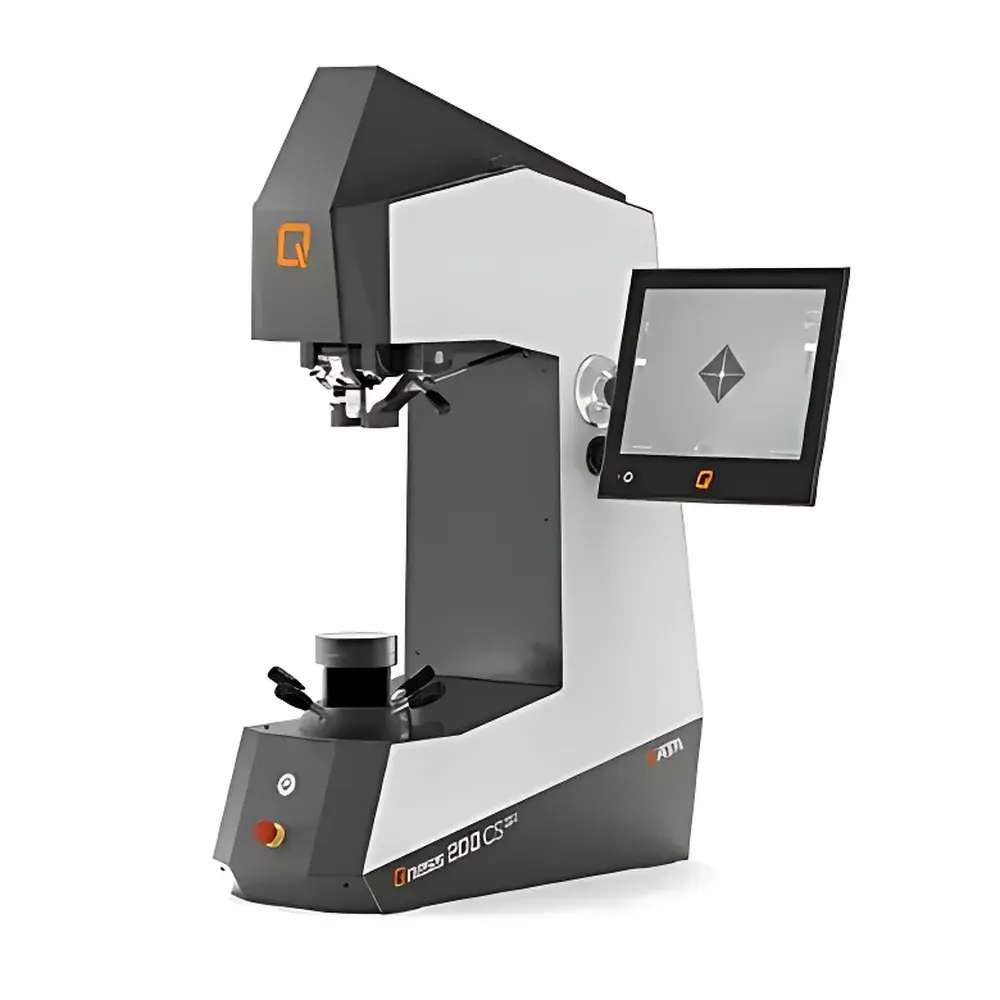
QATM QNESS 200 CS Macro Hardness Tester
| Brand | QATM |
|---|---|
| Origin | Austria |
| Model | QNESS 200 CS |
| Instrument Type | Brinell-Vickers-Rockwell Combined Hardness Tester |
| Test Force Range | 0.5 – 187.5 kgf (4.9 – 1839 N) |
| Test Space | 250 mm (height) × 238 mm (throat depth) |
| Turret Positions | 5 |
| Imaging System | 5 MP industrial camera with Ethernet interface |
| Objective Lenses | XLED 2×, XLED 5×, 5×, 10×, 20×, 50×, 100× |
| Field of View | 0.113 × 0.084 mm (at 100×) to 4.24 × 3.18 mm (at XLED 2×) |
| Stage Diameter | Ø100 mm |
| Height Adjustment | Manual lead-screw drive |
| Operating System | Windows 10 IoT |
| Storage | 128 GB SSD |
| Interfaces | 1× front USB, 4× rear USB, 2× RJ45 Ethernet, 1× DisplayPort |
| Weight | 132 kg |
| Compliance | ASTM E10, E92, E18 |
Overview
The QATM QNESS 200 CS is a fully automated macro hardness testing system engineered for precision, repeatability, and operational efficiency in quality control laboratories and production environments. Designed and manufactured in Austria, it integrates Brinell, Vickers, and Rockwell hardness measurement principles into a single robust platform—enabling standardized evaluation of metallic and ceramic materials per ASTM, ISO, and EN regulatory frameworks. Its core architecture employs a fixed test head combined with vertical Z-axis movement via high-precision lead screw, eliminating mechanical drift and ensuring long-term force stability across the full 0.5–187.5 kgf (4.9–1839 N) test load range. The 250 mm maximum test height and 238 mm throat depth accommodate medium-sized components—including castings, forgings, heat-treated parts, and welded joints—without requiring sample repositioning or auxiliary fixtures.
Key Features
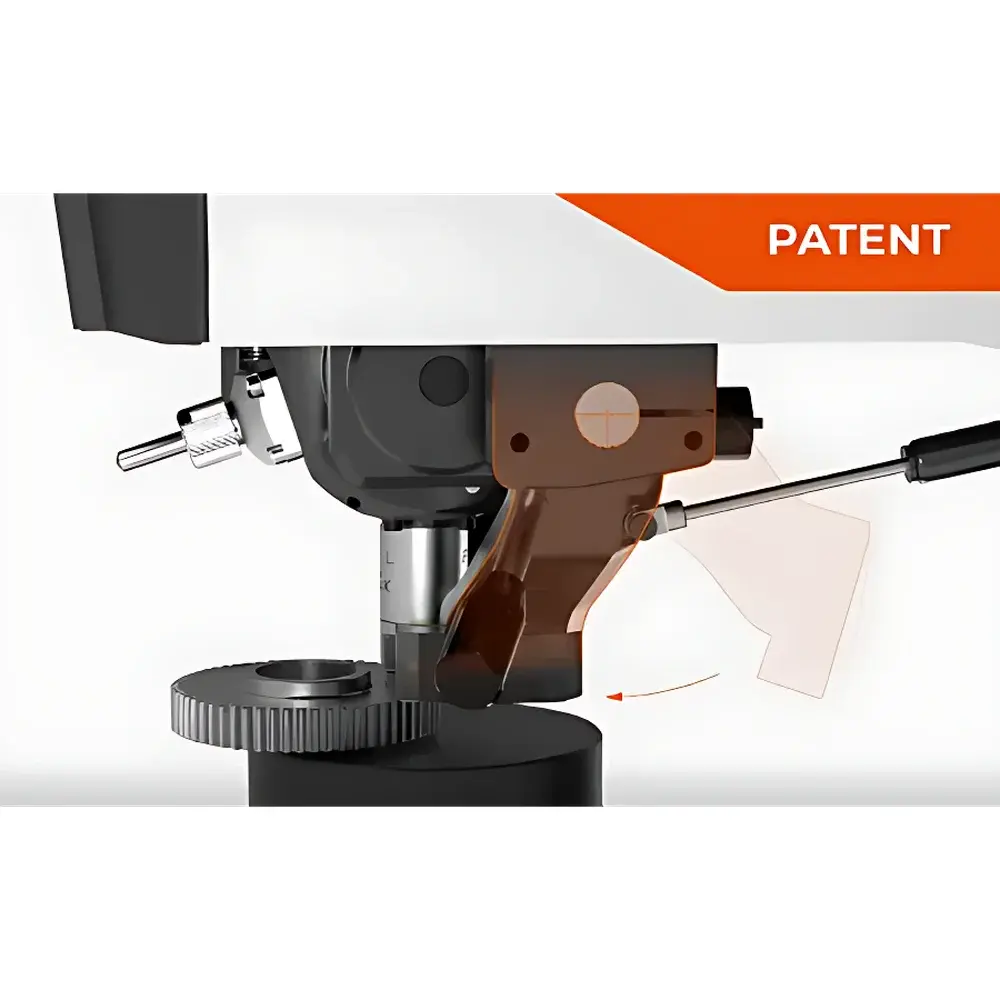
- Five-position motorized turret with rapid, repeatable indexing for seamless transitions between indenters (e.g., diamond pyramid, tungsten carbide ball) and objective lenses.
- Integrated 5-megapixel industrial camera with real-time image acquisition, Ethernet-based transmission, and sub-pixel edge detection algorithms for automatic indentation measurement.
- Modular optical system featuring seven interchangeable objectives: XLED 2× and XLED 5× for wide-field overview imaging, plus conventional 5×, 10×, 20×, 50×, and 100× lenses optimized for precise diagonal or diameter evaluation under standardized lighting conditions.
- Manual lead-screw height adjustment ensures mechanical rigidity and eliminates backlash—critical for maintaining force vector alignment during high-load Brinell testing.
- Compact footprint and reinforced cast-iron base provide vibration damping and thermal stability, supporting consistent results even in non-climate-controlled workshop settings.
- Comprehensive accessory ecosystem including V-blocks, anvil sets, cross-laser alignment aids, anti-collision sensors, and optional barcode/QR code readers for traceable, LIMS-integrated workflows.
Sample Compatibility & Compliance
The QNESS 200 CS accommodates flat, cylindrical, and irregularly shaped specimens up to 132 kg in mass (no upper weight restriction imposed by the stage design). Its Ø100 mm precision-ground stage supports both standard reference blocks and production parts requiring multi-point hardness mapping. All hardness measurements comply with internationally recognized standards: Brinell (ASTM E10 / ISO 6506), Vickers (ASTM E92 / ISO 6507), and Rockwell (ASTM E18 / ISO 6508). The system meets requirements for GLP and GMP environments through audit-trail-enabled software logging, user access controls, and electronic signature support in Qpix T2. Optional configurations support VDA 238-100 for automotive component testing and EN ISO 1463 for coating thickness–hardness correlation studies.
Software & Data Management
Qpix T2 software serves as the central interface for test method definition, sequence automation, result visualization, and data export. It supports customizable test programs—including multi-load series, grid-based mapping, and statistical process control (SPC) charting—with full compliance to FDA 21 CFR Part 11 when configured with electronic signatures and secure user authentication. Measurement data—including raw images, indentation coordinates, calculated hardness values, and metadata (operator ID, timestamp, calibration status)—are stored locally on the embedded 128 GB SSD and can be exported in CSV, PDF, or XML formats. Network integration via dual Ethernet ports enables centralized database synchronization and remote diagnostics without compromising local system autonomy.
Applications
- Metallurgical QA/QC in foundries, forging shops, and heat treatment facilities evaluating bulk hardness uniformity after annealing, quenching, or case hardening.
- Automotive and aerospace supply chains performing incoming material verification and final part release testing per OEM specifications (e.g., Ford WSS-M296, Boeing BAC 5661).
- R&D laboratories conducting comparative studies of surface-modified alloys, thermal spray coatings, and additive-manufactured components.
- Third-party testing labs delivering accredited reports aligned with ISO/IEC 17025 requirements through documented uncertainty budgets and interlaboratory comparison readiness.
- Failure analysis units correlating localized hardness variations with microstructural features observed via complementary SEM or metallography.
FAQ
What hardness scales does the QNESS 200 CS support?
It performs Brinell (HBW), Vickers (HV), and Rockwell (HRA, HRB, HRC, HRD, HRF, HRG, HRH, HRR) tests in accordance with ASTM, ISO, and EN standards.
Is the system compatible with existing laboratory information management systems (LIMS)?
Yes—via configurable CSV/XML export, OPC UA connectivity (optional), or direct database write-through using ODBC drivers integrated into Qpix T2.
Does the QNESS 200 CS require climate-controlled installation?
While optimal performance is achieved at 20–25°C with ≤50% RH, its thermally stable base and force calibration compensation algorithms allow reliable operation in ambient industrial environments.
Can the system perform hardness mapping across large surfaces?
Yes—using programmable XY stages (optional add-on) and Qpix T2’s grid acquisition module, users can define custom measurement arrays with automated stage movement and report generation.
What maintenance intervals are recommended for routine calibration?
Annual verification against certified reference blocks is advised; daily verification using traceable hardness standards is required for ISO/IEC 17025 compliance.



