
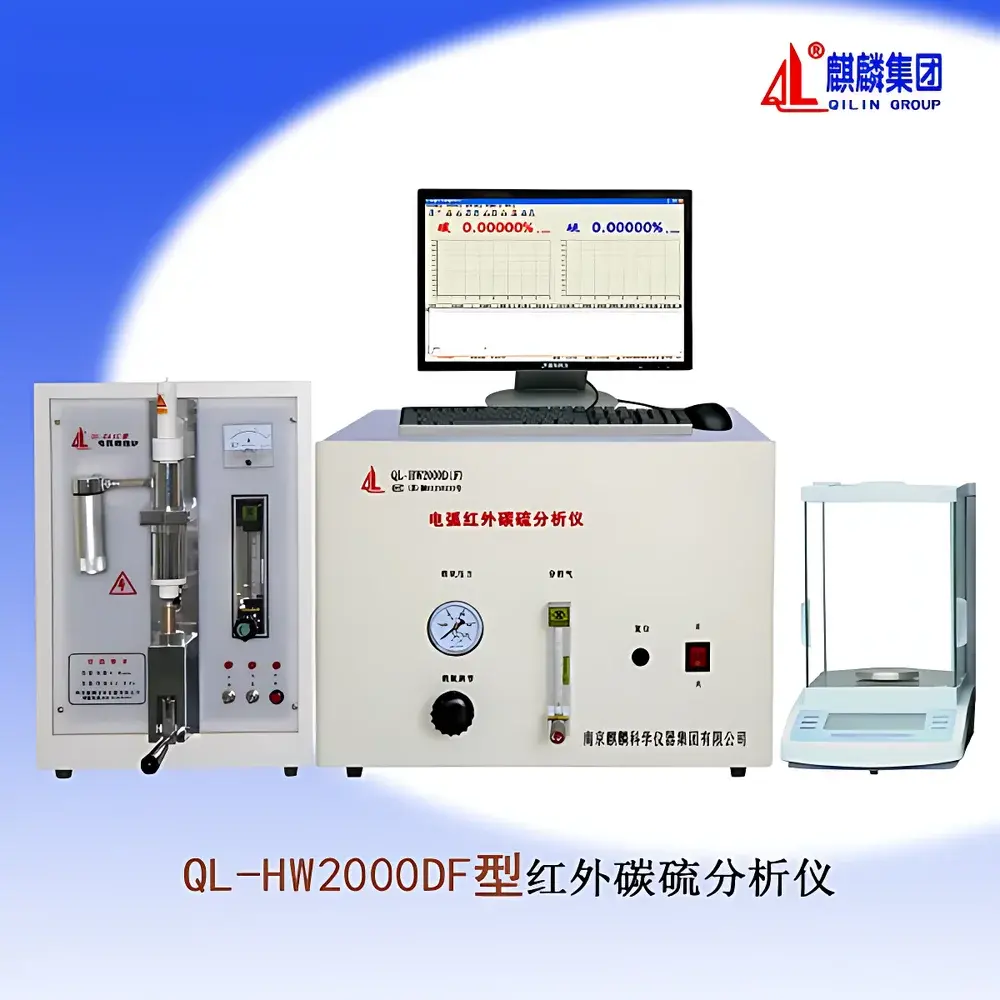
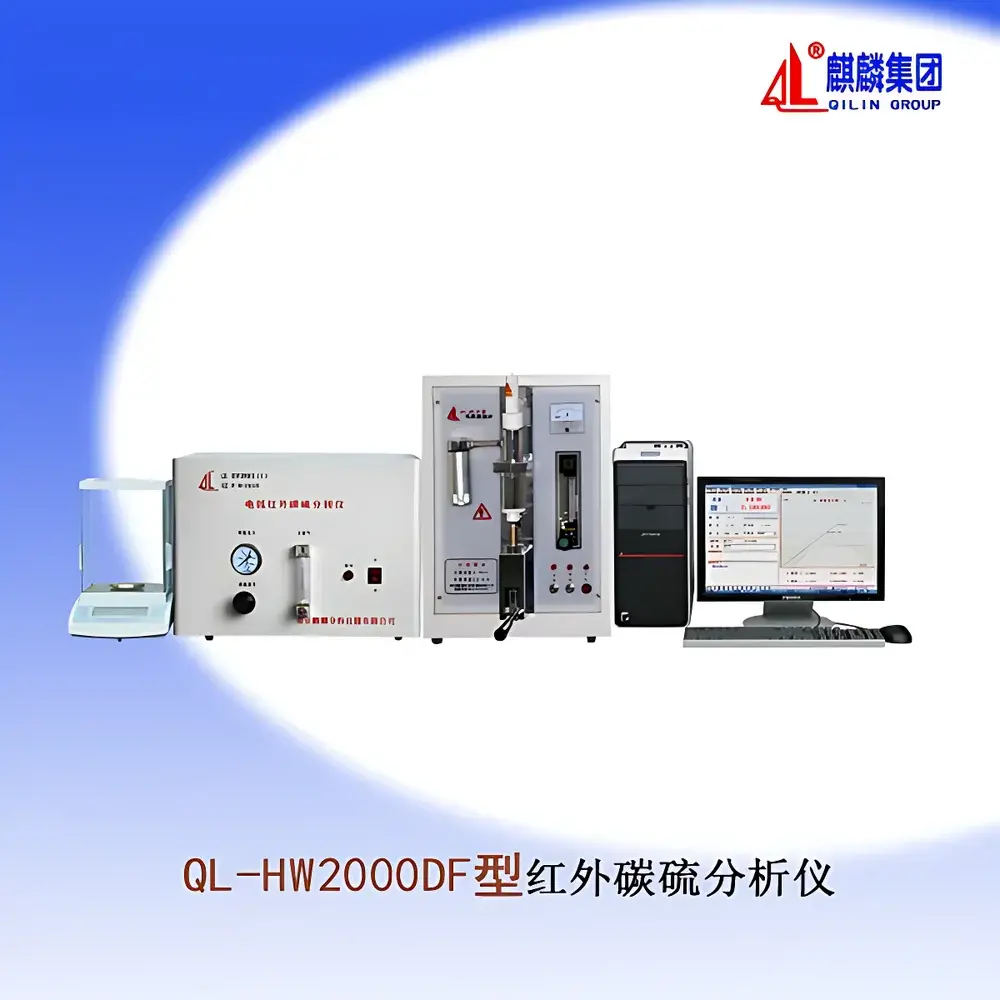
QL-HW2000DF Infrared Carbon-Sulfur Analyzer by Qilin
| Brand | Qilin |
|---|---|
| Origin | Jiangsu, China |
| Model | QL-HW2000DF |
| Measurement Principle | Infrared Absorption |
| Heating System | High-Energy Arc Furnace |
| Carbon Range | ω(C) 0.0010–10.00% |
| Sulfur Range | ω(S) 0.0005–0.500% |
| Analysis Time | Adjustable 20–60 s (typical 35 s) |
| Weighing Precision | 0.0001 g (0.1 mg) |
| Compliance | GB/T 223.69–1997 (C), GB/T 223.68–1997 (S) |
| Power Supply | Switching-mode, EMI-hardened |
Overview
The QL-HW2000DF Infrared Carbon-Sulfur Analyzer is a high-performance elemental analyzer engineered for precise, routine quantification of total carbon and sulfur in solid metallic and inorganic samples. It operates on the principle of non-dispersive infrared (NDIR) absorption spectroscopy: following high-temperature combustion in a controlled arc furnace environment, evolved CO₂ and SO₂ gases pass through dedicated optical cells where their characteristic absorption bands at 4.26 µm (CO₂) and 7.35 µm (SO₂) are measured via dual-channel, temperature-stabilized detectors. The system employs a platinum-based infrared source with aerospace-grade motor-driven optical chopper modulation to ensure signal stability and long-term baseline reproducibility. Designed for metallurgical QC laboratories, foundries, and third-party testing facilities, the QL-HW2000DF delivers robust performance under ISO/IEC 17025-aligned workflows and supports traceability requirements inherent to GMP-compliant metal certification.
Key Features
- Dual-CPU architecture with synchronized high-speed data acquisition—up to four analog-to-digital conversions per second—enabling real-time correction of baseline drift and thermal noise during gas evolution.
- High-energy arc furnace with auto-ignition sequence (ignition completed within 0.4 s), optimized electrode geometry, and low-power consumption (<1.2 kW peak), delivering consistent combustion efficiency across ferrous alloys, cast iron, stainless steels, and non-ferrous matrices including copper and nickel-based superalloys.
- Stable infrared source assembly featuring Pt filament emitter and precision-machined optical path housing, minimizing spectral degradation over extended operational cycles (>10,000 analyses).
- EMI-hardened switching power supply and galvanically isolated signal conditioning circuitry—designed to maintain measurement integrity in industrial environments with variable line voltage and electromagnetic interference from nearby induction furnaces or welding equipment.
- Integrated analytical balance interface supporting dynamic sample weighing (0.0001 g resolution); enables不定量称样 (variable mass loading) without recalibration, improving throughput while maintaining stoichiometric accuracy per ASTM E1019 and ISO 15350 protocols.
Sample Compatibility & Compliance
The QL-HW2000DF accepts solid, non-volatile samples up to 1.0 g in mass, including but not limited to carbon steel, low-alloy steel, tool steel, ductile iron, titanium alloys, and sintered metal powders. Sample preparation requires no acid digestion or solvent extraction—only representative milling to ≤80 mesh and homogeneous packing into ceramic crucibles with tungsten or tin助熔剂 (flux). Instrument validation adheres to national standard methodologies: carbon results conform to GB/T 223.69–1997 (equivalent to ISO 4935:1989), and sulfur measurements satisfy GB/T 223.68–1997 (aligned with ISO 4936:1989). While not pre-certified for FDA 21 CFR Part 11, the system’s audit trail-ready data structure—including timestamped raw spectra, operator ID logging, and calibration history—facilitates internal validation for GLP/GMP environments.
Software & Data Management
The embedded analysis software provides full instrument control, real-time spectral visualization, and automated peak integration using second-derivative algorithms to resolve overlapping CO₂/SO₂ absorbance envelopes. All measurement data—including sample ID, weight, analysis time, gas concentration integrals, and calibration coefficients—are stored in encrypted binary format with SHA-256 checksum verification. Export options include CSV, XML, and PDF reports compliant with LIMS integration standards (ASTM E1482, ISO/IEC 17025 Annex A.2). Calibration management supports multi-point linear regression with forced zero-intercept, and drift compensation is applied using reference gas blanks measured every 10 analyses.
Applications
- Quality control of incoming raw materials and finished castings in automotive and aerospace component manufacturing.
- Verification of carbon equivalency (CE) and hardenability indices in heat-treatable steels per SAE J404 and EN 10027.
- Process validation for desulfurization treatments in steelmaking ladle refining operations.
- Research-grade compositional screening in metallurgical R&D labs evaluating alloy design trade-offs between strength, weldability, and corrosion resistance.
- Third-party certification testing for ISO 9001:2015 and IATF 16949 auditable documentation packages.
FAQ
What sample types are compatible with the QL-HW2000DF?
Solid metallic specimens, including ferrous and non-ferrous alloys, carbides, and refractory metals—provided they are non-hygroscopic and thermally stable below 3,500 °C.
Does the system support automatic calibration verification?
Yes—users may schedule periodic blank runs or certified reference material (CRM) checks; results are logged with pass/fail flags based on user-defined tolerance windows.
Is external gas supply required?
No—oxygen is generated internally via electrolytic cell; optional external O₂ cylinder input is available for high-throughput labs requiring >50 samples/day.
Can the instrument be integrated into a laboratory information management system (LIMS)?
Yes—via TCP/IP-based API or RS-232 serial protocol with configurable data packet structure and handshake protocols.
What maintenance intervals are recommended?
Optical cell cleaning every 200 analyses; furnace electrode replacement every 5,000–8,000 burns; annual detector sensitivity verification using NIST-traceable CO₂/SO₂ standards.




