
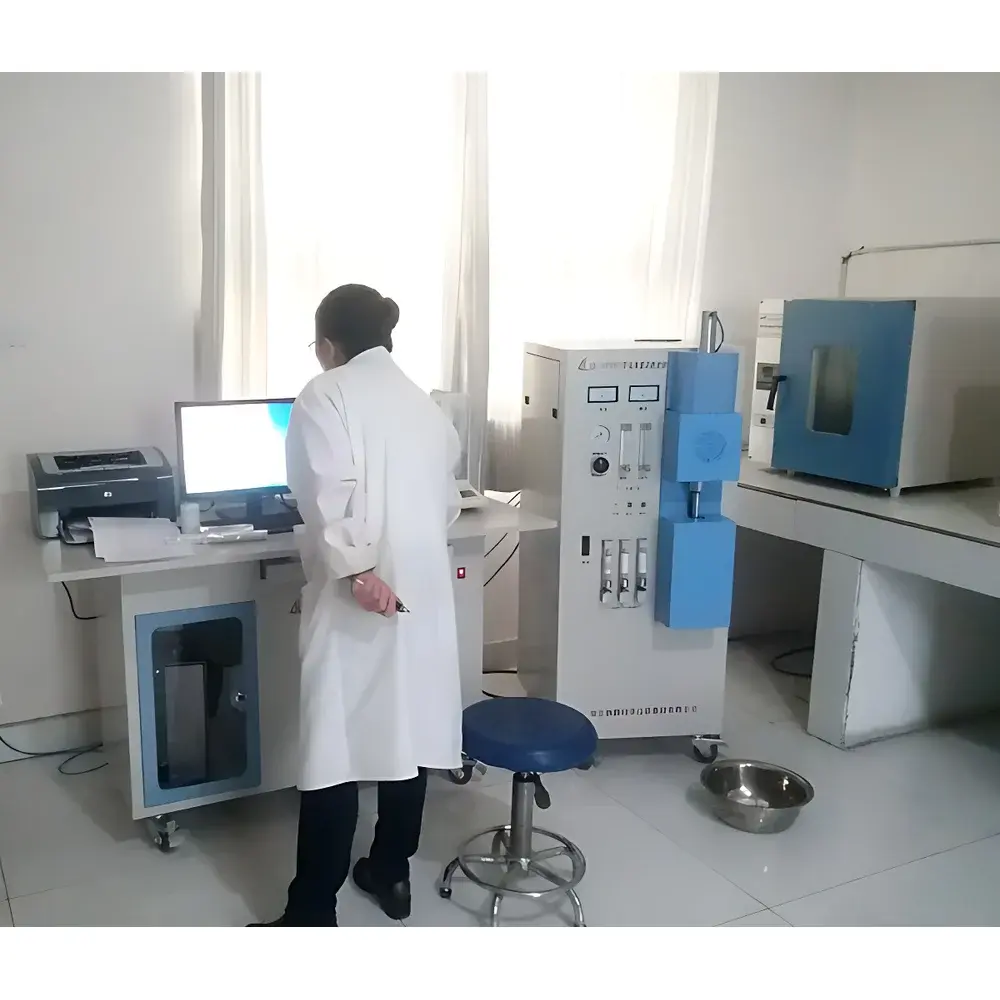
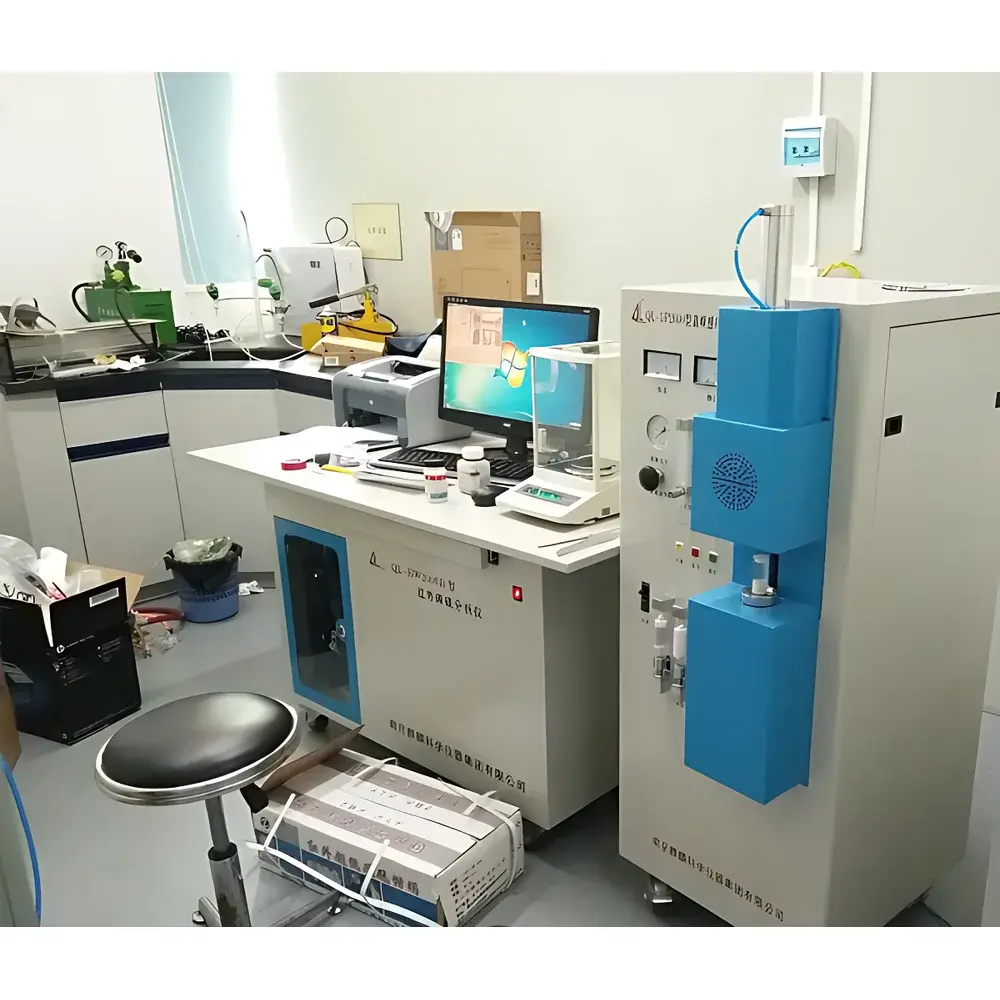
QL Scientific QL2000 High-Frequency Infrared Carbon-Sulfur Analyzer
| Brand | QL Scientific |
|---|---|
| Origin | Jiangsu, China |
| Manufacturer Type | Direct Manufacturer |
| Country of Origin | China |
| Model | QL2000 |
| Measurement Principle | Non-Dispersive Infrared (NDIR) Absorption |
| Heating System | 2.5 kVA High-Frequency Induction Furnace (18–20 MHz) |
| Carbon Range | 0.00001–10.0000 wt% (extendable to 99.999 wt%) |
| Sulfur Range | 0.00001–0.5000 wt% (extendable to 99.999 wt%) |
| Sensitivity | 0.1 ppm (minimum display resolution) |
| Precision | Carbon RSD ≤ 0.5%, Sulfur RSD ≤ 1.0% |
| Analysis Time | 25–60 s (user-adjustable) |
| Compliance | GB/T 20123–2006, ISO 15350:2000 |
| Sample Weighing Accuracy | 0.0001 g |
| Optical Detection | High-stability pyroelectric detectors with narrow-band interference filters |
| Gas Handling | Precision mass flow control |
| Mechanical Drive | Aerospace-grade synchronous motor in IR cell (MTBF > 100,000 h) |
| System Architecture | Modular PCB design with real-time temperature, pressure, and flow compensation |
Overview
The QL Scientific QL2000 High-Frequency Infrared Carbon-Sulfur Analyzer is a fully integrated elemental combustion analyzer engineered for precise, trace-level quantification of total carbon (C) and total sulfur (S) in solid inorganic and organic matrices. It operates on the principle of non-dispersive infrared (NDIR) absorption spectroscopy: sample combustion in a high-frequency induction furnace generates CO₂ and SO₂ gases, which are swept through dedicated optical cells where their characteristic infrared absorption bands (4.26 µm for CO₂, 7.35 µm for SO₂) are measured by thermally stabilized pyroelectric detectors. The system employs dual-beam referencing and real-time environmental compensation—simultaneously correcting for fluctuations in ambient temperature, carrier gas pressure, and volumetric flow—to ensure metrological robustness across extended operational cycles. Designed for routine QC/QA laboratories in metallurgy, mining, cement production, and catalyst development, the QL2000 delivers certified-grade repeatability without requiring cryogenic cooling or complex optical alignment.
Key Features
- 2.5 kVA high-frequency induction furnace operating at 18–20 MHz, delivering rapid, uniform thermal excitation with minimal crucible erosion and consistent combustion efficiency across heterogeneous samples.
- Dual-channel NDIR detection architecture with independently optimized optical paths: narrow-band interference filters suppress spectral overlap (e.g., CO₂ interference on SO₂ measurement), enabling accurate sulfur quantification even in high-carbon alloys.
- Pyroelectric infrared detectors calibrated per ISO 15350:2000 Annex B, providing linear response from sub-ppm to percent-level concentrations with <0.1 ppm minimum display resolution.
- Modular electronic architecture featuring FPGA-based signal processing, embedded temperature/pressure/flow sensors, and closed-loop mass flow controllers—ensuring long-term baseline stability and inter-unit reproducibility.
- Industrial-grade gas handling system incorporating Airtac solenoid valves (rated for ≥100,000 actuations), stainless-steel manifolds, and catalytic CuO/Co₃O₄ scrubbers to eliminate NOₓ, H₂O, and halogen interferences prior to IR detection.
- Automated calibration protocol supporting multi-point linearization using certified reference materials (CRMs) traceable to NIST SRMs or equivalent national standards.
Sample Compatibility & Compliance
The QL2000 accommodates a broad spectrum of solid materials—including ferrous and non-ferrous metals (steels, cast irons, Ni/Co superalloys), ores (hematite, magnetite, bauxite), refractories (silica, alumina, magnesia), coal and coke, catalysts (Pt/Al₂O₃, V₂O₅/TiO₂), and geological specimens (limestone, slag, ceramic powders). Sample mass ranges from 0.1 to 1.0 g, weighed on an analytical balance with 0.1 mg readability. All hardware and firmware comply with GB/T 20123–2006 and ISO 15350:2000 for combustion-based C/S determination. Optional audit trail logging and user-access controls support alignment with GLP and GMP documentation requirements; data export formats (CSV, XML) are compatible with LIMS integration. No radioactive sources or hazardous reagents are employed.
Software & Data Management
QL AnalyzeSuite™ v3.2 (included) provides full instrument control, method configuration, real-time spectral monitoring, and statistical reporting. The software implements ASTM E29–23 rounding rules and calculates RSD, confidence intervals (95%), and recovery rates against CRM values. Raw detector voltage traces, gas flow profiles, and furnace temperature curves are stored with timestamped metadata. All data modifications are logged with operator ID, timestamp, and reason code—meeting FDA 21 CFR Part 11 criteria when paired with network authentication and electronic signature modules. Batch reports include compliance statements referencing ISO 15350:2000 Clause 8 (precision) and Clause 9 (uncertainty estimation).
Applications
- Quality control of carbon steel grades (e.g., ASTM A29, EN 10027) where carbon specification tolerances fall within ±0.02 wt%.
- Sulfur content verification in desulfurized iron ores and blast furnace feedstocks to prevent hot shortness in downstream casting.
- Trace carbon screening in high-purity nickel anodes used in electrorefining, where residual C > 50 ppm degrades cathode morphology.
- Quantitative sulfur analysis in petroleum coke and fluid catalytic cracking (FCC) catalysts per ASTM D5291 and ISO 8754.
- Research applications in metallurgical thermodynamics, including phase diagram validation via precise C/S stoichiometry in carbides and sulfides.
FAQ
What combustion technique does the QL2000 use, and why is high-frequency induction preferred over resistance heating?
The QL2000 employs high-frequency (18–20 MHz) induction heating, which induces eddy currents directly within conductive samples—achieving rapid, homogeneous ignition without electrode contact or thermal lag. This minimizes incomplete oxidation and volatile loss, especially critical for low-sulfur steels and graphitic carbons.
Can the instrument measure ultra-low sulfur (<10 ppm) in stainless steels?
Yes—when coupled with high-purity oxygen (99.999%), pre-combusted quartz wool traps, and extended integration time (≥45 s), the QL2000 achieves typical detection limits of 3–5 ppm S in 1.0 g stainless steel samples, validated per ISO 15350:2000 Annex C.
Is external calibration required before each analysis batch?
No—systematic drift correction is performed automatically via built-in reference gas pulses and zero-gas baselines. However, daily calibration verification using two CRMs bracketing the expected concentration range is recommended per ISO/IEC 17025:2017 Clause 7.7.
Does the analyzer support automated sample changers?
Yes—the QL2000 RS-485 and Ethernet interfaces support integration with third-party autosamplers (e.g., CETAC ASX-520, Gerstel MPS). Protocol templates are provided for seamless sequence execution and result mapping.
How is moisture and halogen interference managed in coal or polymer samples?
Combustion gases pass sequentially through a CuO oxidation column, a Mg(ClO₄)₂ desiccant trap, and a PbO₂ halogen scavenger before entering the IR cells—ensuring SO₂ and CO₂ signals remain uncompromised by H₂O vapor or HCl/HF byproducts.




