
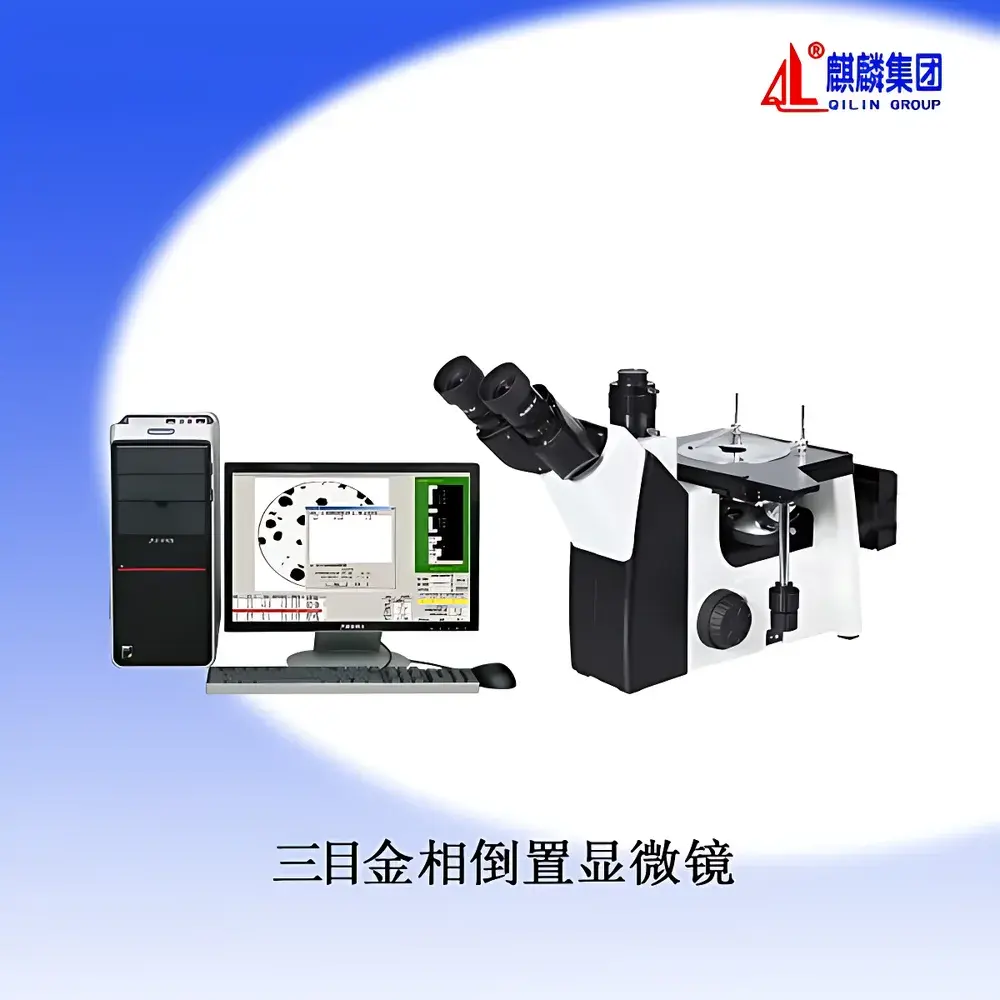
QL QL Inverted Metallurgical Microscope
| Brand | QL |
|---|---|
| Origin | Jiangsu, China |
| Manufacturer Type | General Distributor |
| Product Origin | Domestic |
| Model | QL |
| Price Range | USD 1,400–7,200 (FOB) |
| Configuration | Inverted |
| Image Analysis System Included | No |
| Total Magnification Range | 50× to 500× |
| Eyepieces | PL10X / 18 mm |
| Objectives | 5X, 10X, 20X, 50X Long Working Distance Plan Achromatic Metallurgical Objectives |
| Optical System | Finite Conjugate, Achromatic Correction |
| Illumination | Reflected Köhler Illumination with Adjustable Aperture and Field Diaphragms |
| Light Source | 6V/30W Halogen (optional 3W LED) |
| Focus Mechanism | Coaxial Coarse/Fine Focus, 2 µm Fine Adjustment Resolution |
| Stage | Triple-Layer Mechanical Stage (180 × 155 mm), Travel 75 × 40 mm, Centered Ø12 mm Opening |
| Eyepiece Tube | Trinocular, 45° Inclined, Interpupillary Adjustment 54–75 mm, ±5 Diopter Compensation per Eye, Fixed Beam Splitter Ratio (Binocular:Trinocular = 80%:20%) |
| Polarizing Accessories | Removable Polarizer and Analyzer |
| Micrometer Scale | 0.01 mm per Division (1 mm Total Scale) |
| Camera Adapters | PK-Mount Photo Tube, 3.2X Photo Eyepiece, C-Mount Adapters (0.5X / 1.0X) |
Overview
The QL QL Inverted Metallurgical Microscope is an engineered optical instrument designed for high-fidelity reflected-light observation of opaque, polished specimens—primarily metallic alloys, sintered ceramics, coated surfaces, and semiconductor wafers. Operating on the principle of episcopic illumination, it employs a finite-conjugate achromatic optical path optimized for metallurgical contrast generation via brightfield, darkfield, and polarized light modes. Its inverted configuration positions the objective lenses beneath the specimen stage, enabling stable imaging of large, heavy, or irregularly shaped samples—including bulk castings, cross-sectioned welds, and mounted electronic substrates—without mechanical interference from focusing mechanisms or lighting assemblies. This architecture supports routine quality assurance in foundries, heat treatment facilities, and failure analysis labs, where structural integrity assessment demands consistent depth-of-field, edge definition, and chromatic fidelity across magnifications from 50× to 500×.
Key Features
- Inverted mechanical design with triple-layer mechanical stage (180 × 155 mm), offering 75 mm × 40 mm travel range and centered Ø12 mm aperture for compatibility with standard metallographic mounts.
- Long working distance plan achromatic metallurgical objectives (5X, 10X, 20X, 50X) engineered to minimize parallax and maximize clearance between lens front element and specimen surface—critical for observing specimens with elevated relief or protective coatings.
- Reflected Köhler illumination system with independently adjustable aperture and field diaphragms ensures uniform intensity distribution and optimal resolution at all magnifications; compatible with both 6V/30W halogen and optional 3W LED sources for thermal stability and extended service life.
- Trinocular head with 45° inclination, ±5 diopter compensation per eyepiece, and fixed 80:20 beam-splitting ratio enables simultaneous visual observation and auxiliary imaging without optical realignment.
- Coaxial coarse/fine focus mechanism with 2 µm fine adjustment resolution and independent tension control ensures precise Z-axis positioning during serial sectioning or layer-by-layer microstructural evaluation.
- Integrated polarizing optics: removable linear polarizer and rotatable analyzer (0–360°), supporting birefringence analysis of duplex stainless steels, titanium alloys, and geological thin sections under crossed-nicols conditions.
Sample Compatibility & Compliance
The QL Inverted Metallurgical Microscope accommodates standard 30 mm and 40 mm diameter metallographic mounts, as well as oversized industrial specimens up to 150 mm in height. Its rigid cast-aluminum frame and vibration-damped base meet ISO 10934-1 requirements for dimensional stability during extended imaging sessions. While not certified to GLP or GMP Annex 11 out-of-the-box, the system’s mechanical repeatability, calibrated micrometer scale (0.01 mm/division), and standardized DIN/ISO-compliant optical interfaces support traceable measurement workflows when integrated into laboratory quality management systems aligned with ASTM E3-22 (Standard Guide for Preparation of Metallographic Specimens) and ISO 643:2021 (Steel — Micrographic Determination of Ferrite Content).
Software & Data Management
The microscope does not include embedded image analysis software or proprietary acquisition firmware. However, its trinocular port and standardized C-mount adapters (0.5X/1.0X reduction optics) enable seamless integration with third-party digital imaging platforms compliant with USB3/UVC or GigE Vision protocols. When paired with validated software such as Olympus cellSens, Zeiss ZEN Core, or open-source alternatives like Fiji/ImageJ, users may perform grain size quantification (per ASTM E112), inclusion rating (ASTM E45), phase fraction analysis, and hardness impression measurement—all while maintaining audit-trail readiness through external metadata logging. Optional PK-mount photo tubes permit DSLR coupling for archival documentation requiring RAW sensor capture.
Applications
- Metallurgical QA/QC: Grain structure verification in carbon steels, austenitic stainless grades, and aluminum die-castings per ASTM E112 and ISO 643.
- Failure analysis: Crack propagation mapping, intergranular corrosion assessment, and weld HAZ (heat-affected zone) characterization.
- Semiconductor metrology: Visual inspection of silicon wafer surface defects, CMP residue, and bond pad integrity prior to packaging.
- Geological petrography: Reflectance-based mineral identification in polished ore sections using oil-immersion techniques.
- Coating & plating evaluation: Thickness estimation of electroplated nickel, chromium, or PVD TiN layers via edge-profile analysis.
- Academic instruction: Structured laboratory exercises in materials science curricula covering solidification morphology, phase transformation kinetics, and deformation twinning mechanisms.
FAQ
Is this microscope suitable for fluorescence imaging?
No. The QL series lacks excitation filter sets, dichroic mirrors, and high-sensitivity emission optics required for fluorescence microscopy. It is optimized exclusively for reflected-light contrast techniques.
Can I upgrade to motorized focus or automated stage control?
Not natively. The mechanical focus and manual stage are fixed-design components. Retrofitting requires third-party OEM modules compatible with C-mount and standard stage dovetail interfaces.
What calibration standards are recommended for quantitative measurements?
A NIST-traceable stage micrometer (e.g., Edmund Optics #58-775) and objective-specific graticules are advised. Calibration should be performed per ISO/IEC 17025 guidelines when used in accredited testing environments.
Does the system comply with CE or UL safety directives?
As supplied, the microscope meets basic electrical safety requirements for Class I equipment under IEC 61010-1:2010. CE marking is contingent upon final integration by the end-user’s authorized representative within the EU.
Is technical support available in English for international customers?
Yes. QL’s global distribution partners provide English-language documentation, application notes, and remote troubleshooting assistance. On-site service is coordinated regionally through appointed service centers.





