
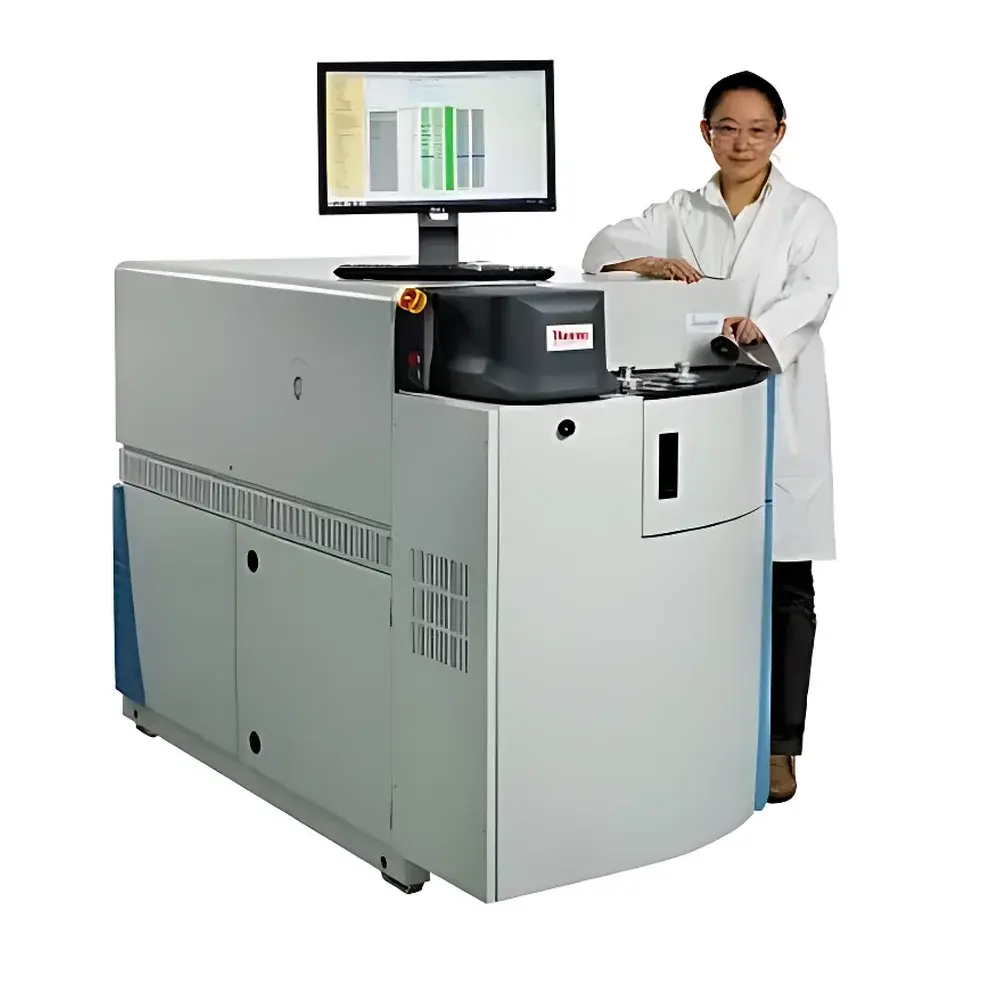
Thermo Fisher ARL iSpark 8860 Direct-Reading Optical Emission Spectrometer
| Brand | Thermo Fisher |
|---|---|
| Origin | Switzerland |
| Model | ARL iSpark 8860 |
| Instrument Type | Benchtop |
| Excitation Source | Spark |
| Detector Configuration | Dual (PMT + CCD) |
| Focal Length | 1000 mm |
| Grating Grooves | 3600 lines/mm |
| Wavelength Range | 120–800 nm |
| Number of Analytical Channels | 128 |
Overview
The Thermo Fisher ARL iSpark 8860 is a high-performance benchtop direct-reading optical emission spectrometer (OES) engineered for precise, rapid, and reproducible elemental analysis of metallic alloys in production and quality control laboratories. It operates on the principle of spark-induced atomic emission spectroscopy: a controlled high-energy spark excites atoms in a solid metal sample, causing them to emit characteristic ultraviolet–visible radiation. This emitted light is dispersed by a Paschen-Runge optical system with a 1000 mm focal length and 3600 lines/mm grating, enabling high spectral resolution and minimal peak overlap. The instrument’s vacuum-sealed cast-iron optical chamber ensures long-term mechanical and thermal stability—critical for maintaining calibration integrity across shifts and over years of operation. Designed specifically for metallurgical applications—including primary metal production, foundry QC, scrap sorting, and aerospace material verification—the iSpark 8860 delivers trace-level detection (sub-ppm for many elements) and exceptional precision for both major, minor, and residual elements.
Key Features
- Dual-detector architecture integrating photomultiplier tubes (PMTs) and a charge-coupled device (CCD), allowing simultaneous high-sensitivity quantitative analysis (via PMT) and full-spectrum acquisition (via CCD) for method development, spectral diagnostics, and inclusion analysis.
- IntelliSource™ dual-current-controlled spark source: a digitally regulated, adaptive discharge generator that dynamically optimizes current rise time, peak current, and discharge duration per element and matrix—enabling robust analysis across ferrous, non-ferrous, and superalloy samples without manual reconfiguration.
- Smart Argon Management (SAM): fully programmable argon flow control across rinse, pre-burn, and integration phases; supports ECO mode (0.1 L/min standby flow) and Super-ECO mode (0 L/min during extended idle periods), reducing consumable cost and environmental footprint without compromising analytical repeatability.
- Optimized spark stand with pulse-purged argon delivery, efficient forced-air cooling, and tool-free electrode and shutter replacement—minimizing downtime and maintenance labor while sustaining plasma stability and shot-to-shot reproducibility.
- Vacuum optical bench with thermally compensated mounting and rigid cast-iron construction, eliminating wavelength drift and ensuring <±0.5 pm long-term spectral stability under ambient lab conditions.
Sample Compatibility & Compliance
The ARL iSpark 8860 accepts flat, conductive metal samples up to 40 mm in diameter and 40 mm in thickness, compatible with standard ASTM E415, ISO 11577, and GB/T 4336 test methods for spark OES analysis. Its multi-matrix capability supports routine calibration and analysis across carbon steels, stainless steels, aluminum alloys, copper-based alloys, titanium grades, and nickel superalloys. The system complies with IEC 61326-1 (EMC), IEC 61010-1 (safety), and supports 21 CFR Part 11-compliant audit trails, electronic signatures, and data integrity protocols when configured with Thermo Scientific SpectraBase™ software and optional GxP modules. Full traceability of calibration standards, measurement sequences, and user actions meets GLP and ISO/IEC 17025 laboratory accreditation requirements.
Software & Data Management
Controlled via Thermo Scientific SpectraBase™ software, the iSpark 8860 provides intuitive workflow management—from method setup and calibration validation to automated report generation and SPC charting. The software features real-time spectral viewing, interference correction algorithms, multivariate regression (PLS) for complex matrices, and built-in uncertainty estimation per ISO/IEC 17025 Annex A. Raw spectral data (including full CCD frames) are stored in vendor-neutral HDF5 format, supporting third-party chemometric tools. Integrated LIMS connectivity (via ASTM E1384 or HL7) enables seamless data exchange with enterprise QA/QC systems. All user actions, parameter changes, and result exports are logged with timestamps and operator IDs, fulfilling FDA 21 CFR Part 11 requirements for electronic records.
Applications
- Real-time grade identification and positive material identification (PMI) in piping, pressure vessels, and structural components.
- Trace element monitoring (e.g., Sn, As, Sb, Bi, Pb) in low-alloy steels to prevent hot shortness and embrittlement.
- Inclusion analysis via spectral background evaluation and line-ratio mapping using CCD-acquired continuum data.
- Scrap metal sorting and recycling feedstock qualification with rapid (<30 s) multi-element screening.
- R&D support for alloy development, including phase diagram validation and segregation studies through spatially resolved spark mapping.
FAQ
What sample preparation is required for analysis?
Flat, clean, and dry surfaces are required; grinding with SiC paper (120–240 grit) is standard. No acid etching or coating is needed.
Does the instrument require continuous vacuum pumping?
No—the optical chamber is sealed and maintained under permanent vacuum; no pumps operate during analysis.
Can the iSpark 8860 analyze non-conductive materials?
Not directly; it is designed exclusively for conductive metals. Non-conductors require alternative techniques such as laser-induced breakdown spectroscopy (LIBS) or XRF.
Is remote diagnostics and software update supported?
Yes—via secure Thermo Connect™ cloud portal with optional 24/7 technical support and over-the-air firmware updates.
How is calibration maintained over time?
Through daily standardization checks using certified reference materials (CRMs); long-term stability is verified via drift correction algorithms and periodic recalibration per ISO 17025 internal procedures.





