
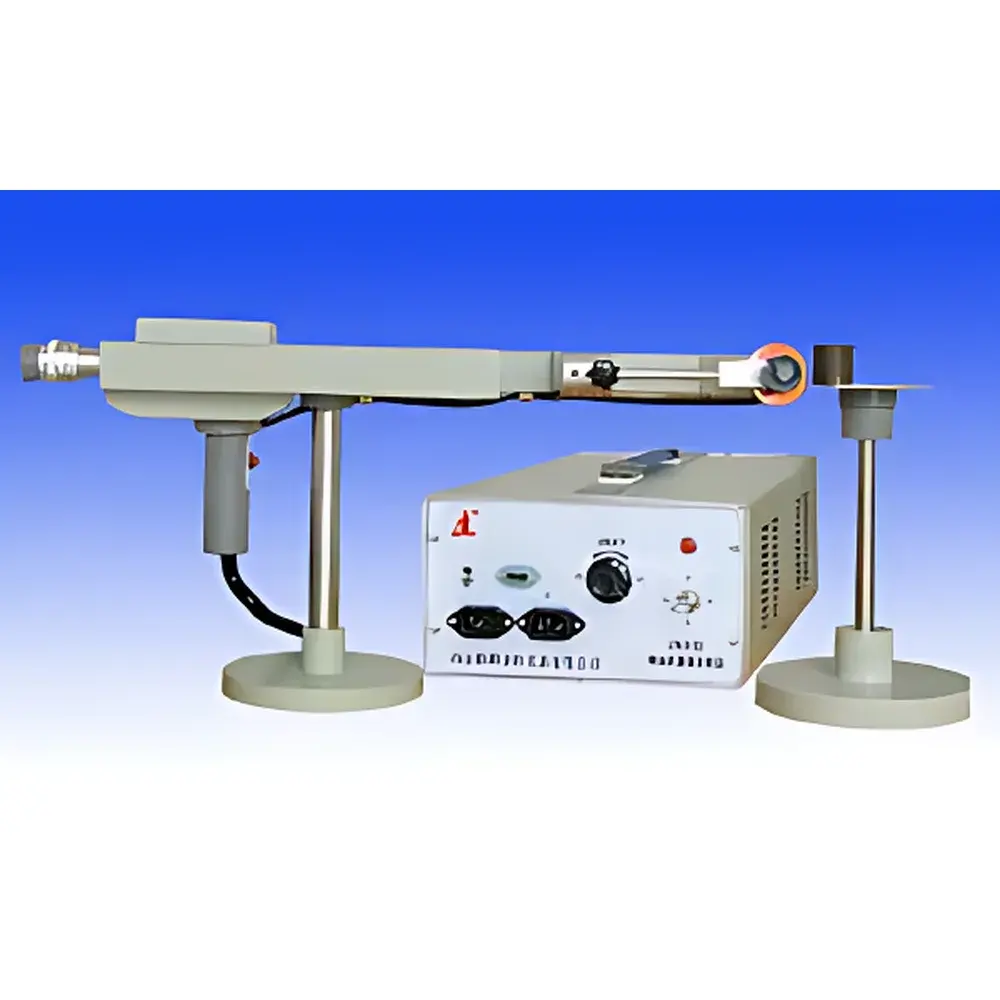
QL-28W Portable Spectroscopic Metal Analyzer
| Brand | Qilin (QL) |
|---|---|
| Model | QL-28W |
| Type | Portable Emission Spectroscopic Analyzer (Arc/Spark Excitation) |
| Wavelength Range | 390–700 nm |
| Operating Voltage | AC 220 V, 50 Hz |
| Arc Current | ~5 A |
| Host Weight | 4.5 kg |
| Generator Weight | 3.0 kg |
| Origin | Jiangsu, China |
| Manufacturer Type | Authorized Distributor |
| Compliance | Domestic GB/T Standards for Metal Spectral Analysis Instruments |
| Pricing | USD 1,780 (FOB Jiangsu) |
Overview
The QL-28W Portable Spectroscopic Metal Analyzer is a compact, arc-excited optical emission spectrometer engineered for rapid qualitative and semi-quantitative elemental identification in metallic materials. Unlike X-ray fluorescence (XRF) or laser-induced breakdown spectroscopy (LIBS) systems, the QL-28W employs controlled electrical arc excitation to volatilize and atomize surface material—generating characteristic atomic emission lines that are dispersed via a precision plane diffraction grating and visually interpreted through an optimized optical path. Its spectral range (390–700 nm) covers key analytical lines for Fe, Cr, Ni, Mo, Mn, Si, V, W, Co, Cu, Al, and other alloying elements critical to carbon steels, alloy steels, tool steels, bearing steels, and non-ferrous metals including copper and aluminum alloys. Designed for field-deployable operation without external gas supply, vacuum pumping, or laboratory infrastructure, the instrument delivers immediate metallurgical fingerprinting—enabling on-site grade verification, material segregation, and mix-up prevention with minimal sample preparation.
Key Features
- True dual-mode deployment: functions as both handheld portable unit and benchtop analyzer with optional stand and grounding clamp
- High-resolution optical system featuring a calibrated plane diffraction grating delivering sharp, well-separated spectral lines across the visible spectrum
- No consumables required: arc excitation uses standard tungsten or graphite electrodes; no argon purge, no vacuum chamber maintenance
- Non-destructive surface analysis: arc spot diameter <1.2 mm; typical ablation depth <5 µm—preserves structural integrity of inspected components
- Operator-independent interface: intuitive visual spectral interpretation supported by built-in reference charts for 32 common steel grades (e.g., Q235, Q345, 42CrMo, GCr15, W18Cr4V) and tool/mold steels
- Ruggedized mechanical design: aluminum alloy chassis, IP52-rated enclosure, shock-absorbing internal mounts for grating and lens assembly
- Integrated arc generator with current stabilization circuitry ensuring consistent excitation energy (~5 A, ±0.3 A) across varying ambient temperatures and line voltage fluctuations (220 V ±10%, 50 Hz)
Sample Compatibility & Compliance
The QL-28W is validated for flat, curved, or irregularly shaped conductive metal samples ≥3 mm thick and ≥10 mm² surface area. It supports direct analysis of wrought, cast, and heat-treated ferrous and non-ferrous alloys—including carbon steels, low-alloy steels, stainless steels, high-speed tool steels (e.g., W6Mo5Cr4V2), hot-work die steels (e.g., 5CrNiMo), cold-work tool steels (e.g., Cr12MoV), bearing steels (e.g., GCr15SiMn), and non-ferrous systems such as brass, bronze, and 6xxx-series aluminum alloys. While not certified to ISO/IEC 17025 for accredited testing, the instrument conforms to GB/T 4336–2016 (Chinese national standard for arc spark optical emission spectrometry of carbon and low-alloy steels) and supports GLP-aligned documentation practices when paired with external logbooks. It does not meet FDA 21 CFR Part 11 requirements for electronic records but enables manual traceability via annotated spectral photographs and physical calibration logs.
Software & Data Management
The QL-28W operates without embedded firmware or proprietary software—relying instead on human visual spectral interpretation guided by printed spectral atlases and grade comparison templates supplied with each unit. This architecture eliminates cybersecurity vulnerabilities, software licensing dependencies, and OS compatibility constraints. For digital workflow integration, users may capture spectral images using standard DSLR or industrial USB microscopes (e.g., 10×–50× magnification, C-mount adapter) and archive them in ISO-compliant file formats (TIFF, PNG) alongside metadata (sample ID, date, operator, electrode type). Calibration verification is performed quarterly using NIST-traceable certified reference materials (CRMs) such as GBW01201a (low-alloy steel) and GBW01211a (stainless steel), with results recorded in paper-based or Excel-based audit trails compliant with internal QA procedures.
Applications
- On-site incoming material inspection at fabrication yards, pipe mills, and forging plants
- Scrap yard sorting and recycling stream optimization for ferrous/non-ferrous separation
- Pre-welding verification of base metal composition to prevent weld mismatch defects
- Tool room verification of die, mold, and cutting tool steel grades prior to heat treatment
- Field failure analysis support—rapid exclusion of incorrect material substitution as root cause
- Technical training and metallurgical education: real-time demonstration of spectral line shifts induced by alloying element variation
FAQ
Does the QL-28W require argon gas or vacuum operation?
No. It utilizes atmospheric-pressure arc excitation and requires no inert gas shielding or vacuum pumping.
Can it analyze painted, plated, or oxidized surfaces?
Surface contaminants must be removed mechanically (e.g., grinding, filing) prior to analysis—the arc cannot penetrate coatings or heavy oxides.
Is spectral line identification automated?
No. Interpretation relies on trained personnel comparing observed emission lines against reference charts; no AI or algorithmic peak matching is implemented.
What is the minimum detectable element concentration?
As a qualitative/semi-quantitative tool, the QL-28W does not specify LODs; detection sensitivity depends on line intensity, observer acuity, and matrix effects—but typically resolves major alloying elements present at ≥0.05 wt% under optimal conditions.
How often must the grating be recalibrated?
The fixed grating requires no routine recalibration; however, annual mechanical alignment verification using a mercury-argon lamp source is recommended per GB/T 4336–2016 Annex D.






