
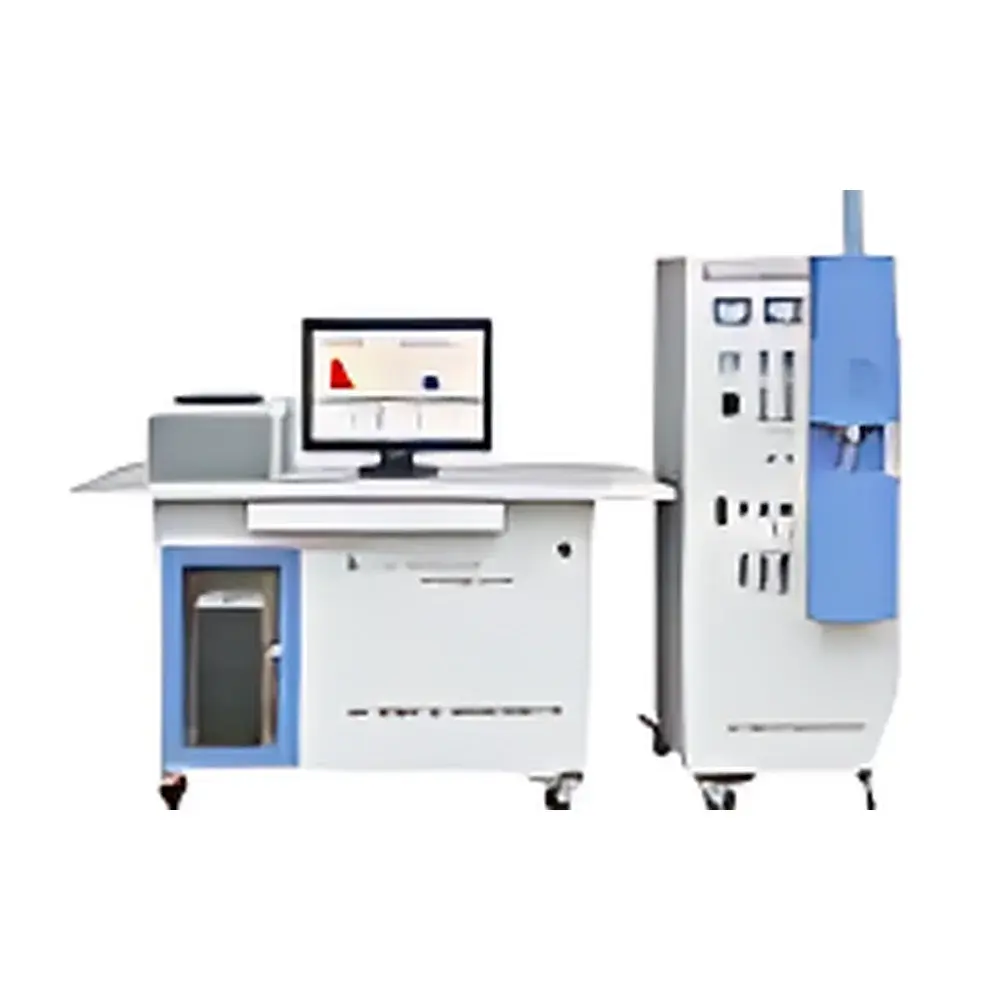
QL-HW2000B High-Frequency Infrared Carbon-Sulfur Analyzer
| Brand | Qilin (QL) |
|---|---|
| Origin | Jiangsu, China |
| Model | QL-HW2000B |
| Measurement Principle | Non-Dispersive Infrared (NDIR) Absorption |
| Heating System | High-Frequency Induction Furnace (2.5 kVA, 18 MHz) |
| Measurement Range | C: 0.00001–99.999 wt%, S: 0.00001–99.999 wt% |
| Sensitivity | 0.1 ppm |
| Accuracy | Compliant with GB/T 20123–2006 and ISO 15350:2000 |
| Analysis Time | Adjustable from 25 to 60 s (typical: 35 s) |
| Balance Integration | Automatic linkage with 0–120 g capacity, 0.1 mg readability |
Overview
The QL-HW2000B High-Frequency Infrared Carbon-Sulfur Analyzer is a fully integrated elemental combustion analyzer engineered for precise quantification of total carbon (C) and total sulfur (S) in solid metallic and non-metallic materials. It operates on the principle of high-frequency induction combustion followed by non-dispersive infrared (NDIR) spectroscopic detection. Solid samples are combusted quantitatively in a purified oxygen atmosphere within a high-frequency induction furnace (18 MHz, 2.5 kVA), converting all carbon and sulfur into CO2 and SO2, respectively. These gaseous oxides pass through optimized optical cells where their characteristic infrared absorption bands—4.26 µm for CO2 and 7.35 µm for SO2—are measured using thermoelectrically cooled, low-noise NDIR detectors. The system’s wide dynamic range (0.00001–99.999 wt%) accommodates both trace-level impurity analysis and bulk composition verification without dilution or reconfiguration.
Key Features
- High-frequency induction furnace with adjustable power output and stable 18 MHz oscillation frequency—ensures complete, reproducible combustion across heterogeneous matrices including ferrous alloys, refractories, and organic-rich samples.
- Dual-channel NDIR detection system featuring thermoelectrically stabilized detectors with <0.1 ppm sensitivity and long-term baseline stability—minimizes drift and supports GLP-compliant calibration intervals.
- Integrated precision balance (0–120 g, 0.1 mg readability) with automatic tare and sample weight acquisition—enables不定量 (variable-mass) weighing protocols per ASTM E1019 and ISO 15350.
- Automated furnace head cleaning mechanism and auxiliary heating element—reduces ash accumulation and ensures consistent SO2 conversion efficiency (>99.8%), critical for sulfur accuracy in high-carbon steels and sulfide ores.
- Modular hardware architecture with isolated gas handling, optical, and electronic subsystems—facilitates field maintenance, component-level diagnostics, and compliance with IEC 61326-1 for electromagnetic compatibility in industrial labs.
- Real-time spectral monitoring and dynamic release curve visualization—allows operators to verify combustion completeness and identify anomalies such as incomplete oxidation or memory effects.
Sample Compatibility & Compliance
The QL-HW2000B is validated for use with iron alloys, stainless and carbon steels, cast irons (including ductile and gray), non-ferrous metals (e.g., Cu-, Al-, Ni-based alloys), rare earth metals, cement, limestone, coal, coke, slag, ceramics, catalysts, foundry sand, and selected organic compounds. All measurements adhere to the metrological requirements of ISO 15350:2000 (Steel and iron — Determination of total carbon and sulfur content — Infrared absorption method after combustion in an induction furnace) and GB/T 20123–2006 (identical technical content). The instrument architecture supports audit-ready operation under GLP and GMP environments, with full support for electronic signatures, user access control, and 21 CFR Part 11–compliant data integrity features when paired with optional validated software modules.
Software & Data Management
Controlled via a Windows-based native application with fully localized English interface, the QL-HW2000B software provides over 40 functional modules—including method configuration, multi-point calibration curve management, statistical process control (SPC) reporting, outlier detection, result correction via matrix-matched standards, breakpoint editing for complex release profiles, and automated system diagnostics. Raw absorbance signals, integration parameters, and calibration coefficients are stored in encrypted binary archives with immutable timestamps. Export formats include CSV, XML, and PDF reports compliant with LIMS integration protocols (ASTM E1482, ISO/IEC 17025 Annex A.3). Audit trails record all user actions, parameter changes, and calibration events with operator ID and time stamp.
Applications
- Quality control of incoming raw materials (e.g., scrap metal, ferroalloys, fluxes) in steelmaking and foundry operations.
- Final product certification for carbon and sulfur content in structural steels, pressure vessel grades, and aerospace alloys per ASTM A751, EN 10027, and JIS G 0320.
- Research-scale compositional mapping of sulfide inclusions and carbide precipitates in heat-treated components.
- Environmental monitoring of sulfur in coal, fly ash, and desulfurization by-products per EPA Method 505.
- Geochemical analysis of carbonates, sulfides, and organic carbon in sedimentary rocks and mining tailings.
- Validation of deoxidation efficiency in ladle metallurgy processes via rapid turnaround (<35 s) sulfur tracking.
FAQ
What combustion atmosphere is required?
High-purity oxygen (≥99.995%, dew point ≤ –70 °C) is mandatory; optional oxygen flow control and pressure regulation modules ensure stoichiometric combustion across sample mass variations.
Is carrier gas required for the infrared cells?
No carrier gas is needed—the NDIR cells operate in static mode with sealed, temperature-stabilized optical paths; zero-gas purging is performed automatically during standby cycles.
Can the instrument analyze liquid or powder samples directly?
Solid samples only. Powders must be pelletized or mixed with tungsten cofactor; liquids require prior evaporation and residue combustion—method validation per ISO 15350 Annex B is recommended.
How often must the infrared detectors be recalibrated?
Factory calibration remains valid for 12 months under normal operation; annual verification using certified reference materials (CRMs) traceable to NIST SRM 1261a or IRMM-039 is required for ISO/IEC 17025 accreditation.
Does the system support remote diagnostics and firmware updates?
Yes—via secure TLS-encrypted Ethernet connection; OEM remote access requires pre-authorized session keys and complies with IEC 62443-3-3 cybersecurity guidelines for laboratory instrumentation.




