
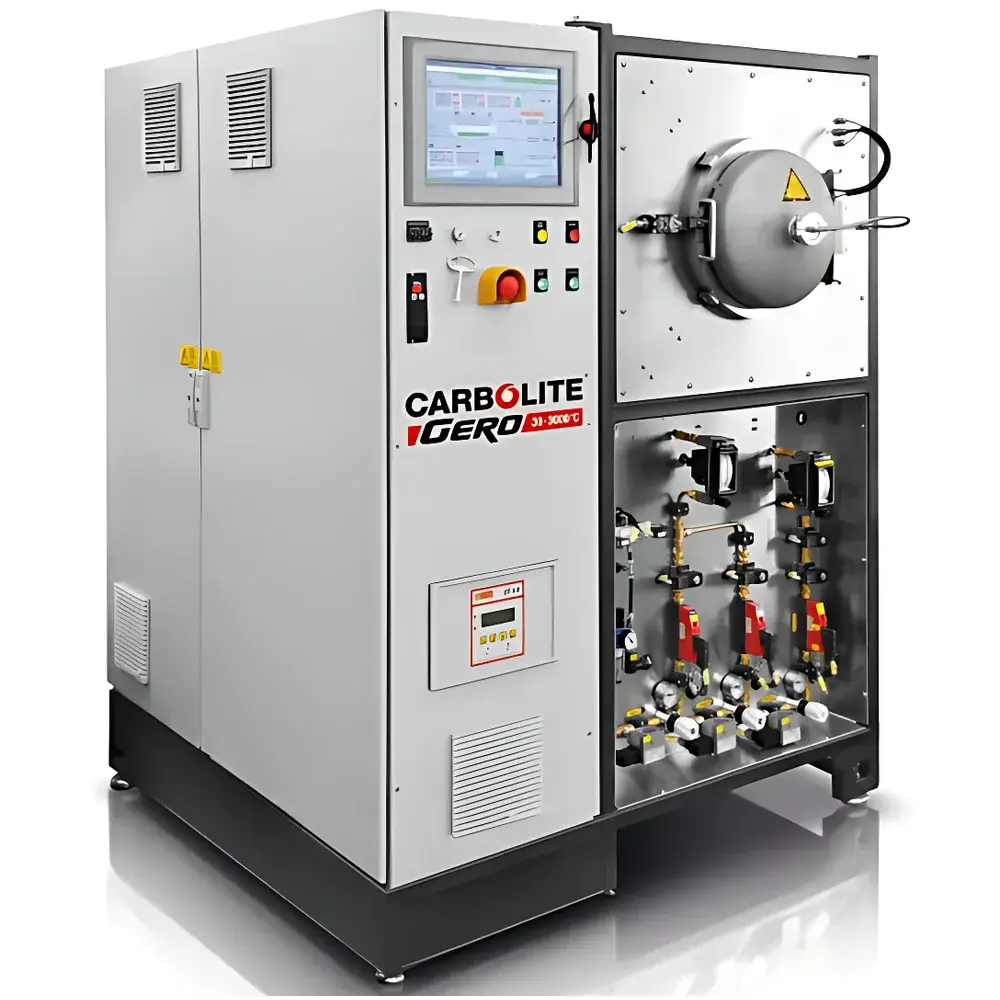
Carbolite Gero GLO Series Vacuum-Tight Tube Furnace
| Brand | Carbolite Gero |
|---|---|
| Origin | Germany |
| Instrument Type | Box-Type Muffle Furnace |
| Max Operating Temperature | 600 °C / 900 °C / 1100 °C |
| Chamber Material | AISI 314 (1.4841) Stainless Steel |
| Internal Temperature Uniformity | ΔT ≤ 6 K (GLO../6 & GLO../9) |
Overview
The Carbolite Gero GLO Series is a vacuum-tight, horizontally oriented tube furnace engineered for precision thermal processing under controlled or inert atmospheres—including nitrogen, argon, forming gas, and hydrogen—up to 1100 °C. Unlike conventional muffle furnaces, the GLO integrates a hermetically sealed cylindrical chamber fabricated from high-temperature-resistant AISI 314 (1.4841) stainless steel, enabling stable pressure differentials and long-term integrity during extended thermal cycles. Its core design follows the principles of uniform radial heat distribution via dual-zone tubular heating elements, complemented by peripheral heating and optional door heating to minimize thermal gradients at critical sealing interfaces. The furnace is specifically optimized for applications requiring strict atmosphere containment, such as catalytic debinding, solvent-free pyrolysis, low-oxygen sintering, and metal injection molding (MIM) pre-sintering stages where binder removal must occur without condensate formation or carbon residue.
Key Features
- Vacuum-tight construction rated for operation under static vacuum (≤10−2 mbar) up to 600 °C and positive pressure (up to 2 bar(g)) in inert or reducing atmospheres
- Water-cooled front door and flange assembly to protect high-performance elastomeric or metal gaskets and extend seal service life
- Dual independent heating zones with PID-controlled power regulation ensure axial temperature profiling and improved uniformity across the hot zone
- Integrated radiation shield mounted behind the door reduces thermal back-transfer and stabilizes front-zone temperatures during ramp-hold cycles
- Compact footprint with modular mounting options—designed for integration into automated MIM production lines or standalone lab-scale process development
- Optional catalytic off-gas treatment module for clean decomposition of organic binders (e.g., PEG, PMMA, paraffin), eliminating condensable volatiles and minimizing exhaust odor
Sample Compatibility & Compliance
The GLO accommodates standard quartz or alumina tubes (ID 50–150 mm) and supports sample carriers compatible with MIM green parts, ceramic green bodies, and metallurgical preforms. Its chamber geometry and gas flow path are designed to meet ASTM F2885–21 (Standard Guide for Thermal Processing of Metal Injection Molded Parts) requirements for debinding uniformity and thermal shock resistance. All electrical, pressure, and gas interface components comply with IEC 61000-6-2/6-4 (EMC), EN 60519-1 (safety for industrial electroheating equipment), and PED 2014/68/EU for pressure equipment. When configured with data logging, alarm interlocks, and user-access controls, the system supports GLP/GMP-aligned validation protocols per ISO/IEC 17025 and FDA 21 CFR Part 11 when paired with compliant software.
Software & Data Management
The GLO operates via Carbolite Gero’s proprietary TCC (Thermal Control Center) software platform, offering multi-segment programmable ramp-soak profiles, real-time graphing of thermocouple channels (Type S or K), and configurable alarm thresholds for overtemperature, cooling failure, or gas flow deviation. Process data—including time-stamped temperature, power consumption, and optional mass flow controller readings—is exported in CSV or XML format for traceability. Audit trails record all parameter changes, user logins, and system events with timestamped digital signatures. For integrated manufacturing environments, OPC UA and Modbus TCP interfaces enable seamless connection to MES or SCADA systems without proprietary middleware.
Applications
- Metal Injection Molding (MIM): Controlled catalytic or thermal debinding of feedstock parts prior to sintering—eliminating cold spots and preventing binder redistribution
- Ceramic Green Body Processing: Solvent-free pyrolysis of polymer-bonded ceramics with zero condensate accumulation in exhaust lines
- Advanced Materials Research: Annealing of thin-film substrates, heat treatment of battery electrode precursors, and pre-sintering of tungsten carbide composites
- Calibration & Reference Standards: High-stability thermal cycling for NIST-traceable reference material conditioning under reproducible gas environments
- Hydrogen-Compatible Processes: Reduction annealing of oxide ceramics and magnetic alloys in dilute H₂/N₂ mixtures with integrated safety interlocks
FAQ
What atmosphere types are supported by the GLO furnace?
The GLO is certified for use with inert gases (N₂, Ar), reducing atmospheres (H₂/N₂ mixtures up to 10% H₂), and vacuum conditions up to 600 °C. Custom configurations support higher H₂ concentrations with additional explosion-proof instrumentation.
Is the GLO suitable for catalytic debinding of MIM parts?
Yes—when equipped with the optional catalytic module, the GLO enables complete, low-residue debinding of common MIM binders (e.g., PEG-based systems) without condensation or charring, meeting ASTM F2885 criteria for green part integrity.
How is temperature uniformity validated across the hot zone?
Uniformity is verified per DIN EN 15381 using nine-point mapping with calibrated Type S thermocouples; standard models achieve ΔT ≤ 6 K over a 100 mm length at setpoint (GLO../9), with tighter tolerances available under special order.
Can the GLO be integrated into an automated MIM production line?
Yes—the furnace features standardized mechanical interfaces, Ethernet/IP and Modbus TCP communication ports, and programmable digital I/O for synchronization with conveyors, load/unload robots, and central process controllers.
What maintenance intervals are recommended for the water-cooling system?
Coolant quality should be verified quarterly; deionized water with 10–15% ethylene glycol is recommended. Filter cartridges and flow sensors require inspection every 12 months or 2000 operating hours, whichever occurs first.



