
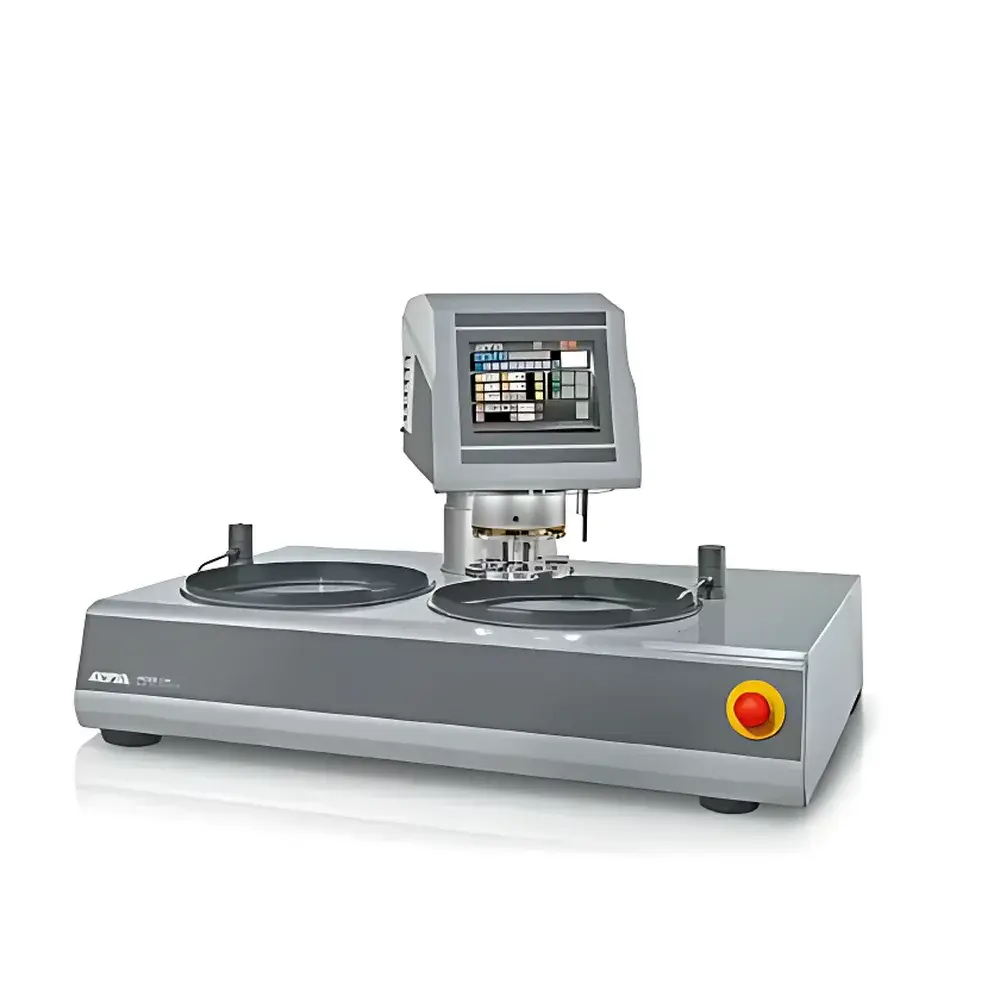
QATM Saphir 560 (Rubin 520) Dual-Disk Precision Grinding and Polishing System
| Brand | QATM |
|---|---|
| Origin | Germany |
| Model | Saphir 560 (Rubin 520) |
| Speed Range | 50–600 rpm |
| Platen Diameter | 200–300 mm |
| Number of Platens | 2 |
| Dimensions (L×W×D) | 1020 × 550–650 × 660 mm |
| Single-Point Load Force | 5–100 N |
| Center-Load Force | dependent on chuck configuration |
| Grinding Head Speed | 30–150 rpm |
| Power Supply | 5.5 kVA |
| Base Unit Power Rating | 2 × 0.75 kW (S6/40%) |
| Grinding Head Power Rating | 0.17 kW (S1) |
| Weight | ~110 kg |
| Water Inlet | R½", max. 6 bar |
Overview
The QATM Saphir 560 (Rubin 520) is a dual-disk, equal-diameter precision grinding and polishing system engineered for reproducible, high-fidelity specimen preparation in metallurgical, ceramic, geological, and advanced materials laboratories. It operates on a dual-platen architecture with synchronized rotational control of both grinding/polishing platens and an independently driven, motorized grinding head—enabling simultaneous or sequential material removal under precisely regulated mechanical loading conditions. The system implements a hybrid force application methodology: single-point loading for localized, specimen-specific pressure control and center-loading for uniform radial force distribution across the sample surface. This dual-force capability ensures optimal flatness, minimal edge rounding, and consistent material removal rates—critical for microstructural analysis, hardness testing, and electron microscopy sample preparation. Designed and manufactured in Germany, the Saphir 560 conforms to IEC 61000-6-2 (immunity) and IEC 61000-6-4 (emission) standards, and its mechanical architecture meets ISO 12100:2012 requirements for machinery safety.
Key Features
- Motorized Rubin 520 grinding head with integrated pneumatic height adjustment and automatic safety guard—reducing operator intervention and enhancing repeatable positioning accuracy.
- Touchscreen HMI (Human-Machine Interface) with intuitive graphical workflow navigation, real-time parameter monitoring, and password-protected user-level access (Operator, Technician, Administrator).
- Programmable process memory: up to 99 pre-defined grinding/polishing protocols—including speed ramping, dwell time, force profile sequencing, and coolant dosing intervals.
- Automated liquid dispensing system with flow-rate calibration and programmable start/stop timing—compatible with water, oil-based lubricants, and colloidal silica suspensions.
- Precision depth control: grinding depth presettable in 0.01 mm increments; real-time displacement measurement via integrated linear encoder; automatic cycle termination upon reaching target depth.
- Bi-directional grinding head rotation (clockwise/counter-clockwise) to minimize directional artifact formation and improve surface isotropy.
- Height and lateral position memory function for rapid repositioning between sample batches or multi-step preparation sequences.
Sample Compatibility & Compliance
The Saphir 560 accommodates specimens ranging from Ø50 mm single samples (up to six per cycle using multi-specimen holders) to large-area sections up to Ø300 mm. It supports rigid and semi-rigid materials including ferrous and non-ferrous metals, sintered carbides, oxide and nitride ceramics, geological thin sections, and composite laminates. All wet-process components are corrosion-resistant (AISI 316 stainless steel and PTFE-lined fluid paths), ensuring compatibility with acidic, alkaline, and abrasive slurries. The system complies with ISO 14971:2019 (risk management for medical devices) where applicable in biomedical material prep, and supports GLP/GMP documentation workflows through audit-trail-enabled software logging (optional QATM LabSuite Pro module). Mechanical design adheres to EN ISO 13857:2019 (safety distances to prevent hazard zone access).
Software & Data Management
Control firmware includes embedded event logging with timestamped records of all operational parameters: platen speed, grinding head speed, applied load, coolant volume dispensed, elapsed time per stage, and final depth reading. Data export is supported via USB 2.0 or Ethernet (TCP/IP) to CSV or XML formats for integration into LIMS or laboratory QA databases. Optional LabSuite Pro software provides advanced features including statistical process control (SPC) charting, inter-operator performance comparison, electronic signature support per FDA 21 CFR Part 11, and automated report generation compliant with ISO/IEC 17025 documentation requirements.
Applications
- Preparation of metallographic specimens for optical and scanning electron microscopy (SEM/EDS).
- Flatness-critical sectioning of brittle materials such as silicon wafers, battery electrode layers, and thermal barrier coatings.
- Standardized grinding for ASTM E3, ISO 14489, and EN 10365 compliance testing.
- Controlled material removal in failure analysis labs—especially for cross-sectional evaluation of solder joints, adhesive bonds, and multilayer packaging.
- High-reproducibility polishing of geological thin sections for petrographic analysis per ASTM D5777.
- Research-grade surface conditioning prior to nanoindentation or XRD texture analysis.
FAQ
What is the difference between single-point and center loading modes?
Single-point loading applies force directly to the specimen’s center via the grinding head’s vertical actuator—ideal for individual samples requiring precise, isolated pressure control. Center loading distributes force radially through the chuck mechanism—suited for multi-specimen holders or when uniform stress across the entire platen interface is required.
Can the Saphir 560 be integrated into an automated lab workflow?
Yes—the system supports digital I/O signals (24 V DC) for external start/stop commands and status feedback, and its Ethernet interface enables remote monitoring and script-driven protocol execution via LabVIEW or Python-based automation frameworks.
Is the Rubin 520 grinding head compatible with third-party consumables?
The head accepts standard M14-threaded grinding/polishing discs and holders conforming to EN 12413 and ISO 6344 specifications; however, QATM-certified consumables are recommended to maintain calibrated force transmission and depth measurement accuracy.
What maintenance intervals are specified for the pneumatic height adjustment system?
Compressed air filters require replacement every 6 months under continuous operation; pneumatic cylinder seals are rated for ≥100,000 cycles and inspected during annual preventive maintenance per QATM Service Bulletin SB-GRIND-2023-01.



