
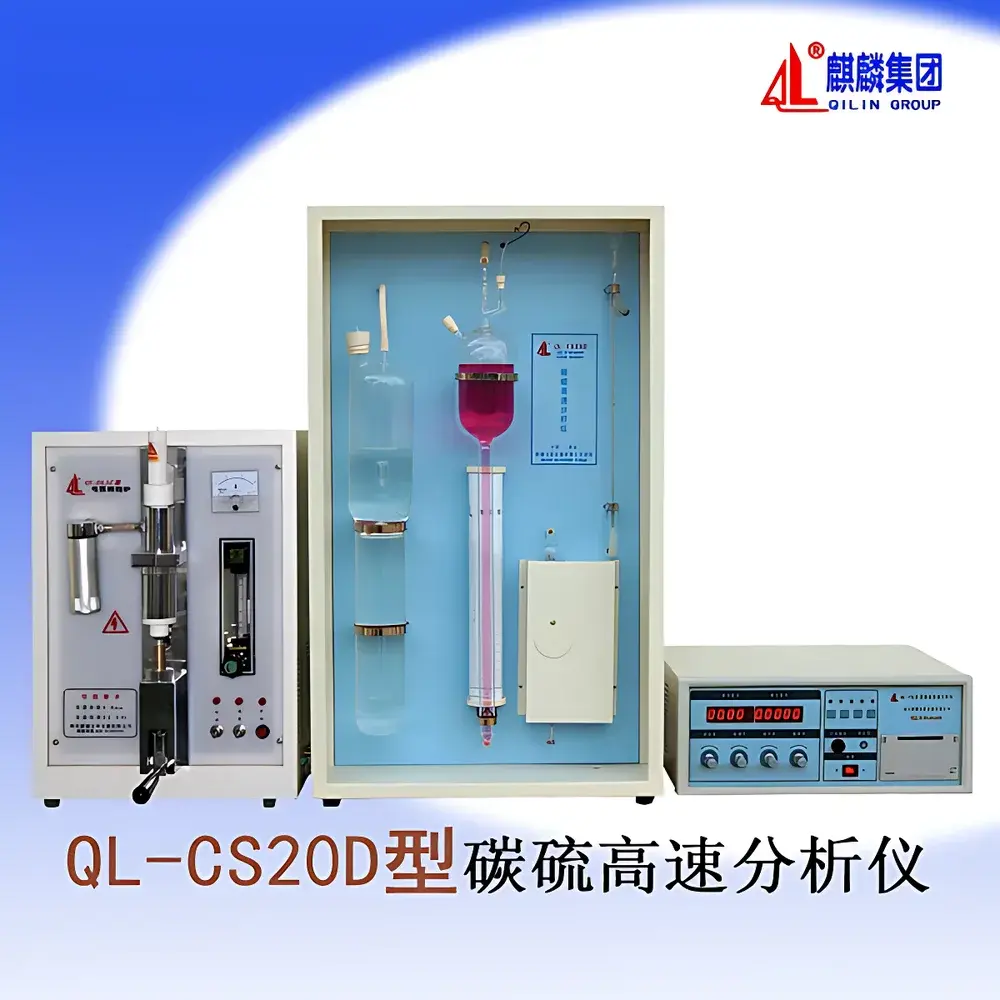
Nanjing Qilin QL-CS20D High-Speed Carbon-Sulfur Analyzer
| Brand | Qilin (QL) |
|---|---|
| Origin | Jiangsu, China |
| Model | CS20D |
| Measurement Principle | Gas Volumetric Method (C), Iodometric Titration (S) |
| Heating System | Arc Furnace |
| Carbon Range | 0.05–6.00 wt% |
| Sulfur Range | 0.005–0.300 wt% |
| Sample Weight Options | 0.25 g / 0.5 g / 1.0 g |
| Analysis Time | 45 s (with DL1A arc furnace) |
| Readout | Direct digital display of mass fraction (%) with thermal printer output |
| Accuracy | Compliant with GB/T 223.69–1997 (C) and GB/T 223.68–1997 (S) |
| Operating Environment | 0–40 °C, 90.658–106.658 kPa |
Overview
The Nanjing Qilin QL-CS20D High-Speed Carbon-Sulfur Analyzer is a dedicated elemental combustion analyzer engineered for rapid, reliable quantification of total carbon (C) and sulfur (S) in solid metallic and inorganic materials. It operates on two classical wet-chemical principles integrated into a single automated platform: gas volumetric determination for carbon and iodometric titration for sulfur. The system couples with a DL1A high-energy arc furnace to achieve complete combustion of refractory samples—including steels, cast irons, ferroalloys, non-ferrous metals, cement clinkers, ores, catalysts, and ceramic precursors—at temperatures exceeding 3,000 °C. This ensures quantitative liberation of CO₂ and SO₂ gases from complex matrices, followed by selective absorption and stoichiometric measurement. Unlike modern infrared-based analyzers, the QL-CS20D retains traceability to gravimetric and volumetric reference methods—making it suitable for laboratories requiring method equivalence with legacy standards or operating under budget-constrained QA/QC environments where robustness and operational transparency are prioritized over ultra-high throughput.
Key Features
- Dual-method architecture: Gas volumetric analysis for carbon using differential pressure transduction; automated iodometric titration for sulfur with reagent delivery controlled by time-based dosing (electrode-free design).
- Three calibrated sample mass modes (0.25 g, 0.5 g, 1.0 g) enabling dynamic range extension across low-, medium-, and high-concentration samples without manual recalibration or factor conversion.
- Isolated capacitive touch-key interface minimizes electromagnetic interference from arc ignition and improves long-term operational stability in industrial lab settings.
- Single-chip microcontroller (SCM)-based data acquisition and processing engine performs real-time compensation for ambient temperature and barometric pressure fluctuations (90.658–106.658 kPa), ensuring consistency across geographic locations.
- Optimized dual-absorption protocol (selectable 1× or 2×) enhances recovery accuracy for sulfur in high-carbon or slag-containing samples, reducing interferences from incomplete oxidation or SO₃ carryover.
- Direct digital readout of mass fraction (%) via 7-segment LED display and integrated thermal printer—eliminating transcription errors and supporting GLP-compliant hard-copy record generation.
Sample Compatibility & Compliance
The QL-CS20D accommodates heterogeneous solid samples up to 1.0 g, including chip, drillings, ground powders, and pressed pellets. Its arc furnace configuration enables direct analysis of materials with high melting points and low thermal conductivity—such as Mn-steels, Ni-based superalloys, and refractory oxides—without pre-fusion or flux addition. The instrument meets national standard specifications per GB/T 223.69–1997 (carbon) and GB/T 223.68–1997 (sulfur), which align methodologically with ISO 4935:1989 (steel—determination of carbon) and ISO 4936:1989 (steel—determination of sulfur). While not inherently compliant with FDA 21 CFR Part 11 or EU Annex 11 due to lack of electronic audit trail and user-role management, its analog-digital hybrid architecture supports manual verification workflows required under ISO/IEC 17025:2017 Clause 7.7 (results reporting) and ASTM E1019 (standard test methods for determining carbon, sulfur, nitrogen, and oxygen in steel and iron).
Software & Data Management
The QL-CS20D operates without embedded PC software or network connectivity. All measurement logic, signal conditioning, and result calculation reside within its proprietary SCM firmware. Data output is exclusively via real-time LED display and thermal printout—each report includes date/time stamp, sample ID (manually entered), mass input, selected absorption mode, and final C/S values in %wt. For laboratories integrating the analyzer into LIMS or ERP ecosystems, optional RS-232 serial output (TTL-level) allows connection to external PCs running custom terminal emulators or lightweight data logging utilities. No proprietary drivers or cloud services are required. This architecture ensures deterministic response timing, immunity to OS updates or cybersecurity vulnerabilities, and full traceability of raw sensor outputs through documented calibration certificates (provided at factory commissioning).
Applications
- Metallurgical QC labs performing incoming inspection of scrap, pig iron, and alloying additives in foundries and rolling mills.
- Cement and mineral processing facilities verifying limestone calcination efficiency and pyrite content in raw meal.
- Research institutes studying desulfurization kinetics in coal-derived chars or catalytic coke deposits.
- Third-party testing labs serving ISO 9001-certified suppliers needing auditable, standards-aligned C/S data for material certifications.
- Educational institutions teaching classical combustion analysis principles alongside modern IR and TOF-MS techniques.
FAQ
What sample preparation is required prior to analysis?
Minimal preparation is needed: samples must be clean, dry, and homogenized (e.g., milling or drilling). No fluxes, binders, or pre-oxidation steps are necessary. Particle size should be ≤ 0.2 mm for reproducible combustion.
Can the QL-CS20D analyze coated or surface-treated metals?
Yes—provided the coating mass is negligible relative to total sample weight (< 0.5%). For thick coatings (e.g., galvanized steel), mechanical removal of the surface layer is recommended to avoid bias from non-metallic constituents.
Is routine calibration required between analyses?
No daily calibration is mandated. The system relies on physical standards (certified reference materials with known C/S content) for periodic verification—typically before each analytical batch or shift, per ISO/IEC 17025 internal quality control protocols.
How does ambient pressure variation affect sulfur measurement accuracy?
The built-in barometric sensor continuously corrects titration volume calculations. Validation tests across 90–107 kPa show ≤ ±0.002% absolute deviation in sulfur results at 0.050% level, confirming robustness under typical laboratory altitude variations.
What maintenance intervals are recommended for the arc furnace and absorption system?
Furnace electrodes require replacement every ~500–800 analyses depending on sample type. Absorption pipettes and reagent reservoirs should be cleaned weekly; iodine solution must be standardized biweekly using potassium iodate primary standard.




