
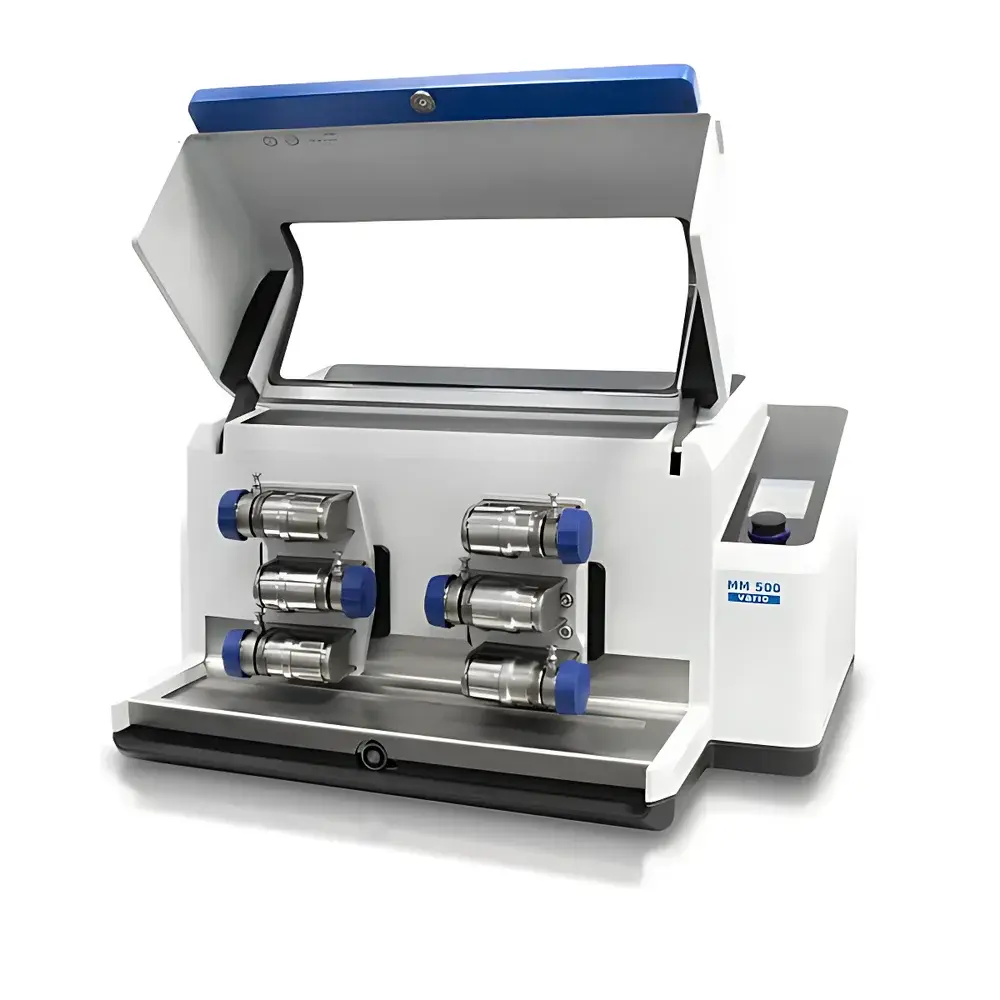
Retsch MM500 Vario High-Energy Vibratory Ball Mill
| Brand | Retsch |
|---|---|
| Origin | Germany |
| Model | MM500 Vario |
| Instrument Type | Vibratory Ball Mill |
| Sample Applicability | Hard, medium-hard, brittle, soft, elastic, and fibrous materials |
| Final Particle Size | ≤5 µm |
| Feed Particle Size | ≤8 mm |
| Batch Capacity | 6 × 20 mL |
| Maximum Frequency | 35 Hz |
| Processing Time Range | 0.1–99 h |
| Compatible Vial Sizes | 1.5–50 mL (including 1.5/2/5 mL Eppendorf tubes with adapters) |
| Grinding Jar Materials | Hardened steel, stainless steel, tungsten carbide, agate, zirconia, PTFE |
| Compliance | Designed for ISO/IEC 17025-compliant laboratories |
Overview
The Retsch MM500 Vario is a high-energy vibratory ball mill engineered for precision comminution, mechanical alloying, and homogenization of diverse solid materials under controlled laboratory conditions. Operating on the principle of high-frequency oscillatory impact—where grinding jars undergo rapid vertical vibration at up to 35 Hz—the instrument transfers kinetic energy to grinding media (balls), inducing intense collisions between balls, sample particles, and jar walls. This mechanism enables efficient particle size reduction down to ≤5 µm, even for exceptionally hard or refractory materials such as ceramics, alloys, minerals, and pharmaceutical excipients. Unlike planetary or centrifugal mills, the MM500 Vario’s vibratory motion delivers superior energy transfer per unit time while minimizing thermal load—making it especially suitable for temperature-sensitive applications, including cryogenic milling when used with liquid nitrogen-cooled jars.
Key Features
- Six independent grinding stations enabling true parallel processing—ideal for comparative studies, method development, and high-throughput sample preparation.
- Adjustable frequency range (3–35 Hz) with digital control and real-time display, ensuring reproducible energy input across batches.
- Modular jar holder system compatible with all MM400 accessories—including 0.5 mL, 1.5 mL, 2 mL, and 5 mL Eppendorf tube adapters—allowing seamless integration into existing lab workflows.
- Wide selection of jar materials (hardened steel, stainless steel, tungsten carbide, agate, zirconia, PTFE) to prevent contamination and enable application-specific chemically inert milling.
- Programmable run time from 0.1 minutes to 99 hours, supporting both rapid pre-screening and extended mechanochemical synthesis protocols.
- Integrated safety interlock system with automatic shutdown upon lid opening or abnormal vibration detection, compliant with EN 61000-6-2/6-4 electromagnetic compatibility standards.
Sample Compatibility & Compliance
The MM500 Vario accommodates a broad spectrum of sample types: hard (e.g., silicon carbide, quartz), medium-hard (e.g., limestone, feldspar), brittle (e.g., glass, salts), soft (e.g., polymers, chalk), elastic (e.g., rubber, elastomers), and fibrous (e.g., plant tissue, cellulose). Its versatility extends to dry grinding, wet grinding (with solvents such as ethanol or toluene), and cryo-grinding using pre-chilled jars. For regulated environments, the instrument supports traceable operation when paired with Retsch’s TruControl™ software—providing electronic records of parameters (frequency, duration, jar ID), user login logs, and timestamped event history. These capabilities align with requirements for GLP (Good Laboratory Practice), GMP (Good Manufacturing Practice), and FDA 21 CFR Part 11 compliance when implemented within validated SOP frameworks.
Software & Data Management
While the MM500 Vario operates via an intuitive front-panel interface, full traceability and remote monitoring are achieved through optional integration with Retsch’s TruControl™ software suite. This platform enables secure user management, parameter locking, electronic signature functionality, and automated report generation—including PDF summaries with metadata (operator ID, date/time, jar material, frequency profile). All data are stored in encrypted local databases or network drives, supporting audit readiness and long-term archiving per ISO/IEC 17025 Clause 7.5.2. The system also allows export of raw operational logs (.csv) for statistical process analysis in external tools such as JMP or Minitab.
Applications
- Mechanochemical synthesis of metal–organic frameworks (MOFs), solid-state battery cathodes (e.g., LiCoO₂ composites), and catalyst precursors.
- Preparation of nanoscale powders for XRD, SEM-EDS, and BET surface area analysis.
- Routine quality control of raw materials in pharmaceutical, ceramic, and metallurgical industries—ensuring batch-to-batch consistency in particle size distribution.
- Homogenization of heterogeneous biological matrices prior to DNA/RNA extraction or proteomic profiling.
- Accelerated aging studies via controlled mechanical degradation of polymer blends and composite laminates.
FAQ
What is the maximum recommended sample volume per jar?
For optimal energy transfer and reproducibility, Retsch recommends filling jars to 10–30% of total volume with sample + grinding media. For a standard 20 mL jar, this corresponds to ~2–6 mL of bulk material.
Can the MM500 Vario be used for cryogenic grinding?
Yes—when equipped with stainless steel or hardened steel jars pre-cooled in liquid nitrogen, the MM500 Vario supports cryo-milling of thermolabile compounds, including APIs and biopolymers.
Is the instrument compatible with regulatory documentation requirements?
When used with TruControl™ software and configured with role-based access control and audit trail activation, the system meets core elements of FDA 21 CFR Part 11 and EU Annex 11 for electronic records and signatures.
How does the MM500 Vario differ from the MM400 model?
The MM500 Vario offers higher maximum frequency (35 Hz vs. 30 Hz), six independent grinding positions (vs. one or two), enhanced thermal management, and backward compatibility with all MM400 accessories—including tube adapters and jar types.
What maintenance is required for long-term performance?
Routine inspection of the rubber damping feet, periodic cleaning of the drive shaft coupling, and verification of jar clamping torque per Retsch Technical Bulletin TB-MILL-01 are recommended every 500 operating hours.



