
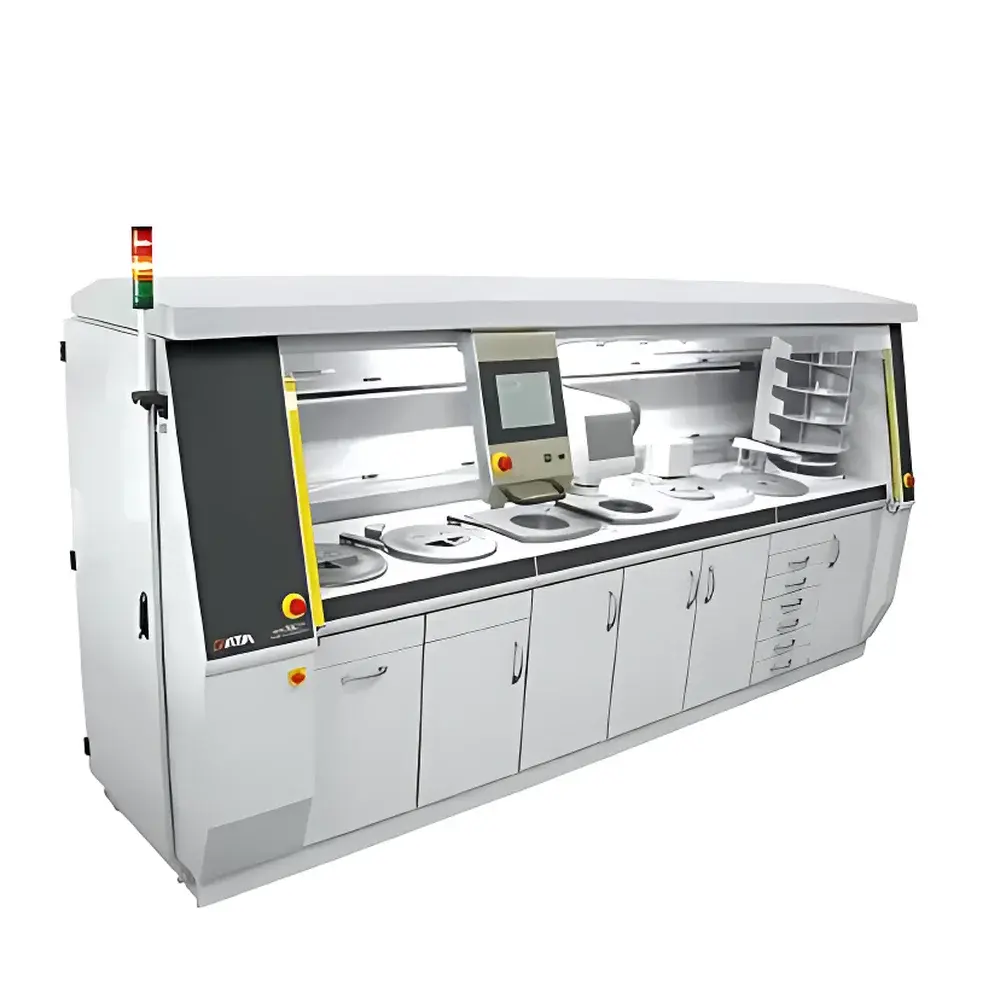
QATM QPOL 300 BOT Fully Automated Grinding and Polishing System
| Brand | QATM |
|---|---|
| Origin | Germany |
| Model | QPOL 300 BOT |
| Platen Diameter | 300 mm |
| Number of Platens | 1 |
| Enclosure Material | Anodized Aluminum |
| Automation Level | Fully Sequential, Step-to-Step Process Control |
| Sample Holder Capacity per Station | Up to 6 specimens (configurable) |
| Safety Compliance | Integrated Light Curtain (EN ISO 13857), Emergency Stop Circuit (EN 60204-1) |
| Programmable Steps | Up to 11 sequential operations (pre-grinding, grinding, polishing, cleaning, drying, etc.) |
| Control Interface | 10.1″ TFT Touchscreen with Multi-Language GUI (English, German, French, Chinese) |
Overview
The QATM QPOL 300 BOT is a fully automated, benchtop-integrated grinding and polishing system engineered for high-reproducibility metallographic sample preparation in quality control, failure analysis, and R&D laboratories. Based on the Couette-flow principle of controlled abrasive removal and surface planarization, the system executes standardized, time- and force-regulated material removal sequences across multiple specimen holders—eliminating operator-dependent variability inherent in manual or semi-automated systems. Its compact footprint (W × D × H: 850 × 720 × 890 mm) and modular station architecture enable seamless integration into ISO/IEC 17025-accredited labs, GLP-compliant environments, and production-floor QC labs requiring traceable, auditable sample prep workflows.
Key Features
- Fully sequential automation: The QPOL 300 BOT transitions autonomously between up to 11 programmable steps—including pre-grinding, coarse/fine grinding, diamond polishing, colloidal silica final polishing, ultrasonic cleaning, and inert-gas drying—without manual intervention or fixture repositioning.
- Modular multi-station design: Four to eight independent processing stations can be housed within a single anodized aluminum cabinet, each accommodating up to six standard 30 mm or 40 mm diameter specimen mounts (custom fixtures available).
- Intelligent force control: Load is dynamically regulated via servo-driven vertical actuators (0–50 N range, ±0.5 N repeatability), ensuring consistent pressure distribution across all specimens during each step—critical for minimizing relief artifacts and edge rounding.
- Integrated safety architecture: Complies with EN ISO 13857 (safe distance requirements) and EN 60204-1 (electrical safety); features dual-channel light curtain monitoring, mechanical emergency stop, and automatic platen shutdown upon door opening.
- Human-centric HMI: 10.1″ capacitive touchscreen with intuitive drag-and-drop workflow editor, real-time process visualization, and password-protected user roles (Operator, Technician, Administrator) aligned with FDA 21 CFR Part 11 audit trail requirements.
Sample Compatibility & Compliance
The QPOL 300 BOT accommodates metallic, ceramic, and composite specimens ranging from soft aluminum alloys to hardened tool steels (up to 65 HRC) and brittle silicon carbide substrates. Standard mounting supports epoxy cold-mount, thermosetting resin hot-mount, and conductive carbon-embedded samples. All consumables—including SiC papers (P80–P2500), diamond suspensions (15–1 µm), and colloidal silica (0.04 µm)—are compatible with ASTM E3, ISO 1127, and EN 10365 standard test methods. Each run generates a timestamped digital log (including applied force, rotation speed, dwell time, and coolant flow rate), supporting ISO/IEC 17025 clause 7.8 (reporting of results) and internal QA documentation.
Software & Data Management
QATM’s proprietary QSoft™ v5.2 software enables method creation, validation, and version-controlled deployment across networked instruments. Methods include parameter locking (e.g., RPM limits per step), inter-step logic gates (e.g., “proceed only if surface roughness < 0.8 µm Ra, verified by optional inline profilometer”), and electronic signature capture. Raw logs are exportable as CSV or PDF; full audit trails—including user login/logout, parameter edits, and error events—are retained for ≥36 months. Optional integration with LIMS platforms (via ASTM E1384-compliant HL7 or REST API) allows direct linkage of prep metadata to subsequent SEM, EDS, or hardness test records.
Applications
- Metallographic lab accreditation: Supports repeatable preparation of ASTM E3-compliant cross-sections for grain size analysis (ASTM E112), inclusion rating (ASTM E45), and decarburization depth measurement (ASTM E1077).
- Aerospace & power generation: Prepares turbine blade Ni-superalloy sections with minimal deformation layer (< 1.2 µm), enabling accurate γ′ phase quantification via TEM.
- Automotive casting QC: Processes high-volume Al-Si alloy cylinder head samples under identical thermal and mechanical conditions—reducing inter-lab variance in porosity assessment (ISO 27874).
- Academic research: Enables comparative studies of novel AM metals (e.g., Ti-6Al-4V ELI) where surface integrity directly influences fatigue crack nucleation behavior.
FAQ
Does the QPOL 300 BOT support ASTM E3-compliant preparation protocols?
Yes—predefined method templates for ASTM E3, ISO 1127, and EN 10365 are included, with adjustable parameters validated against certified reference materials (e.g., NIST SRM 2826).
Can the system integrate with existing laboratory information management systems (LIMS)?
Yes—via optional HL7 v2.x or RESTful API module, enabling bidirectional transfer of sample IDs, prep timestamps, and operator credentials.
What maintenance intervals are recommended for long-term reproducibility?
Platen flatness verification every 6 months (using optical interferometry), motor encoder calibration annually, and light curtain alignment check prior to each shift.
Is remote diagnostics supported?
Yes—QATM Remote Assist enables encrypted, technician-initiated screen sharing and firmware update deployment without compromising local network security policies.
Related Products



