
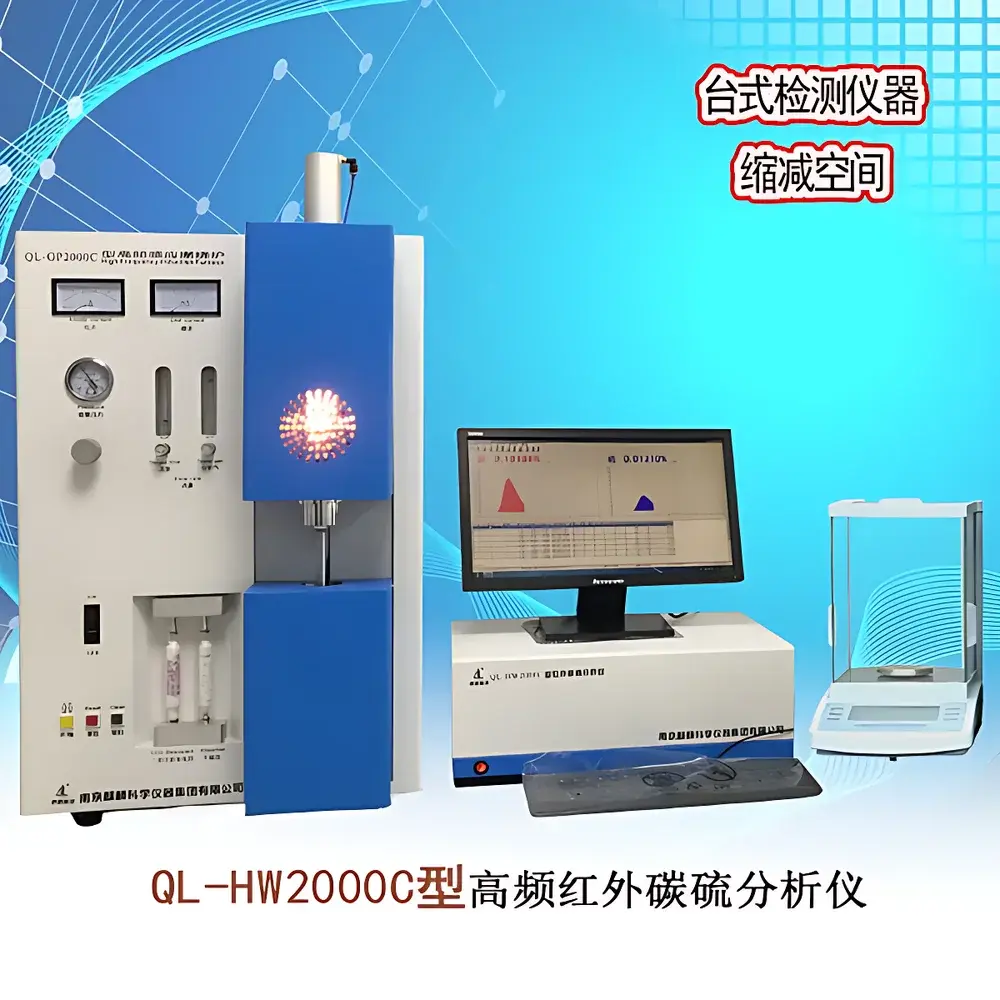
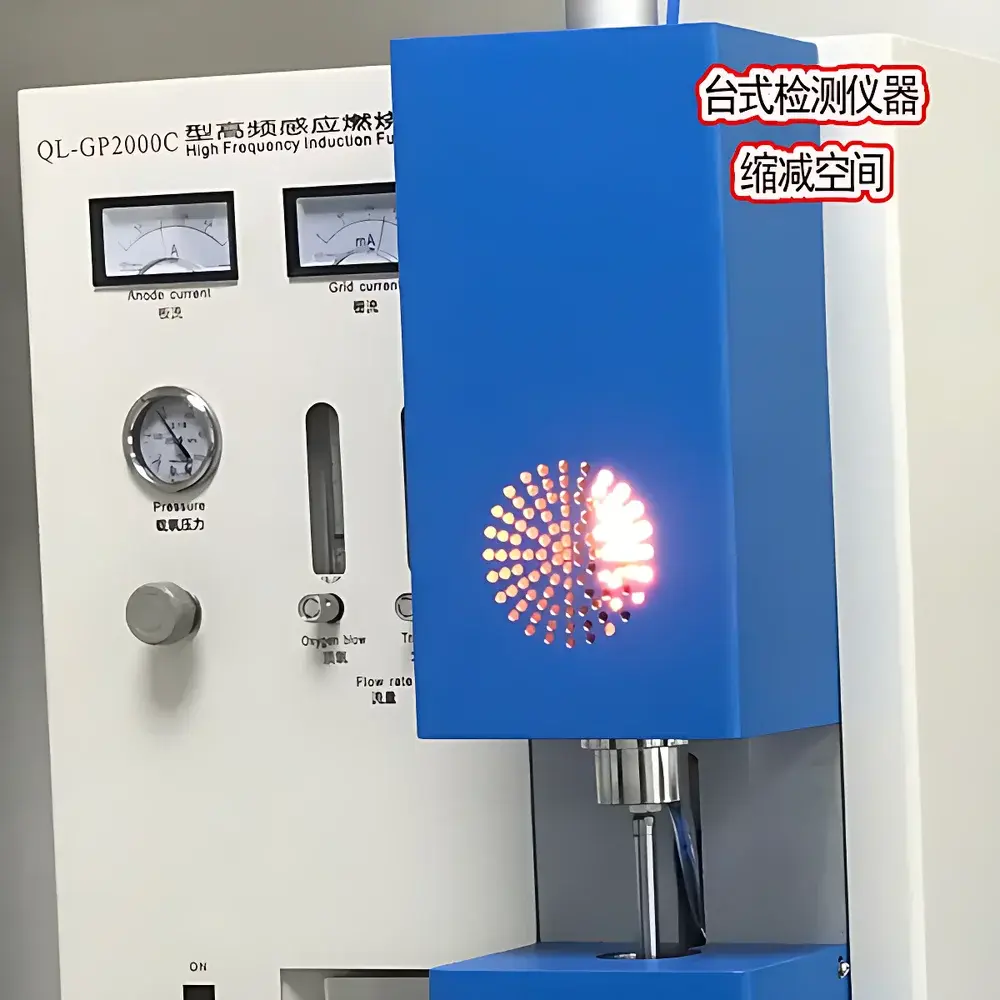
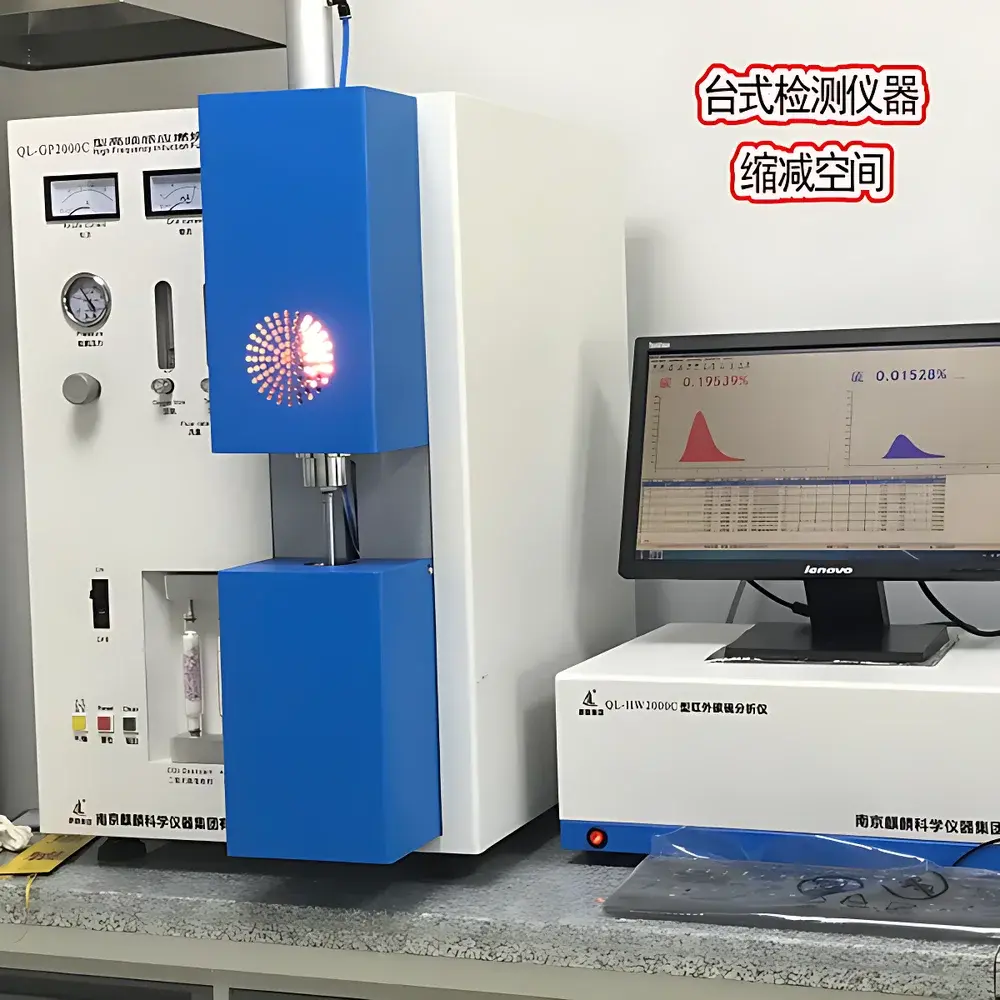
QL-Qilin HW2000C High-Frequency Infrared Carbon-Sulfur Analyzer
| Key | Brand: QL-Qilin |
|---|---|
| Origin | Jiangsu, China |
| Model | HW2000C |
| Measurement Principle | Non-Dispersive Infrared (NDIR) Absorption |
| Heating System | 2200 W / 20 MHz High-Frequency Induction Furnace |
| Carbon Range | 0.0001–25.0000 wt% (extendable to 99.999%) |
| Sulfur Range | 0.0001–15.0000 wt% (extendable to 99.999%) |
| Sensitivity | 0.1 ppm for both C and S |
| Precision | Compliant with GB/T 20123–2006 and ISO 15350:2000 |
| Analysis Time | Adjustable 20–100 s (typical 35 s) |
| Sample Mass | 0.5 g (standard steel reference) |
| Continuous Operation | 24/7 |
| Dust Filter | 0.4 µm sintered metal filter |
| Optical Path | Agilent 1521/2521 high-speed fiber-optic coupling with multi-stage EMI isolation |
| Detector | High-stability pyroelectric infrared detector |
| Cell | Gold-plated dual-cell NDIR absorption chamber |
| Light Source | Platinum-based IR emitter (800 °C stable operation) |
| Data Acquisition | 24-bit ADS1224 ADC, 20 Hz real-time sampling |
| Communication | USB 2.0 host–peripheral interface |
| Software Platform | Windows XP–compatible Delphi-based application with SQL-compatible database backend |
Overview
The QL-Qilin HW2000C High-Frequency Infrared Carbon-Sulfur Analyzer is a benchtop elemental combustion analyzer engineered for precise, rapid, and reproducible quantification of total carbon (C) and total sulfur (S) in solid metallic and inorganic matrices. It operates on the principle of non-dispersive infrared (NDIR) spectroscopy following high-temperature oxidative combustion in a controlled argon/oxygen atmosphere. The sample—typically 0.5 g of solid material—is flash-combusted at up to 2200 W in a 20 MHz high-frequency induction furnace, converting all carbon and sulfur into CO2 and SO2, respectively. These diatomic gases are swept through a dust-removal and drying system before entering dual-wavelength NDIR detection cells. The instrument measures absorbance at precisely defined spectral bands: 4.26 µm for CO2 and 7.4 µm for SO2, leveraging the intrinsic vibrational-rotational absorption characteristics of polar molecules under quantum-mechanically resolved transitions. Calibration is traceable to certified reference materials (CRMs), and analytical output is reported as mass percent (wt%) with full digital integration and linearized signal processing.
Key Features
- Modular dual-CPU architecture: Upper-level PC handles user interface and data management; lower-level Atmega162 microcontroller governs real-time furnace control, gas flow regulation, and detector synchronization.
- High-fidelity optical detection: Platinum-coated IR source operating at 800 °C ensures stable spectral output; gold-plated absorption cells minimize surface adsorption and cross-contamination; thermoelectric detectors deliver low-noise, high-dynamic-range signal acquisition.
- Robust combustion module: 2200 W high-frequency furnace with adjustable power/voltage/current modes enables optimized thermal treatment across heterogeneous samples—from low-carbon steels to refractory alloys and mineral concentrates.
- Integrated particulate management: 0.4 µm sintered metal dust filter, motor-driven automatic ash removal, and heated furnace head collectively suppress sulfur loss and improve recovery accuracy—particularly critical for sulfide-rich or volatile-sulfur matrices.
- EMI-hardened signal path: Agilent 1521/2521 fiber-optic link between furnace and detector eliminates electromagnetic interference from RF generation; multi-stage galvanic and optical isolation preserves measurement integrity in industrial laboratory environments.
- Regulatory-ready hardware design: Built-in leak detection, over-current/over-time alarms, and real-time pressure monitoring support GLP-compliant operation and facilitate audit readiness per ISO/IEC 17025 requirements.
Sample Compatibility & Compliance
The HW2000C is validated for routine analysis of ferrous and non-ferrous metallurgical samples—including carbon steels, stainless steels, cast irons, alloy steels, ferroalloys, rare-earth metals, and nickel-based superalloys—as well as inorganic materials such as cement clinker, limestone, coal, coke, iron ore, and slag. Its extended dynamic range (C: 0.0001–99.999 wt%; S: 0.0001–99.999 wt%) accommodates both ultra-trace impurity quantification and bulk composition verification. Analytical performance meets the precision and repeatability criteria specified in GB/T 20123–2006 (identical to ISO 15350:2000) for solid metallic materials. While not FDA 21 CFR Part 11–certified out-of-the-box, the software architecture supports audit trail logging, user role assignment, and electronic signature configuration—enabling customization for regulated QA/QC environments under GMP or ISO 9001 frameworks.
Software & Data Management
The analyzer runs on a Windows XP–based Delphi application featuring a modular, database-driven architecture. All analytical results—including raw absorbance traces, integrated peak areas, calibration coefficients, and operator metadata—are stored in an embedded Microsoft Access database. The software provides channel-specific configuration (unlimited C/S channel definition), dynamic real-time curve visualization (20 Hz sampling), and statistical post-processing tools including blank subtraction, curve fitting, outlier rejection, and confidence interval estimation. Multi-user access control allows administrators to assign granular permissions (e.g., method editing, result approval, database export). Data export supports CSV, Excel, and XML formats; customizable reporting templates accommodate both internal lab documentation and third-party LIMS integration. Diagnostic utilities include automated furnace head seal verification and infrared cell baseline stability assessment.
Applications
This instrument serves core quality control functions in foundries, steel mills, scrap recycling facilities, and geological survey laboratories. Typical use cases include: incoming raw material certification (e.g., ferromanganese, silicomanganese); finished product release testing (e.g., ASTM A29/A29M mechanical property correlation); process optimization in electric arc furnace (EAF) and basic oxygen furnace (BOF) operations; environmental compliance screening for sulfur content in coal and coke; and R&D-grade compositional mapping of experimental alloy systems. Its sub-ppm sensitivity and <35 s typical cycle time enable high-throughput batch analysis without compromising metrological rigor—making it suitable for both production-floor deployment and accredited reference labs.
FAQ
What standards does the HW2000C comply with?
It meets the precision, repeatability, and calibration requirements of GB/T 20123–2006 and ISO 15350:2000 for carbon and sulfur determination in solid metallic materials.
Can the instrument analyze non-metallic samples such as coal or cement?
Yes—its broad dynamic range and configurable combustion parameters support accurate analysis of coal, coke, limestone, cement, ores, and ceramics when paired with appropriate fluxes and calibration standards.
Is the software compatible with modern Windows OS versions?
The native application is compiled for Windows XP; however, virtualization or compatibility mode deployment on Windows 10/11 is routinely implemented by end users with verified functional equivalence.
How is system stability maintained during extended unattended operation?
The furnace incorporates automatic leak detection, thermal runaway protection, and continuous gas-flow monitoring; the detector subsystem features temperature-stabilized optics and auto-zero referencing to ensure 24/7 operational reliability.
What maintenance intervals are recommended for optimal performance?
Daily: ash removal and filter inspection; weekly: O-ring and combustion tube visual check; quarterly: detector alignment verification and furnace coil resistance calibration; annually: full optical path cleaning and CRM-based performance revalidation.



