
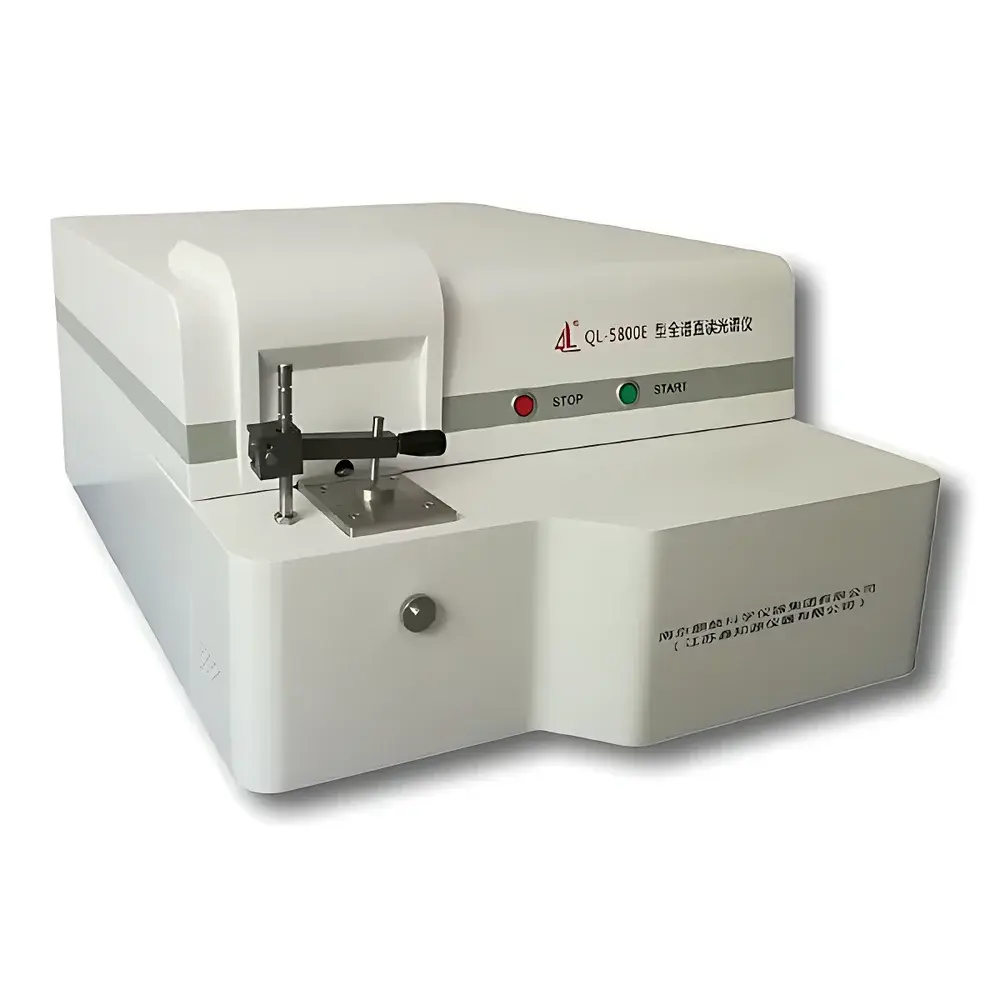
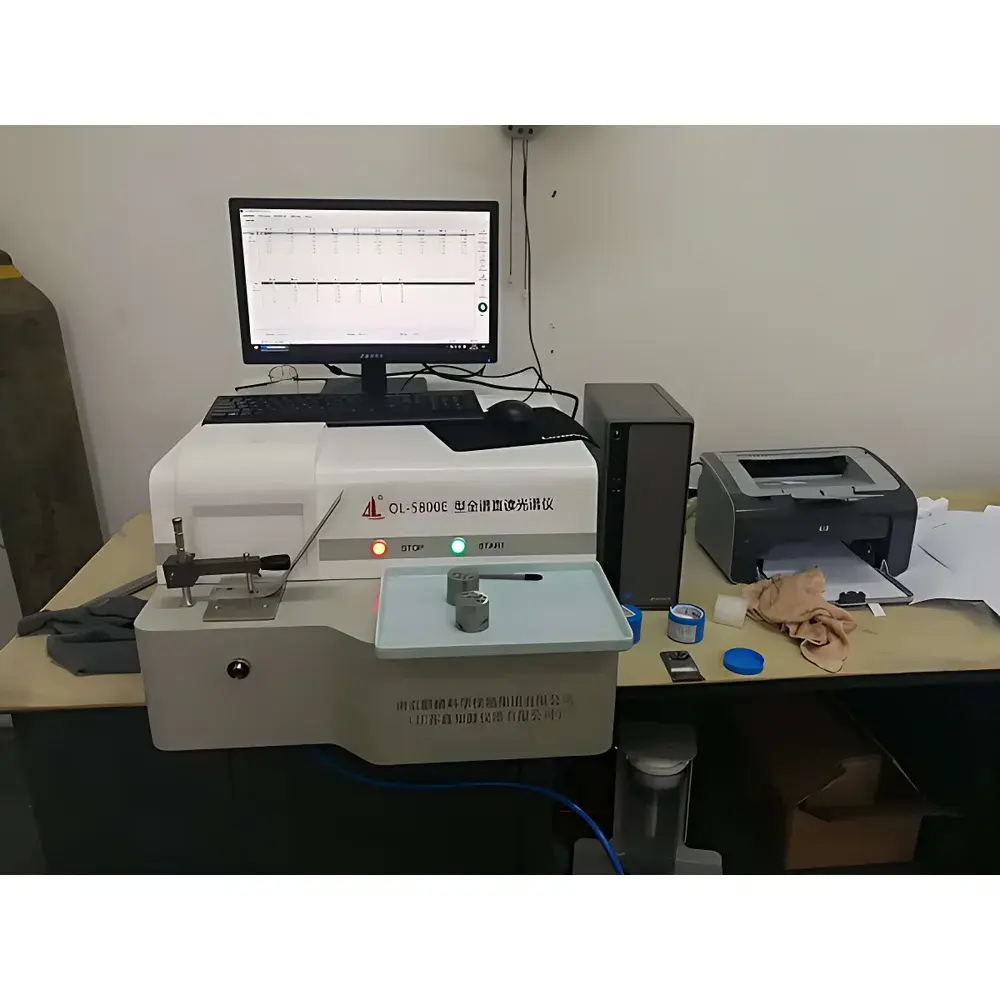
Qilin QL-5800E Benchtop Full-Spectrum Direct-Reading Spark Optical Emission Spectrometer
| Brand | Qilin / QL |
|---|---|
| Origin | Jiangsu, China |
| Manufacturer Type | Authorized Distributor |
| Country of Origin | China |
| Model | QL-5800E |
| Price | USD 23,500 (FOB Nanjing) |
| Instrument Type | Benchtop |
| Excitation Method | Spark Discharge |
| Detector Type | High-Performance CCD Array |
| Focal Length | 401 mm |
| Grating Groove Density | 2400 lines/mm |
| Wavelength Range | 140–680 nm |
| Number of Spectral Channels | 60 |
| Optical System | Paschen-Runge Mount with Vacuum-Enclosed Roland Circle |
| Light Source | Digital Plasma Spark Source with High-Energy Pre-Ignition (HEPS) |
| Discharge Frequency | 100–1000 Hz |
| Power Supply | AC 220 V, 50/60 Hz, 1000 W |
| Dimensions (W×D×H) | 780 × 565 × 360 mm |
| Weight | 78 kg |
| Typical Analysis Time | ~20 s per sample |
| Electrode Material | Tungsten Jet Electrode |
| Inter-Electrode Gap | 4 mm |
| Vacuum System | Multi-Stage Oil-Backstream Prevention with Differential Pressure Valve and In-Line Oil Trap |
Overview
The Qilin QL-5800E is a benchtop full-spectrum direct-reading optical emission spectrometer (OES) engineered for high-precision elemental analysis of solid metallic samples using spark discharge excitation. It employs a vacuum-enclosed Paschen-Runge optical layout with a 401 mm focal length Roland circle mount, enabling simultaneous detection across the full UV-VIS range (140–680 nm) without mechanical scanning. The instrument utilizes a high-resolution CCD array detector—replacing traditional photomultiplier tube (PMT) arrays—to deliver uniform sensitivity across all wavelengths, including deep-UV spectral lines critical for accurate quantification of non-metallic elements such as C, P, S, N, B, and As. Its digital plasma spark source incorporates High-Energy Pre-Ignition (HEPS) technology, ensuring stable energy delivery and reproducible ablation under argon atmosphere. Designed for routine quality control and R&D applications in metallurgical, foundry, aerospace, and recycling environments, the QL-5800E meets fundamental requirements for ISO/IEC 17025-compliant laboratories and supports traceability under GLP/GMP frameworks through audit-ready software logging.
Key Features
- Full-spectrum CCD detection with pixel-level spectral resolution, enabling flexible re-calibration and post-acquisition line selection without hardware modification.
- Auto-optical alignment system: real-time spectral line mapping and drift compensation via reference line identification; eliminates manual peak search and maintains long-term wavelength stability.
- Modular vacuum optics with plug-in lens assembly: allows safe cleaning or replacement of entrance windows and collimating lenses while the vacuum chamber remains operational.
- Multi-stage oil-backstream prevention: differential pressure isolation valve + inline oil trap ensures CMOS/CCD detector integrity and extends optical lifetime in continuous operation.
- Open-style spark stand with adjustable sample clamping mechanism: accommodates irregular geometries, rods down to Ø3 mm, and flat plates up to 300 mm diameter.
- Jet electrode design with argon sheath flow: tungsten electrode generates localized argon curtain during spark, minimizing air intrusion and oxide formation at the excitation point.
- Integrated gas management module: replaces solenoid valves and analog flowmeters with digital mass-flow control; includes automatic electrode purge cycle prior to each analysis.
- Digital spark source with programmable discharge parameters: adjustable pre-spark duration, integration time, and current profile optimized per matrix (Fe, Al, Cu, Ni, Mg, Ti, Zn, Pb, Sn, Ag).
- Real-time environmental monitoring: on-board sensors track vacuum level, optical chamber temperature (±0.1 °C), argon pressure, and source status—data logged with every spectrum.
Sample Compatibility & Compliance
The QL-5800E supports quantitative analysis across ten primary metallic base matrices: iron (Fe), aluminum (Al), copper (Cu), nickel (Ni), cobalt (Co), magnesium (Mg), titanium (Ti), zinc (Zn), lead (Pb), tin (Sn), and silver (Ag). Each matrix is supported by factory-predefined calibration curves traceable to certified reference materials (CRMs) compliant with ASTM E1086, ISO 11577, and GB/T 4336. The system operates under inert argon purge (≥99.998% purity) and maintains vacuum below 10 Pa in the optical chamber—critical for UV transmission and carbon/sulfur line integrity. All firmware and software modules comply with data integrity principles aligned with FDA 21 CFR Part 11 (electronic signatures, audit trail, user access control), and raw spectral data files are stored in vendor-neutral .SPE format for third-party validation.
Software & Data Management
The QL-5800E runs on Qilin SpectraLink™ v4.x—a Windows 10–compatible application with bilingual (English/Chinese) UI and role-based user permissions. It features embedded spectral deconvolution algorithms, inter-element interference correction (e.g., Fe 238.204 nm on C 247.856 nm), and automated matrix-matched calibration updates. All analytical sequences—including excitation parameters, integration windows, and background correction zones—are saved as reusable method templates. Raw intensity values, net intensities, and concentration results are exported in CSV, XML, or LIMS-compatible ASTM E1382 format. Ethernet TCP/IP communication enables remote diagnostics, firmware updates, and centralized instrument fleet monitoring via secure HTTPS interface—eliminating reliance on aging fiber-optic or RS-232 links.
Applications
The QL-5800E is deployed in incoming material inspection (IMI), melt process control, finished product certification, scrap sorting, and failure analysis workflows. Typical use cases include: verification of alloy grade conformity (e.g., SS304 vs. SS316), low-carbon steel carbon content verification (<0.02 wt%), sulfur segregation mapping in castings, phosphorus specification in aluminum die-cast alloys, and trace boron detection in nickel superalloys. Its speed (~20 s/sample), multi-matrix flexibility, and sub-ppm detection limits for key residuals (e.g., As < 5 ppm, Sn < 3 ppm in Cu) make it suitable for high-throughput foundry labs operating under ISO 9001 or IATF 16949 quality systems.
FAQ
Does the QL-5800E require daily vacuum pump maintenance?
No—the integrated oil-trap and differential pressure valve eliminate oil backstreaming; vacuum pump service intervals extend to 6–12 months under typical 8-hr/day operation.
Can the instrument analyze coated or painted metal samples?
Surface contaminants must be removed prior to analysis; spark ablation requires direct conductive contact with bulk metal. Optional milling accessories are available for surface preparation.
Is method transfer possible between different QL-5800E units?
Yes—calibration models, spectral libraries, and analysis methods are fully portable via encrypted USB export/import; cross-unit reproducibility is maintained within ±0.5% RSD for major elements.
What argon consumption rate does the jet electrode system achieve?
Average consumption is 12–15 L/min during analysis and 2–3 L/min in standby mode—approximately 30% lower than conventional spark stands with static argon flow.
How is compliance with ISO/IEC 17025 demonstrated?
The system provides full audit trail (user actions, parameter changes, calibration events), electronic signature capability, uncertainty estimation per element/matrix, and CRM traceability documentation upon request.






