
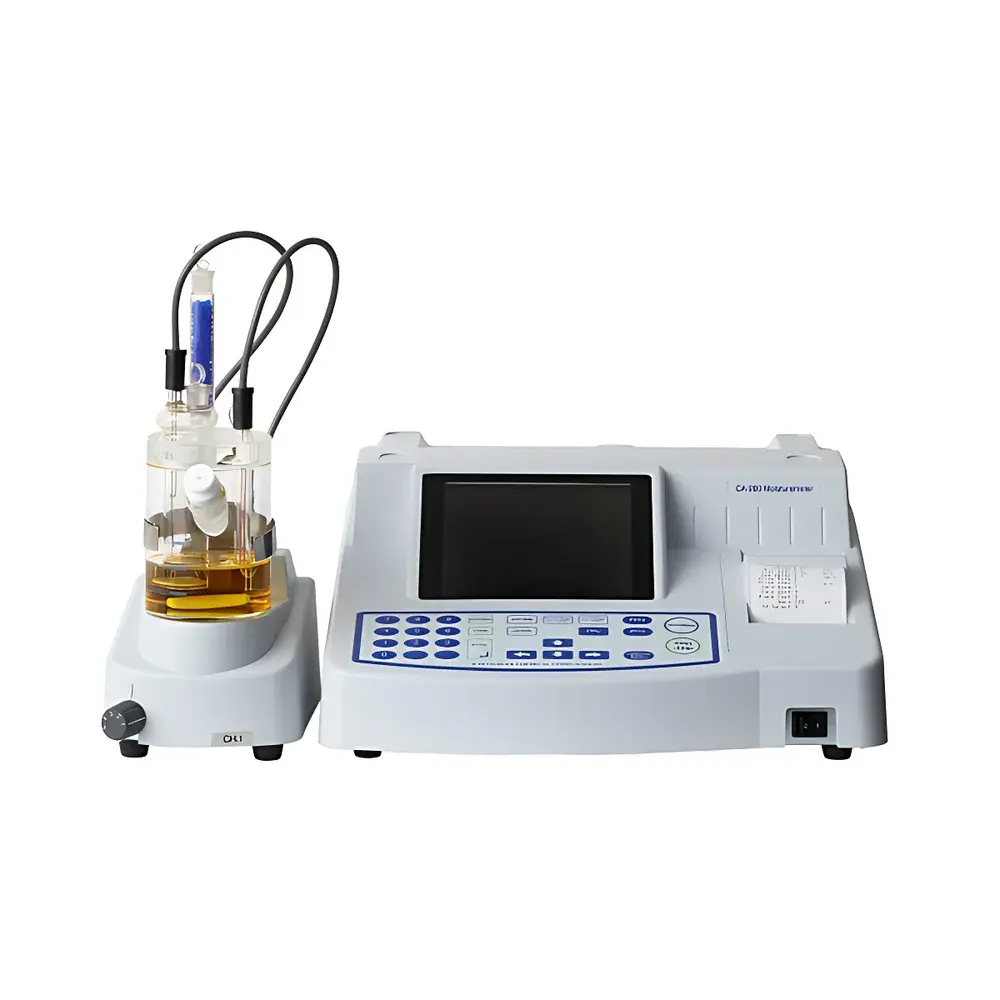
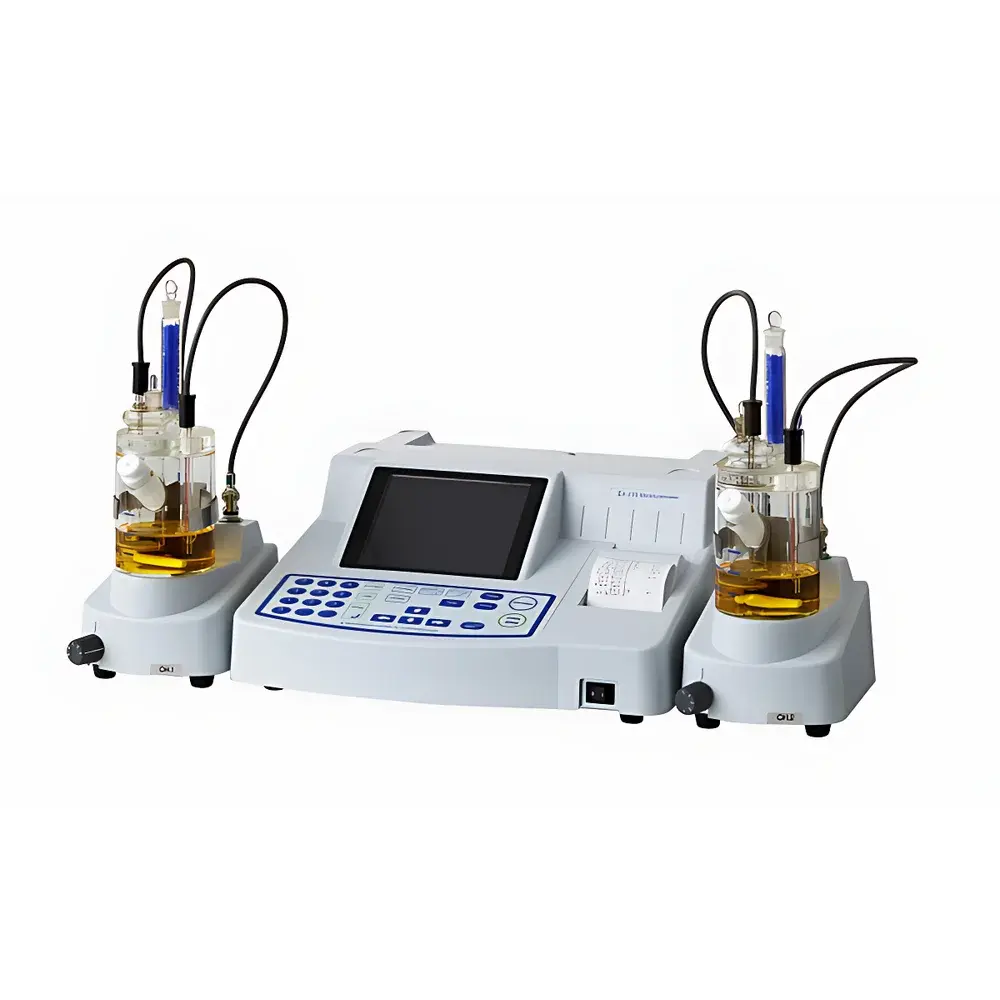
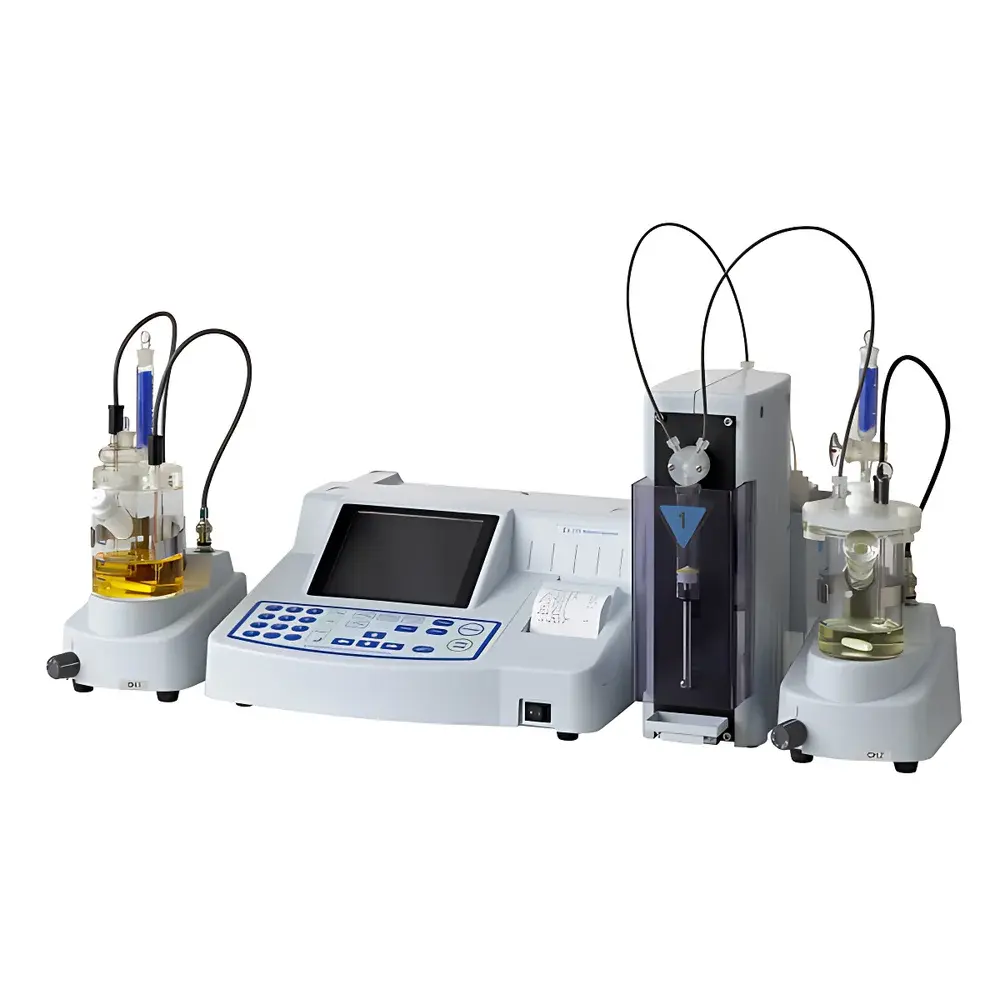
MITSUBISHI CHEMICAL CA-200 Coulometric Karl Fischer Moisture Analyzer for Insulating Oils
| Brand | MITSUBISHI CHEMICAL |
|---|---|
| Origin | Japan |
| Model | CA-200 |
| Measurement Principle | Coulometric Karl Fischer Titration |
| Method Type | Single-Channel |
| Measurement Range | 10 µg – 100 mg H₂O |
| Titration Speed | 2.2 mg H₂O/min (36 µg H₂O/sec) |
| Electrolysis Current | 430 mA |
| Precision | CV ≤ 0.3% for samples ≥ 1 mg H₂O (n = 10) |
| Data Storage | 20 individual files + 50 composite files |
| Display | 5.7-inch color LCD |
| Interfaces | RS-232C (optional), USB host (2 ports), internal balance input (auto-weighing), dedicated USB storage port |
| Power Supply | AC 100–120 V / 230–240 V, 50/60 Hz |
| Power Consumption | 80 VA (100–120 V), 310 VA (230–240 V) |
| Dimensions (Main Unit) | 220 × 350 × 360 mm (W×D×H) |
| Weight | ~5 kg |
| Stirrer Dimensions | 120 × 180 × 148 mm |
| Weight | ~1 kg |
| Compliance | GLP/GMP-supporting architecture, audit-ready data handling |
Overview
The MITSUBISHI CHEMICAL CA-200 Coulometric Karl Fischer Moisture Analyzer is a high-precision, single-channel instrument engineered specifically for trace moisture quantification in electrically insulating oils—including transformer oil, turbine oil, and other hydrocarbon-based dielectric fluids used in power generation and transmission infrastructure. Unlike volumetric KF titrators, the CA-200 employs coulometric titration, where iodine is generated electrochemically at the anode in real time, enabling sub-microgram-level detection sensitivity (down to 10 µg H₂O) and exceptional repeatability. Its design reflects over four decades of Mitsubishi Chemical’s expertise in electroanalytical instrumentation for regulated industrial environments. The system operates on the stoichiometric principle that one mole of iodine reacts with one mole of water—ensuring fundamental accuracy when paired with Mitsubishi’s certified anhydrous reagents and stabilized electrolyte solutions. This makes the CA-200 not only suitable for routine QC testing but also compliant with ASTM D6304, IEC 60814, and ISO 12937 standards governing moisture analysis in petroleum products.
Key Features
- Coulometric KF measurement with real-time iodine generation—eliminates reagent consumption variability and enhances long-term calibration stability.
- 5.7-inch full-color LCD interface with intuitive icon-driven navigation and built-in contextual help system for rapid operator onboarding.
- Dual USB host ports: one supports direct connection to USB printers for hard-copy reporting; the other accommodates mass-storage devices for secure export of raw data, method files, and audit logs.
- Automatic electrode conditioning function: periodic current reversal cleans the platinum working electrode surface during idle intervals, mitigating passivation and drift without manual intervention.
- Modular fluidic architecture: supports optional dual-cell configurations (e.g., parallel titration cells or integrated vaporizer modules) for extended method flexibility in multi-sample workflows.
- GLP/GMP-ready firmware: enforces user authentication, electronic signature capture, version-controlled method storage, and tamper-evident audit trails meeting FDA 21 CFR Part 11 requirements for regulated laboratories.
Sample Compatibility & Compliance
The CA-200 is validated for direct injection and headspace analysis of low-polarity, non-aqueous matrices including mineral-based and synthetic transformer oils (e.g., naphthenic, paraffinic, and silicone fluids), turbine lubricants, and hydraulic oils. Its coulometric cell design minimizes interference from acidic additives, oxidation byproducts, or dissolved gases commonly found in service-aged oils. The instrument complies with international standard test methods including ASTM D6304 (Standard Test Method for Determination of Water in Petroleum Distillates by Coulometric Karl Fischer Titration), IEC 60814 (Insulating liquids—Oil-impregnated paper and pressboard—Determination of water content—Coulometric method), and ISO 12937 (Petroleum products—Determination of water—Coulometric Karl Fischer titration method). All firmware and data handling protocols are architected to support ISO/IEC 17025-accredited laboratories requiring documented traceability and instrument qualification (IQ/OQ/PQ).
Software & Data Management
Data integrity is enforced through hierarchical user access control (administrator, analyst, viewer), encrypted local file storage, and timestamped event logging for all critical operations—including method edits, calibration updates, and result approvals. Up to 20 independent analytical methods and 50 composite method sets (e.g., multi-step sequences involving pre-treatment heating or solvent dilution) can be stored onboard. Results—including titration curves, endpoint detection parameters, and calculated water concentration (ppm or mg/kg)—are automatically saved with metadata (operator ID, sample ID, balance reading, ambient temperature/humidity if interfaced). USB export generates CSV- and PDF-formatted reports compatible with LIMS integration. Optional RS-232C connectivity enables bidirectional communication with laboratory information management systems for automated data ingestion and electronic batch record generation.
Applications
- Preventive maintenance monitoring of moisture ingress in power transformers and circuit breakers per IEEE C57.106 guidelines.
- Quality release testing of new insulating oils prior to commissioning, ensuring compliance with IEC 60296 specifications (max. 10 ppm for new oil).
- Root-cause analysis of dielectric failure events through retrospective moisture profiling across oil sampling points (top/bottom of tank, filter outlets).
- Stability assessment of oil preservation systems (e.g., nitrogen blankets, membrane dryers) via longitudinal moisture trend analysis.
- Validation of dehydration equipment performance (vacuum dehydrators, adsorption filters) by measuring inlet/outlet moisture differentials.
FAQ
What sample volume is required for accurate measurement?
Typical injection volumes range from 0.1 to 1.0 mL for liquid oils, depending on expected moisture concentration. For samples containing <50 ppm H₂O, larger volumes (up to 2 mL) may be used to improve signal-to-noise ratio.
Can the CA-200 analyze solid or semi-solid samples?
Not directly—the instrument is optimized for liquid-phase analysis. Solid samples (e.g., cellulose pressboard) require complementary headspace extraction using Mitsubishi’s optional HS-200 vaporizer module, followed by carrier-gas transfer into the coulometric cell.
Is method validation documentation available?
Yes—Mitsubishi Chemical provides IQ/OQ protocol templates, linearity verification data (10–100,000 µg H₂O), and precision studies per ICH Q2(R2) guidelines upon request for regulated users.
How often does the reagent need replacement?
Under typical usage (20–30 determinations/day), the anolyte solution remains stable for ≥6 months when stored under inert gas and protected from ambient humidity. The catholyte is replaced concurrently with every anolyte change.
Does the system support remote diagnostics or firmware updates?
Firmware updates are performed locally via USB drive. Remote diagnostic support is available through authorized service partners using secure VPN-assisted screen sharing—no cloud connectivity or external network exposure is implemented.







