
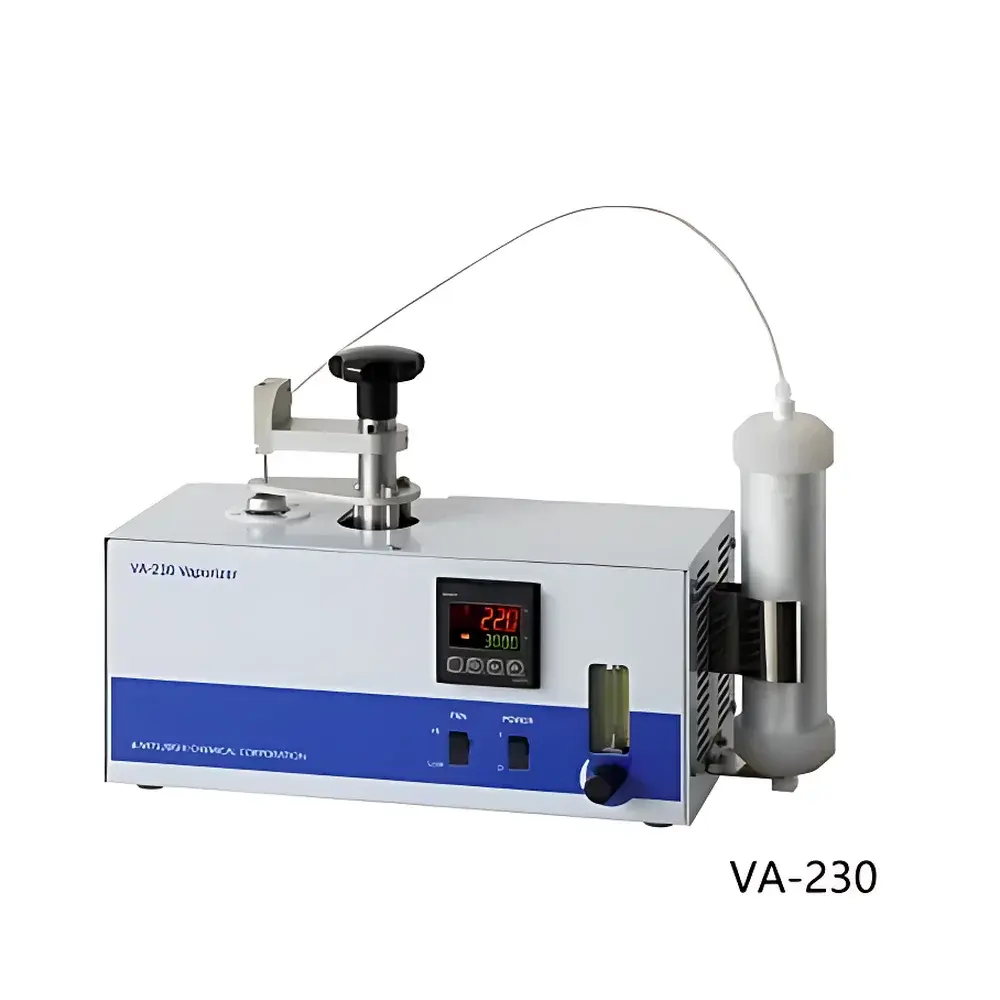
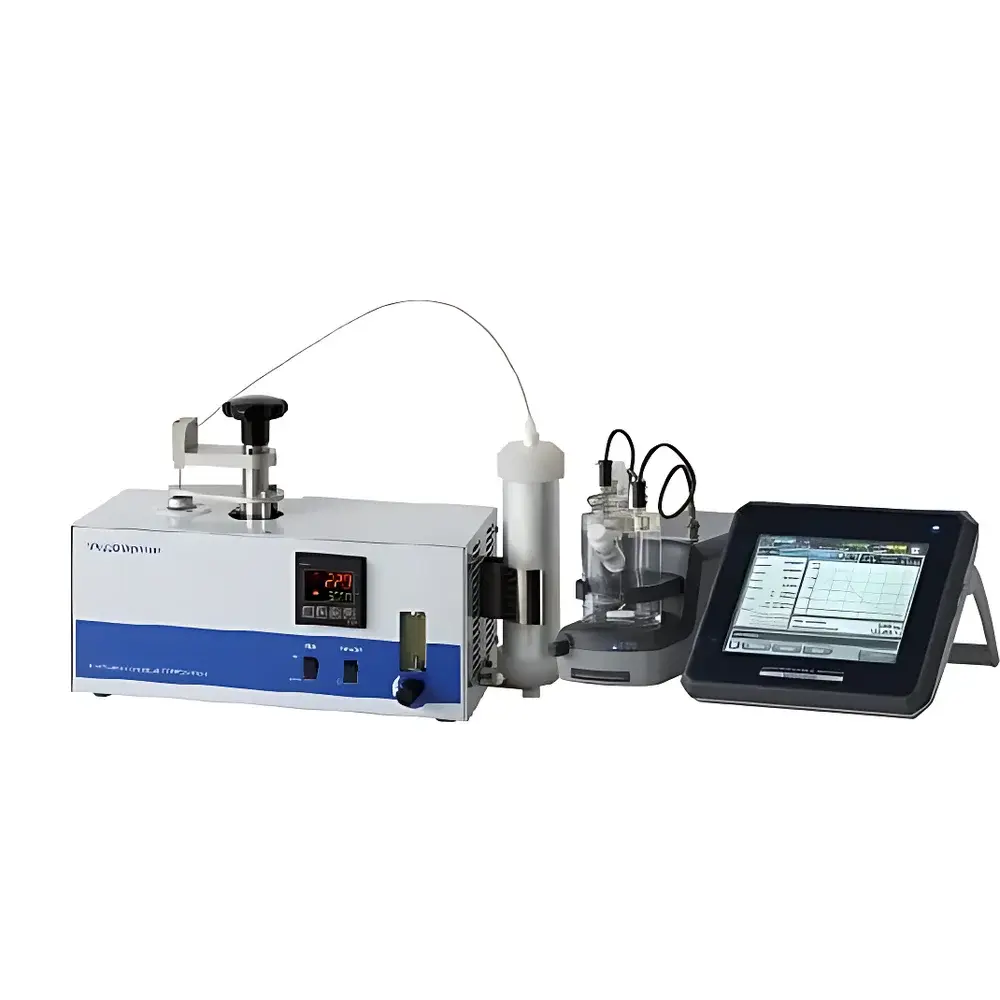
Mitsubishi Chemical VA-230 Vial-Type Solid Sample Moisture Evaporator
| Brand | Mitsubishi Chemical |
|---|---|
| Origin | Japan |
| Manufacturer Type | Authorized Distributor |
| Product Origin | Imported |
| Model | VA-230 |
| Titration Method | Fully Automatic Coulometric Karl Fischer Titration |
| Instrument Type | Coulometric Karl Fischer Moisture Analyzer |
| Measurement Resolution | ±0.1 µA |
| Water Content Range | 0.5 µg to 999.9999 mg |
| Accuracy | <0.3% RSD |
| Minimum Dispense Volume | 0 µL |
| Titration Control Precision | 0 (coulometric, current-controlled) |
Overview
The Mitsubishi Chemical VA-230 Vial-Type Solid Sample Moisture Evaporator is a precision-engineered auxiliary unit designed exclusively for coulometric Karl Fischer (KF) moisture determination of non-volatile, thermally stable solid and semi-solid materials. It operates on the principle of controlled thermal desorption: samples are sealed in disposable glass vials (standard 10 mL or 20 mL serum-type vials), heated uniformly via an aluminum block heater (70–300 °C), and the evolved water vapor is swept by high-purity nitrogen carrier gas into the KF titration cell—where quantitative electrochemical reaction with iodine occurs. This closed-system, inert-gas purged configuration eliminates atmospheric moisture interference and ensures stoichiometric transfer efficiency. The VA-230 is not a standalone analyzer but an integrated evaporation module, requiring coupling with a compatible coulometric KF titrator—most commonly the CA-310 series—to complete the measurement cycle. Its design adheres to ISO 8533:2014 (determination of water in plastics) and ASTM D6304 (standard test method for determination of water in petroleum products by coulometric Karl Fischer titration), supporting trace-level moisture quantification down to 30 ppm (w/w) in matrices where direct dissolution is impractical or chemically incompatible.
Key Features
- Modular vial-based sample introduction: Enables use of single-use, crimp-sealed glass vials—eliminating cross-contamination and simplifying cleaning protocols.
- Precise aluminum block heating system with ±1 °C temperature stability across the full 70–300 °C range; programmable ramp-and-hold profiles support method optimization for sensitive or high-melting-point materials.
- Integrated nitrogen carrier gas management: Front-panel flow control knob allows fine-tuning of purge gas velocity between 100–500 mL/min; compatible with standard lab-grade N₂ (≥99.99% purity, ≤120 kPa inlet pressure).
- Compact footprint (300 × 135 × 220 mm) and lightweight construction (3.5 kg) facilitate benchtop integration alongside CA-310 or equivalent coulometric titrators without spatial constraints.
- Optimized thermal transfer geometry ensures rapid, uniform heating of vial contents—critical for reproducible water release kinetics from heterogeneous solids such as battery separators, polymer pellets, or pharmaceutical excipients.
- No moving parts or consumable valves; maintenance requirements limited to periodic vial port cleaning and heater calibration verification per GLP-compliant laboratory schedules.
Sample Compatibility & Compliance
The VA-230 accommodates solid and semi-solid samples up to 10 g mass or 2.5 mL volume per vial—including hygroscopic powders (e.g., lithium cobalt oxide, sodium sulfate), thermoplastic granules (polyethylene, PET), coated films (LCD alignment layers), lyophilized biologics, and food-grade starches. It excludes volatile solvents, low-boiling organics (<100 °C), or samples prone to thermal decomposition below 70 °C. Regulatory alignment includes support for USP , EP 2.5.12, and JP 2.05 moisture testing protocols when paired with a 21 CFR Part 11–compliant KF titrator (e.g., CA-310 with audit trail firmware). All hardware components meet IEC 61010-1 safety standards for laboratory electrical equipment.
Software & Data Management
As a hardware-only evaporation module, the VA-230 has no embedded software or display interface. Full method control, data acquisition, and report generation are handled exclusively by the connected coulometric titrator—typically the CA-310’s dedicated KF analysis software. That software provides full traceability: user-defined methods (temperature ramp rate, hold time, gas flow), electronic signatures, automatic calculation of water content (µg, %, ppm), raw current-time curve export (CSV), and compliance-ready PDF reports with metadata (date/time, operator ID, instrument serial number, vial ID). Audit trails record all parameter changes and result modifications, satisfying GLP/GMP documentation requirements.
Applications
- Quality control of lithium-ion battery materials: moisture quantification in cathode/anode powders and microporous polyolefin separators—critical for preventing HF generation during cell formation.
- Pharmaceutical solid dosage forms: residual moisture assessment in freeze-dried APIs and tablet excipients per ICH Q5C guidelines.
- Polymer manufacturing: batch release testing of engineering resins (PA6, PBT) where hydrolysis sensitivity mandates sub-100 ppm specification limits.
- Electronics-grade chemicals: moisture verification in photoresist solvents and liquid crystal formulations prior to thin-film deposition.
- Food ingredient certification: validation of low-moisture status in dairy powders, maltodextrins, and functional food additives.
FAQ
Can the VA-230 be used with volumetric Karl Fischer titrators?
No. The VA-230 is engineered exclusively for coulometric systems (e.g., CA-310) due to its reliance on microcurrent measurement and stoichiometric iodine generation. Volumetric titrators lack the necessary current-sensing architecture.
Is calibration required before each analysis?
The VA-230 itself does not require calibration; however, the coupled CA-310 titrator must undergo daily verification using certified water standards (e.g., 1.00 mg H₂O/ampoule) per ISO/IEC 17025 internal quality procedures.
What vial types are compatible?
Standard crimp-top 10 mL or 20 mL glass serum vials with PTFE-lined septa (e.g., Agilent 5182-0837, Thermo Fisher 20109263); vial caps must ensure gas-tight sealing at operating temperatures up to 300 °C.
Does the VA-230 support automated sample changers?
No. It is a manual-load, single-vial system. High-throughput labs integrate it with third-party robotic arms or sequential vial loaders interfaced via digital I/O signals from the CA-310.
Can nitrogen be substituted with dry air or argon?
Nitrogen is mandatory. Dry air introduces oxygen, which accelerates iodine oxidation and causes drift; argon lacks the optimal thermal conductivity profile for consistent vapor transport and is not validated per ASTM D6304.




