
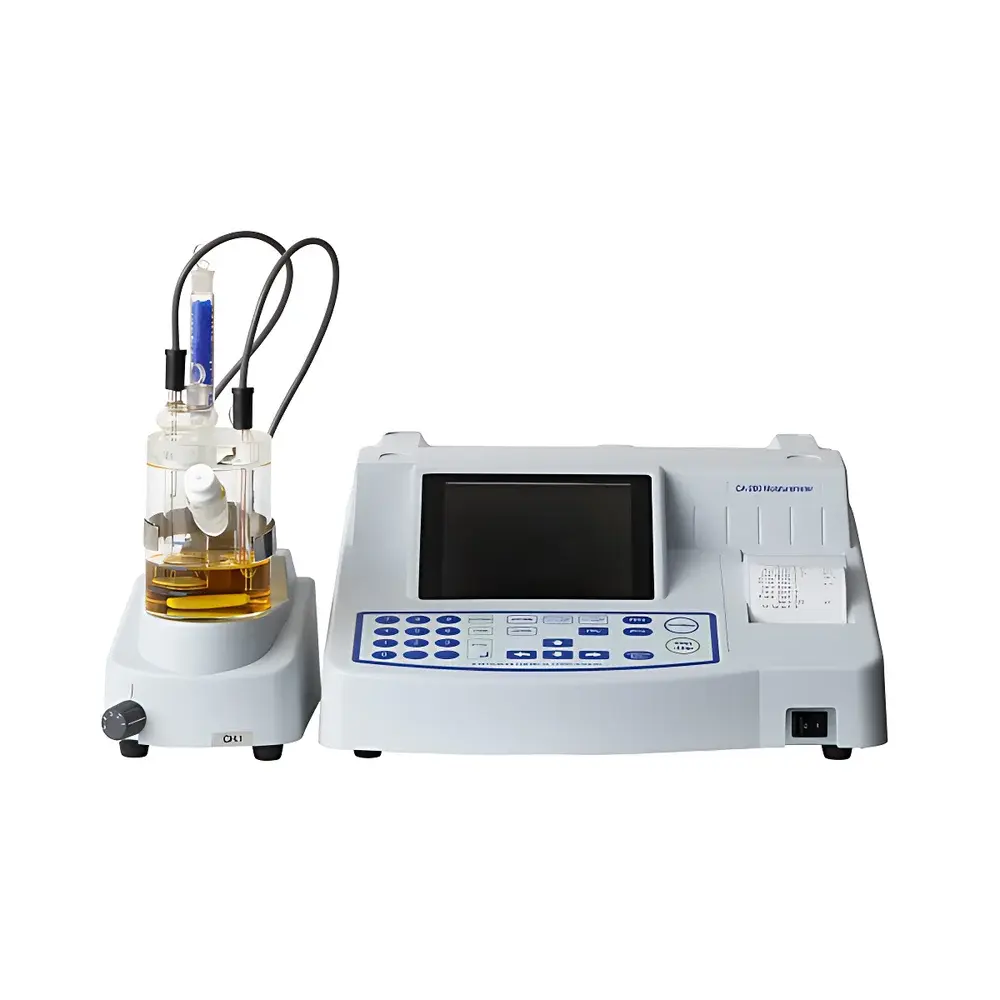
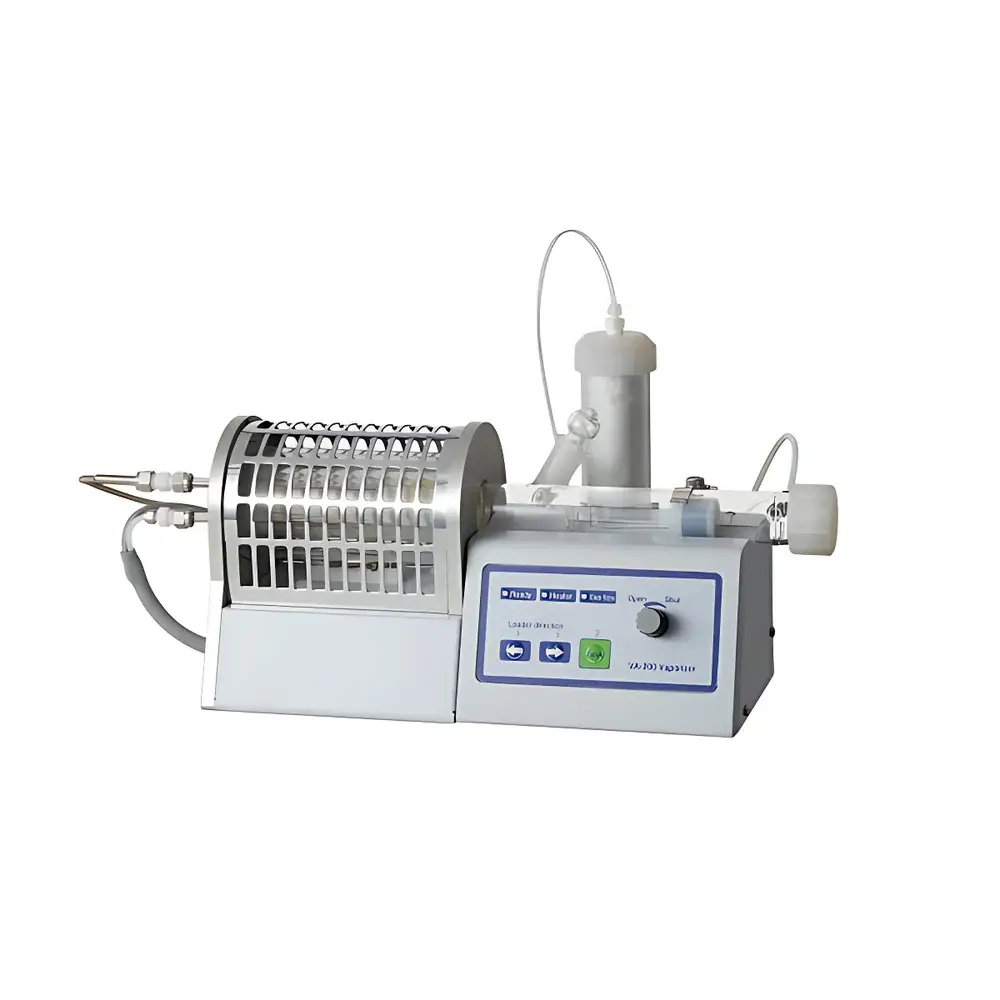
MITSUBISHI CHEMICAL CA-200 Coulometric Karl Fischer Moisture Analyzer for Lubricating Oils
| Brand | MITSUBISHI CHEMICAL |
|---|---|
| Origin | Japan |
| Instrument Type | Coulometric Karl Fischer Moisture Analyzer |
| Moisture Range | 10 µg – 100 mg H₂O |
| Accuracy | ≤0.3% RSD (≥1 mg H₂O, n=10) |
| Minimum Dispensing Volume | 1/2000 of burette volume |
| Electrolysis Current | 430 mA |
| Average Titration Speed | 2.2 mg H₂O/min |
| Display | 5.7-inch color LCD |
| Power Supply | AC 100–120 V / 230–240 V, 50/60 Hz |
| Dimensions (Analyzer) | 220 × 350 × 360 mm (W×D×H) |
| Weight | ~5 kg |
Overview
The MITSUBISHI CHEMICAL CA-200 is a high-precision coulometric Karl Fischer moisture analyzer engineered specifically for demanding applications in lubricant quality control and industrial fluid analysis. It operates on the electrochemical principle of coulometric Karl Fischer titration—where iodine is generated *in situ* via controlled electrolysis of iodide ions in the reagent, and stoichiometrically reacts with water according to the classic Karl Fischer reaction: I₂ + SO₂ + H₂O + 3RN + CH₃OH → 2RN·HI + RN·HSO₄CH₃. This method ensures absolute specificity for water, eliminating interference from solvents, organic acids, or volatile components commonly present in base oils, greases, and transformer fluids. Unlike volumetric systems, the CA-200 delivers superior resolution at trace levels (down to 10 µg H₂O), making it compliant with ASTM D6304, ISO 12937, and IP 386 for lubricant moisture determination. Its architecture integrates real-time electrode polarization compensation and automatic drift correction—critical for long-term stability during unattended operation in QC laboratories.
Key Features
- Dual-Channel Expandability: Supports simultaneous connection of two coulometric cells, dual vaporizers (e.g., VA-210), or dual reagent delivery modules—enabling parallel sample analysis without hardware duplication.
- Intelligent Electrode Management: Auto-compensates for electrode surface contamination via dynamic current profiling; eliminates manual cleaning cycles and reduces measurement downtime.
- Programmable Vaporization Interface: Fully compatible with the VA-210 oil-specific vaporizer—featuring transparent conductive glass heating (70–199 °C), precise nitrogen carrier gas flow control (0.1–0.5 L/min), and optimized thermal desorption for viscous samples including greases and bituminous fractions.
- GLP/GMP-Ready Architecture: Built-in audit trail logging (time-stamped method parameters, operator ID, reagent lot numbers), electronic signature support, and 200-result local storage with CSV export via USB.
- User-Configurable Calculation Engine: Open formula editor allows definition of custom moisture units (e.g., ppm, wt%, mg/kg) and multi-step calculations—including density-corrected reporting for bulk oil samples.
- Modular Electrode Options: Interchangeable membrane-free (for routine AQUAMICRON® single-solution systems) and membrane-type generator electrodes (for ketones, aldehydes, and low-hydroxyl matrices per USP ).
Sample Compatibility & Compliance
The CA-200, when paired with appropriate accessories (VA-210 vaporizer, solid sample oven, or gas diffusion module), accommodates heterogeneous matrices across ISO/IEC 17025-accredited testing environments. Validated for liquids (mineral oils, synthetic esters, hydraulic fluids), semi-solids (lithium-based greases, asphalt emulsions), and solids (clays, metal oxides, polymer pellets). Meets regulatory requirements for moisture quantification in pharmaceutical excipients (ICH Q5C), transformer oil maintenance (IEEE C57.106), and food-grade lubricants (NSF H1). All firmware and calibration protocols align with FDA 21 CFR Part 11 data integrity standards when used with optional RS-232C PC interface and validated software.
Software & Data Management
The embedded operating system provides full method lifecycle control: 20 user-defined method folders (each supporting 50 sub-protocols), password-protected parameter locking, and automatic drift compensation curves. Measurement data includes timestamped titration curves, endpoint detection logs, and raw coulombic charge integration values. Results export directly to USB flash drives in industry-standard .CSV format—compatible with LIMS integration and statistical process control (SPC) platforms. Optional PC software enables advanced reporting (ASTM-compliant certificate generation), remote diagnostics, and multi-instrument fleet monitoring.
Applications
- Quantification of water in turbine oils, gear oils, and compressor lubricants per ASTM D1744 and D6304
- Moisture screening of insulating oils prior to transformer commissioning (IEC 60814)
- Stability assessment of lithium complex greases during shelf-life studies
- QC release testing of API Group III/IV base stocks and additive packages
- Trace moisture verification in pharma-grade silicone oils (USP )
- Research-grade water content mapping in bio-lubricants and renewable ester formulations
FAQ
What sample types require the VA-210 vaporizer?
The VA-210 is mandatory for non-volatile or high-boiling-point matrices—including lubricating greases, spent catalysts, tar residues, and polymer melts—where direct injection would cause incomplete water release or cell contamination.
Can the CA-200 comply with 21 CFR Part 11?
Yes—when configured with audit-trail-enabled firmware, electronic signatures, and secure PC connectivity (RS-232C + validated software), it satisfies electronic record and signature requirements for regulated pharmaceutical and medical device manufacturing.
How does the membrane-free electrode simplify daily operation?
It eliminates membrane replacement, reduces reagent consumption by ~40%, and supports rapid solvent exchange using single-component AQUAMICRON® KF reagents—ideal for high-throughput lubricant labs.
Is calibration traceable to NIST standards?
Yes—MITSUBISHI CHEMICAL provides certified water standards (e.g., Hydranal® CertiPUR® ampoules) with NIST-traceable certificates; instrument calibration verification follows ISO/IEC 17025 clause 6.5.2.
What maintenance intervals are recommended for GLP compliance?
Daily: electrode rinse and drift check; Weekly: VA-210 glass heater inspection and nitrogen line purge; Quarterly: full cell reconditioning and electrolyte replacement per manufacturer’s SOP-CA200-MNT-01.





