
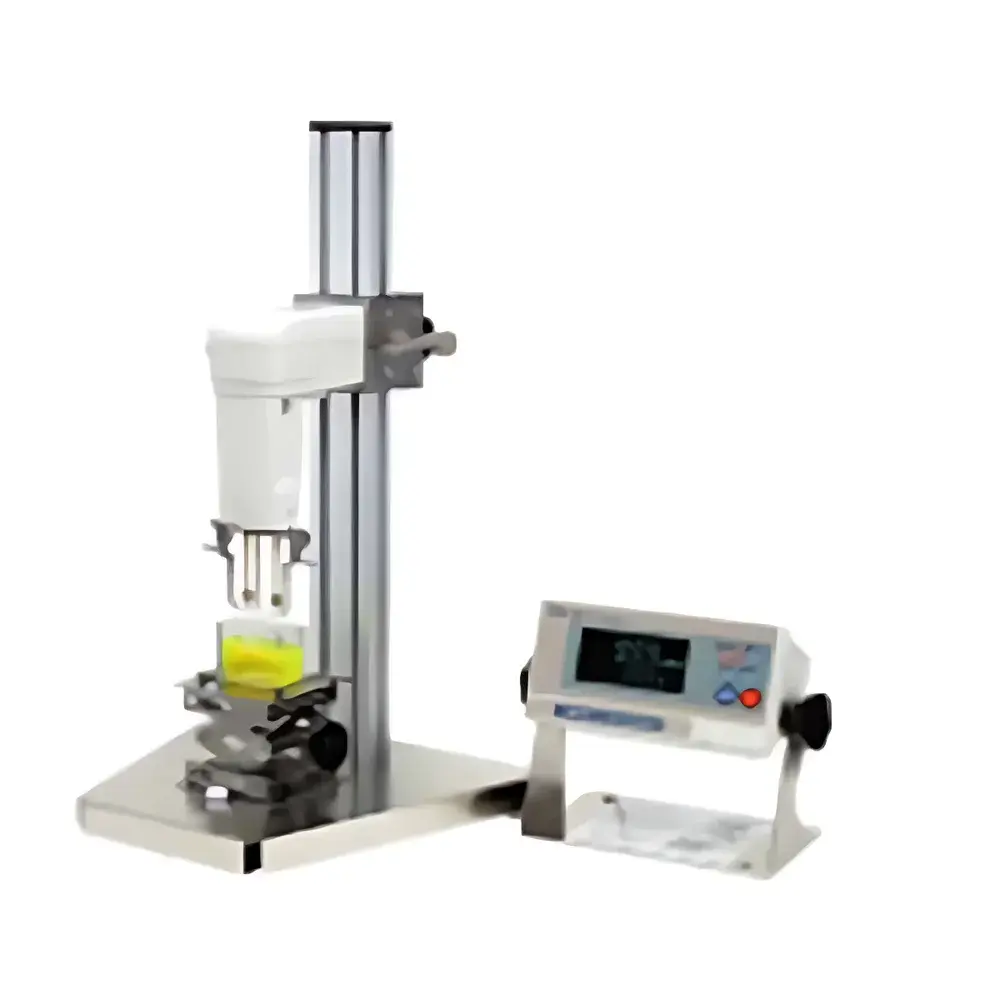
Anders SV-10 / SV-100 Oscillating Viscometer
| Origin | Japan |
|---|---|
| Manufacturer Type | Authorized Distributor |
| Origin Category | Imported |
| Model | SV-10 / SV-100 |
| Instrument Type | Oscillating Viscometer |
| Viscosity Range | 0.3–10,000 mPa·s (SV-10), 1,000–10,000 mPa·s (SV-100) |
| Repeatability | ±1% of reading (full scale, S.D., 20–30 °C, no condensation) |
| Sample Volume | ≥35 mL |
| Operating Frequency | 30 Hz sinusoidal fork oscillation |
| Display Units | mPa·s, Pa·s, cP, P (user-selectable) |
| Interface | RS-232C |
| Sensor Material | Stainless steel |
| Temperature Equilibration Time | <5 s |
Overview
The Anders SV-10 and SV-100 are precision oscillating viscometers engineered for laboratory and quality control environments requiring rapid, non-invasive viscosity measurement across a broad dynamic range. Unlike rotational or capillary methods, these instruments employ a resonant dual-prong tuning-fork sensor driven at a fixed 30 Hz sinusoidal frequency. Viscous damping of the oscillation amplitude is directly correlated to the fluid’s dynamic viscosity via calibrated mechanical impedance models—enabling real-time, continuous monitoring without shear history or sample disturbance. This principle ensures high fidelity for temperature-sensitive, volatile, foaming, or structurally fragile samples where conventional methods introduce artifacts. The SV series is particularly suited for in-process characterization of polymer solutions, pharmaceutical suspensions, food emulsions, and reactive systems undergoing gelation or phase transition.
Key Features
- Fixed-frequency (30 Hz) oscillating fork sensor with stainless-steel construction—chemically inert, corrosion-resistant, and easy to clean between measurements;
- High-resolution fluorescent display with user-selectable viscosity units (mPa·s, Pa·s, cP, P) and intuitive on-screen navigation;
- Exceptional repeatability of ±1% of reading (full scale, under controlled ambient conditions: 20–30 °C, no condensation);
- Minimal sample requirement: only ≥35 mL required—ideal for precious or limited-quantity formulations;
- Non-destructive measurement principle preserves sample integrity; compatible with volatile solvents, low-surface-tension liquids, and shear-thinning or thixotropic systems;
- Low-frequency excitation minimizes foam rupture—enables reliable viscosity assessment of aerated products such as whipped creams, shampoos, and foamed polymers;
- Integrated temperature sensor with minimal thermal mass achieves thermal equilibrium in under 5 seconds, supporting accurate viscosity–temperature profiling;
- Single-point or two-point calibration routine accessible via front-panel interface—traceable to standard reference oils (e.g., NIST-traceable silicone oils);
- RS-232C serial interface for direct connection to PCs or thermal printers—supports time-stamped data export and basic automation scripting.
Sample Compatibility & Compliance
The SV viscometers accommodate Newtonian and non-Newtonian fluids—including pseudoplastic, dilatant, and weakly structured systems—without requiring sensor replacement or geometry adjustment. Their passive, low-energy sensing mechanism avoids shear-induced structural breakdown, making them suitable for regulatory-compliant QC workflows. While not certified to ISO/IEC 17025 out-of-the-box, the instruments support GLP/GMP-aligned documentation practices when paired with validated software protocols. Calibration procedures align with ASTM D2196 (Standard Test Methods for Rheological Properties of Non-Newtonian Materials) and ISO 2555 (Plastics — Resins in the Liquid State or as Emulsions or Dispersions — Determination of Apparent Viscosity). Temperature reporting meets requirements for USP (Rheology) and FDA 21 CFR Part 11 when integrated into validated data acquisition systems.
Software & Data Management
Though the base unit operates standalone, the RS-232C port enables integration with third-party data logging platforms (e.g., LabVIEW, MATLAB, or custom Python-based acquisition tools). Raw output includes timestamped viscosity (mPa·s), temperature (°C), and instrument status flags. No proprietary software is bundled; however, ASCII-formatted serial output allows straightforward parsing for LIMS ingestion or statistical process control (SPC) charting. Audit trails—when implemented externally—can satisfy 21 CFR Part 11 requirements for electronic records and signatures, provided system validation is performed per organizational SOPs.
Applications
- Real-time monitoring of solvent evaporation kinetics during coating formulation;
- Viscosity profiling of thermosetting resins during cure cycles (e.g., epoxy, polyurethane);
- Batch release testing of topical gels, ointments, and oral suspensions per pharmacopeial standards;
- Quality assurance of dairy-based beverages, plant-based milks, and sauces exhibiting yield stress behavior;
- In-line compatibility screening for cleaning-in-place (CIP) rinse solutions and bioreactor harvest streams;
- Research into colloidal stability, micelle formation, and polymer entanglement dynamics under quiescent conditions.
FAQ
What is the fundamental measurement principle of the Anders SV viscometer?
It uses forced sinusoidal oscillation of a stainless-steel tuning fork at 30 Hz; viscosity is derived from the amplitude damping of the resonant motion.
Can the SV-10 measure samples below 0.3 mPa·s?
No—the lower detection limit is 0.3 mPa·s due to signal-to-noise constraints inherent to the oscillation method.
Is sensor calibration traceable to national standards?
Yes—calibration can be performed using NIST-traceable reference oils; certificate of calibration may be issued by authorized service centers.
Does the instrument require periodic maintenance beyond cleaning?
No moving parts or consumables are present; routine verification with reference fluids every 3–6 months is recommended for critical applications.
How does the SV handle temperature gradients during measurement?
The compact, low-mass temperature sensor achieves thermal equilibrium with the sample in under 5 seconds, minimizing drift and enabling accurate Δη/ΔT analysis.



