
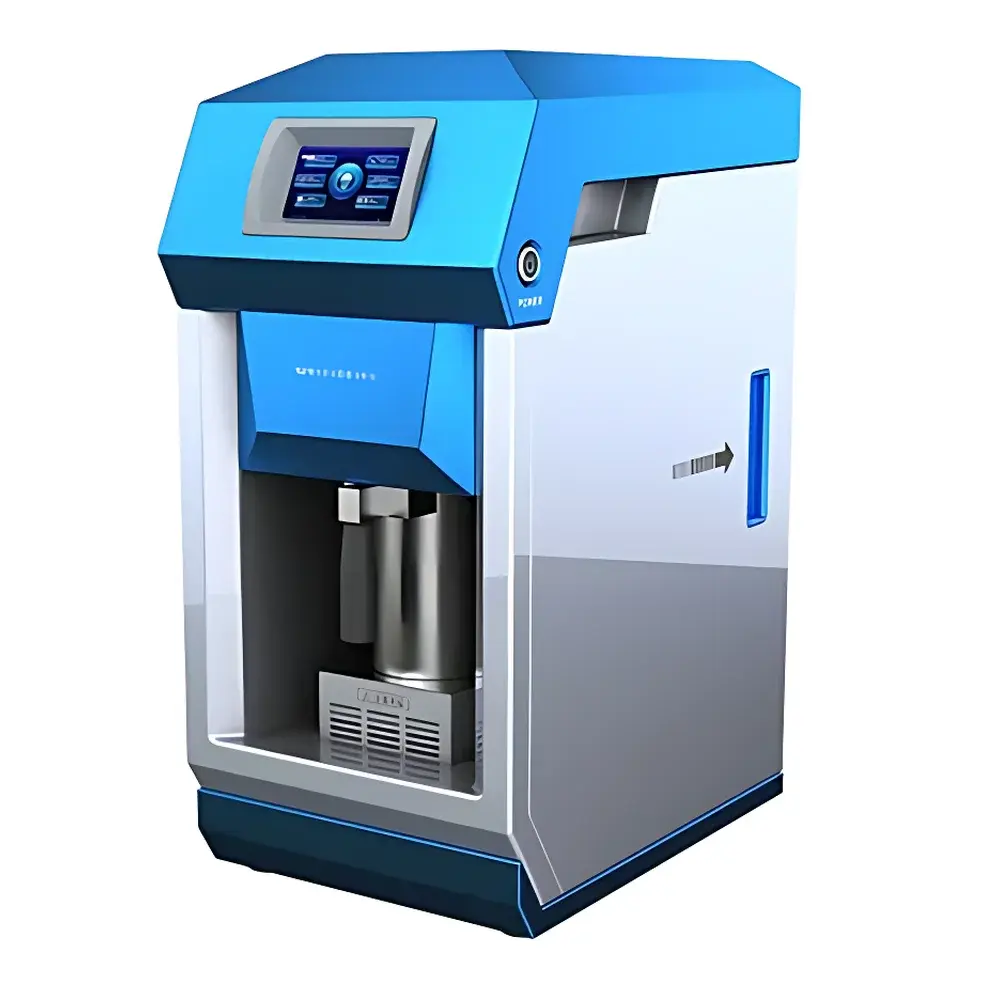
Sonnen G350 Automated Filter-Bag Fat Analyzer
| Brand | Sonnen |
|---|---|
| Origin | Shanghai, China |
| Model | G350 |
| Extraction Chamber Volume | 600 mL |
| Receiving Flask Volume | 500 mL |
| Temperature Range | Ambient to 105 °C |
| Temperature Control Accuracy | ±1 °C |
| Batch Capacity | 15 samples per run |
| Filter Bag Pore Size | 3 µm |
| Sample Mass Range | 0.1–5 g |
| Fat Determination Range | 0.1–100% |
| Solvent Recovery Rate | ≥90% |
| Repeatability | ±0.2% |
| Extraction Time (per batch, excluding heating) | 90 min |
| Solvent | Petroleum Ether (BP 30–60 °C) |
| Power Supply | AC 220 V, 50 Hz |
| Rated Power | 500 W |
| Net Weight | 30 kg |
Overview
The Sonnen G350 Automated Filter-Bag Fat Analyzer is an ISO-compliant, fully automated solvent extraction system engineered for precise and reproducible determination of total fat and lipid content in solid and semi-solid matrices. It operates on the principle of continuous-flow Soxhlet-style extraction using disposable 3-µm pore polypropylene filter bags—offering a closed, leak-free, and operator-independent alternative to traditional glassware-based methods. Unlike conventional reflux or manual Soxhlet systems, the G350 integrates programmable solvent dosing, timed immersion, dynamic percolation, integrated solvent recovery, and controlled pre-drying into a single unattended workflow. Its design conforms to core regulatory frameworks governing food, feed, environmental, and agricultural testing—including ISO 3947, AOAC Official Methods®, and multiple GB/T standards (e.g., GB/T 5009.6, GB/T 6433). The instrument is intended for routine QC/QA laboratories requiring high-throughput, traceable, and auditable fat analysis under GLP and GMP-aligned operational conditions.
Key Features
- Filter-bag extraction platform with 3-µm pore-rated, three-dimensional structured polypropylene bags—ensuring high retention efficiency, minimal sample loss, and compatibility with both polar and non-polar solvents.
- 15-position automated batch processing with motorized cup-lifting mechanism and precision auto-alignment; all extraction steps—including solvent addition, soaking, percolation, distillate collection, and pre-drying—executed without manual intervention.
- Integrated solvent recirculation loop achieving ≥90% recovery of petroleum ether (BP 30–60 °C), reducing hazardous waste volume and lowering operational costs in compliance with EPA and ISO 14001 principles.
- Intelligent thermal management: PID-controlled heating from ambient to 105 °C (±1 °C accuracy), coupled with built-in stainless-steel condenser and real-time cooling water temperature monitoring for stable reflux conditions.
- Capacitive color touchscreen interface with 250 user-configurable method templates—enabling rapid method recall for diverse matrices including cereals, animal feed, soil, sludge, leather, plastics, and paper products.
- Aluminum alloy extraction cup assembly—lightweight, corrosion-resistant, and thermally stable—designed for repeated thermal cycling and long-term mechanical integrity.
- Comprehensive safety architecture: sealed extraction chamber, automatic solvent-level sensing, overtemperature cutoff, and interlocked door monitoring per IEC 61010-1.
Sample Compatibility & Compliance
The G350 accommodates heterogeneous solid samples ranging from 0.1 to 5 g, including ground foodstuffs (e.g., nuts, dairy powders), pelleted feed, milled grains, dried biomass, sediment, and industrial materials such as leather shavings or polymer granules. Its filter-bag geometry eliminates channeling and ensures uniform solvent penetration—critical for accurate quantification of bound lipids and semi-volatile organics (e.g., plasticizers, pesticides, herbicides). Method validation data support compliance with GB/T 5009.6-2003, GB/T 6433-2006, ISO 3947:1994, and SN/T 0800.2-1999. The system supports 21 CFR Part 11–ready software upgrades (via optional audit trail module), and its manufacturing quality system is certified to ISO 9001:2015. All hardware components meet RoHS Directive 2011/65/EU requirements for restricted substances.
Software & Data Management
The embedded firmware enables full method parameterization—including soak time, extraction duration, rinse cycles, drying temperature, and solvent volume—with timestamped execution logs stored internally for ≥10,000 runs. Optional PC-based software (SonnenLab Suite v3.2) provides CSV export, LIMS integration via ASTM E1384-compliant ASCII output, electronic signature support, and FDA 21 CFR Part 11–compliant audit trails (user login history, parameter change logs, result modification records). Calibration verification routines include reference standard checks (e.g., certified triglyceride standards) and system suitability tests per AOAC 991.36 guidelines.
Applications
- Routine fat quantification in food safety and nutritional labeling labs (e.g., compliance with EU Regulation No. 1169/2011).
- Feed formulation and quality control in aquaculture and livestock production facilities.
- Environmental analysis of total petroleum hydrocarbons (TPH) and extractable organic matter in soils and wastewater sludges (EPA Method 3541 equivalents).
- Preparative extraction for GC-FID, GC-MS, or HPLC analysis—serving as a standardized sample preparation step prior to chromatographic separation.
- Regulatory testing of migration limits in packaging materials (e.g., plasticizers from PVC films into food simulants).
- Research applications in lipidomics, biofuel feedstock screening, and botanical oil yield optimization.
FAQ
What solvent types are compatible with the G350?
Petroleum ether (boiling point range 30–60 °C) is the primary recommended solvent. Chloroform, diethyl ether, and hexane may be used with appropriate method validation and safety review.
Does the system require external cooling water?
No—the G350 includes an integrated stainless-steel condenser with internal recirculating coolant; only ambient air ventilation is required.
Can the G350 be validated for ISO/IEC 17025 accreditation?
Yes—its documented performance specifications (repeatability ±0.2%, temperature stability ±1 °C), traceable calibration procedures, and full audit logging support formal method validation per ISO/IEC 17025:2017 Clause 7.2.
How is solvent recovery verified during operation?
Recovery rate is calculated automatically by comparing dispensed volume to condensed return volume using calibrated flow sensors and gravimetric endpoint detection.
Is remote monitoring supported?
Via optional Ethernet module and SonnenLab Suite, users can monitor real-time status, receive email alerts for cycle completion or fault conditions, and access historical run data through secure HTTPS interface.



