
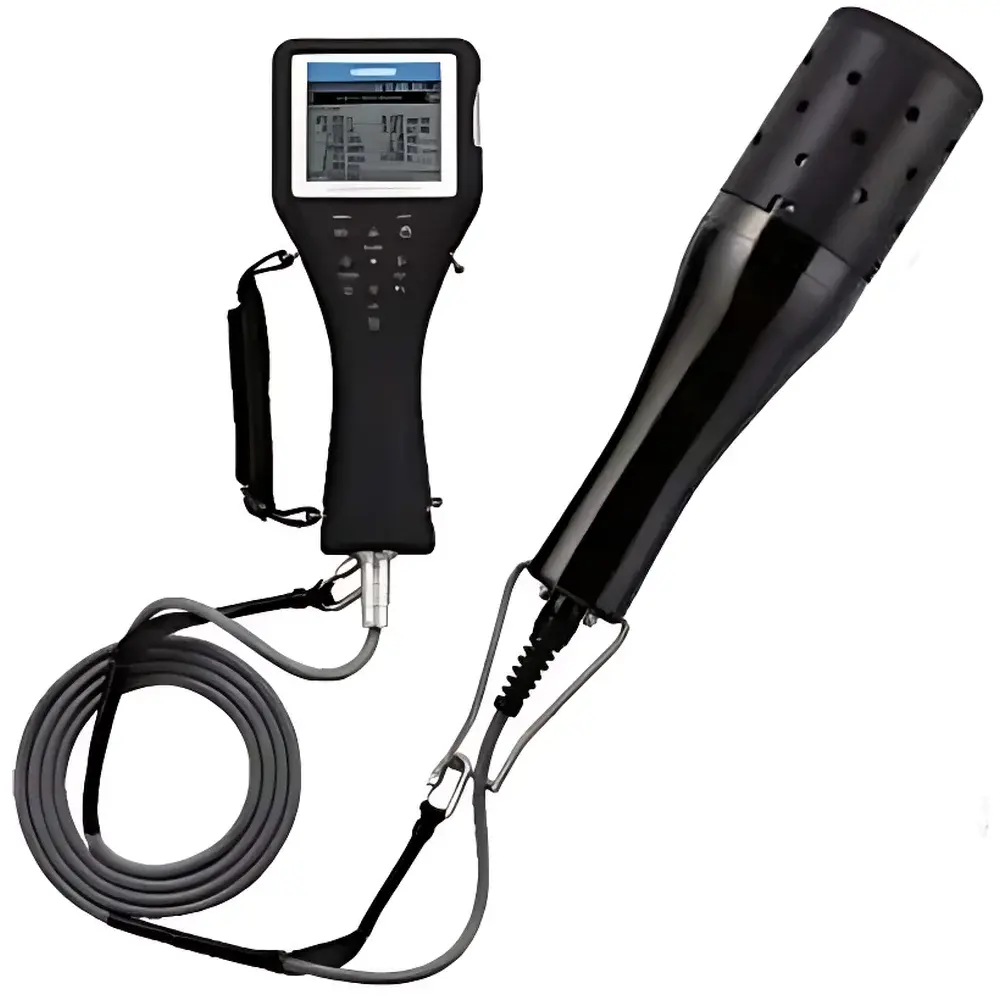
HORIBA U-50 Series Portable Multiparameter Water Quality Analyzer
| Brand | HORIBA |
|---|---|
| Origin | Japan |
| Model | U-50 Portable Series |
| Instrument Type | Portable / Handheld Water Quality Analyzer |
| Measured Parameters | pH, ORP, Conductivity, Dissolved Oxygen, Temperature, Salinity, TDS, Specific Gravity (Seawater), Turbidity (LED or Tungsten Lamp), Depth (pressure-based, up to 30 m) |
| Turbidity Standards | U-53 complies with US EPA Method 180.1 |
| Turbidity Resolution | 0.01 NTU (U-53/U-54 variants) |
| Operating Temperature Range | −10 °C to +55 °C |
| IP Rating | IP68 (electrode), IP67 (host unit with cable connected) |
| Battery Life | Up to 70 hours (alkaline AA × 4, backlight off) |
| Data Storage | 10,000 measurement sets |
| Communication | USB |
| Display | 320 × 240 monochrome LCD with backlight |
| Weight | ~1.76 lbs (host), ~3.97 lbs (electrode assembly) |
| Electrode Cable Length | Standard 2 m (optional 10 m or 30 m) |
Overview
The HORIBA U-50 Series is a rugged, field-deployable multiparameter water quality analyzer engineered for high-reliability environmental monitoring in diverse aquatic environments—including rivers, lakes, groundwater wells, estuaries, wastewater treatment plants, and coastal zones. Based on proven electrochemical and optical sensing principles, the U-50 platform integrates seven core sensor modalities—glass electrode (pH), platinum redox electrode (ORP), Clark-type polarographic dissolved oxygen (DO) sensor, four-electrode AC conductivity cell, precision Pt1000 temperature sensor, dual-wavelength turbidity detectors (LED or tungsten lamp), and piezoresistive pressure transducer (for depth)—all housed within a single, corrosion-resistant probe assembly. Its modular design allows configuration-specific variants (U-51 through U-54G) to support application-driven requirements—from basic freshwater assessment (U-51) to EPA-compliant turbidity monitoring (U-53) or ISO 7027–certified marine measurements (U-54). All models feature automatic temperature compensation (ATC), auto-ranging conductivity, salinity-derived DO correction (0–70 ppt), and real-time calculation of derived parameters including TDS (user-adjustable conversion factor), seawater specific gravity (δt), and corrected conductivity at 25 °C.
Key Features
- Ruggedized IP68-rated probe housing constructed from PPS, PEEK, SUS316L stainless steel, titanium, FKM elastomers, and FEP membrane—engineered for long-term immersion in aggressive media including brackish water, wastewater, and sediment-laden streams.
- Dual-standard turbidity detection: U-53 models implement LED-based forward-scatter (30°) per US EPA Method 180.1; U-54 models employ tungsten-lamp 90° scatter compliant with EN ISO 7027, both delivering 0.01 NTU resolution and integrated self-cleaning brush mechanisms to mitigate biofouling.
- Enhanced polarographic DO sensor with accelerated response time (<60 s to 90% step change) and simplified membrane/electrolyte maintenance—reducing field calibration frequency and operational downtime.
- Multi-language interface supporting English, Japanese, Russian, Spanish, and Portuguese—enabling seamless deployment across multinational environmental agencies and contract laboratories.
- Integrated GPS receiver (12-channel) available on G-series models (U-52G, U-53G, U-54G) for georeferenced data logging, essential for regulatory reporting, spatial trend analysis, and GIS-integrated watershed management.
- Onboard 10,000-point memory with USB export capability, supporting traceable data acquisition under GLP/GMP-aligned workflows; timestamped records include raw sensor outputs, calculated parameters, and environmental metadata (GPS coordinates, depth, ambient temperature).
Sample Compatibility & Compliance
The U-50 Series is validated for use across natural and anthropogenic aqueous matrices—including freshwater, seawater, brackish groundwater, treated effluent, and stormwater runoff. Probe materials meet ASTM D1129 (standard terminology for water) and ISO 5667-3 (water sampling—preservation and handling) requirements for chemical inertness and leach resistance. Turbidity modules satisfy regulatory validation criteria: U-53 complies with US EPA Method 180.1 for drinking water and surface water monitoring; U-54 conforms to EN ISO 7027 for standardized optical measurement in marine and industrial applications. Conductivity and pH modules are suitable for compliance with ISO 7888 (electrical conductivity), ISO 10523 (pH determination), and ASTM D1293 (pH of water). The system supports audit-ready documentation—calibration logs, sensor diagnostics, and user-defined QA/QC flags—aligning with EPA 40 CFR Part 136 and EU WFD (Water Framework Directive) reporting frameworks.
Software & Data Management
Data acquisition and post-processing are managed via HORIBA’s proprietary U-50 PC software (Windows-compatible), which enables batch download, spectral visualization of temporal profiles, statistical summary generation (mean, SD, min/max), and export to CSV, Excel, or PDF formats. The software enforces electronic signature-capable calibration verification, stores full sensor diagnostic histories (including membrane integrity checks and zero-current drift logs), and maintains immutable audit trails meeting FDA 21 CFR Part 11 requirements for electronic records and signatures. Field units support direct USB connection without drivers; no cloud dependency ensures data sovereignty and secure offline operation in remote or classified environments.
Applications
- Regulatory surface water surveillance programs mandated by national environmental agencies (e.g., US EPA, Environment Canada, JEA).
- Wastewater treatment plant process control—real-time DO profiling in aeration basins, conductivity monitoring for salinity intrusion detection, and turbidity verification pre-discharge.
- Groundwater quality assessment during site remediation, including redox potential mapping for plume delineation and pH/EC correlation with contaminant mobility.
- Marine and estuarine research—simultaneous δt, salinity, DO, and turbidity logging to characterize stratification, hypoxia events, and sediment resuspension dynamics.
- Educational field labs and NGO-led citizen science initiatives requiring robust, intuitive instrumentation with multilingual accessibility and low total cost of ownership.
FAQ
What turbidity standards does the U-50 series comply with?
U-53 models conform to US EPA Method 180.1 using LED forward-scatter detection; U-54 models comply with EN ISO 7027 using tungsten-lamp 90° scatter geometry.
Does the instrument support automatic calibration verification?
Yes—pH calibration includes automated two-point verification using standard buffers (pH 4.01 and 7.00 or 10.01); conductivity employs dual-point (e.g., 1413 µS/cm and 12.88 mS/cm) validation with % deviation reporting.
Can depth measurements be used for pressure-compensated DO calculations?
Yes—integrated pressure transducers (U-52G/U-53G/U-54G) provide real-time hydrostatic head data, enabling barometrically corrected DO saturation modeling per ISO 5814.
Is the system compatible with GLP-compliant laboratory workflows?
Yes—the device logs operator ID, calibration timestamps, sensor serial numbers, and environmental conditions, supporting full traceability required under ISO/IEC 17025 and OECD GLP Principles.
What is the maximum operating depth for the probe?
All U-50 probes are rated for continuous submersion to 30 meters (100 feet) static water column, with pressure-based depth measurement accuracy of ±0.3 m over that range.
Related Products







