
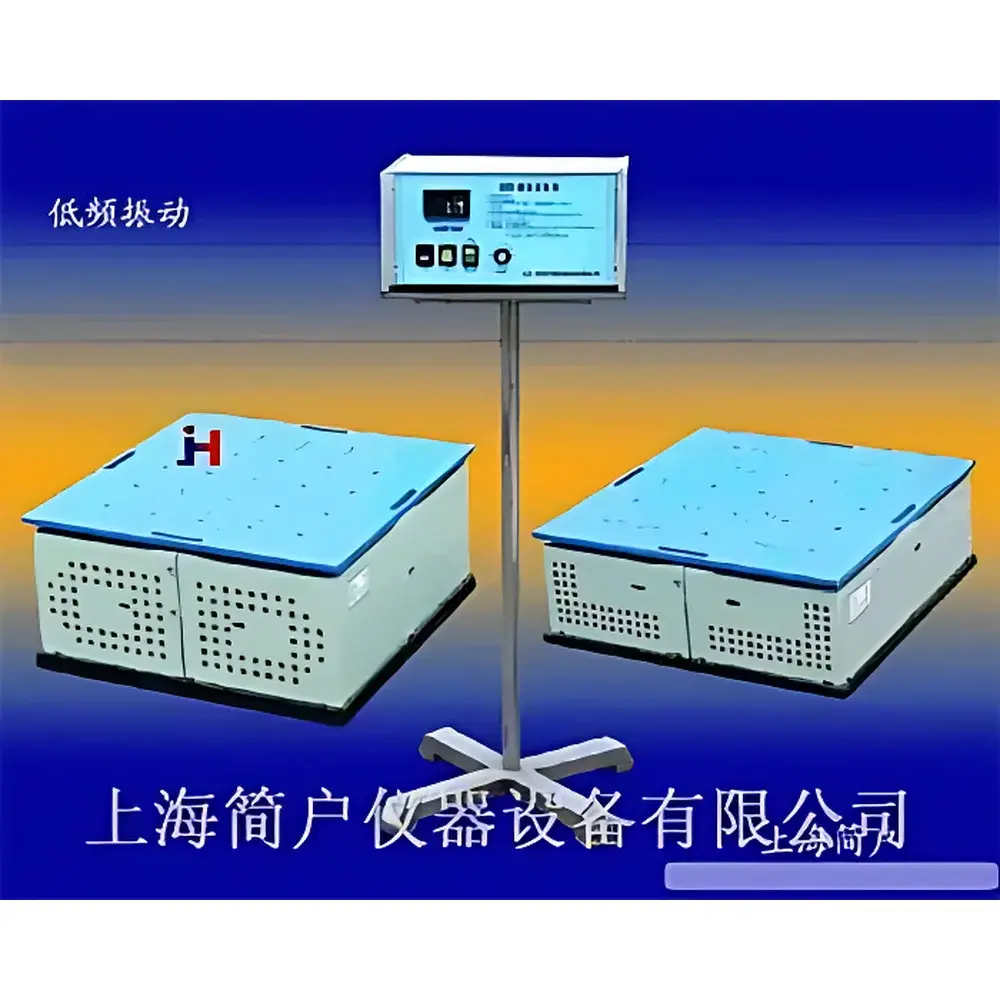
JIANHU JDZD-L Low-Frequency Vibration Test System
| Brand | JIANHU |
|---|---|
| Model | JDZD-L |
| Origin | Shanghai, China |
| Type | Electromagnetic Vertical Vibration Shaker |
| Max Load Capacity | 100 kg |
| Frequency Range | 2–100 Hz |
| Sweep Duration | Up to 30 days per profile |
| Amplitude | 0–5 mm peak-to-peak |
| Max Acceleration | 20 g (196 m/s²) |
| Vibration Axis | Vertical |
| Waveform | Sine, Amplitude Modulation, Fixed-Frequency Mode |
| Control Interface | RS-485 (optional PC integration) |
| Power Supply | 220 V ±20%, 5 A, 2.2 kW |
| Table Size | 50 cm × 50 cm |
| Dimensions (W×H×D) | 50 cm × 20 cm × 50 cm |
| Compliance | Designed for IEC 60068-2-6, ISO 10816-1, GB/T 2423.10, and MIL-STD-810H vibration test protocols |
Overview
The JIANHU JDZD-L Low-Frequency Vibration Test System is an electromagnetically driven vertical shaker engineered for controlled mechanical excitation in environmental reliability testing. It operates on the principle of electromagnetic force generation via voice-coil actuator technology, delivering precise sinusoidal motion across a defined frequency band (2–100 Hz) with programmable amplitude and acceleration profiles. Unlike high-frequency resonant or hydraulic shakers, this system prioritizes stability, repeatability, and thermal management at low-to-mid frequency ranges—making it suitable for evaluating structural integrity, solder joint fatigue, connector retention, and packaging resilience under sustained vibratory stress. Its design targets laboratory and quality assurance environments where compliance with international vibration test standards—including IEC 60068-2-6 (sinusoidal vibration), ISO 10816-1 (vibration severity assessment), and MIL-STD-810H Method 514.8—is required for product qualification and failure mode analysis.
Key Features
- Electromagnetic voice-coil actuator with forced-air cooling, ensuring consistent output over extended test durations (up to 30 days per sweep cycle)
- Vertical-only single-axis configuration optimized for gravity-aligned load paths and simplified fixture mounting
- Adjustable peak-to-peak displacement (0–5 mm) and acceleration (up to 20 g) governed by closed-loop feedback control
- Fixed-frequency and amplitude-modulated sine wave modes for steady-state durability screening
- RS-485 serial interface supporting remote command execution, real-time parameter monitoring, and event logging
- Robust steel-frame construction with reinforced base plate and isolation feet to minimize energy loss and floor coupling
- Integrated safety interlocks including over-temperature cutoff, over-current protection, and emergency stop circuitry compliant with EN 60204-1
Sample Compatibility & Compliance
The JDZD-L accommodates test specimens up to 100 kg mounted on its 50 cm × 50 cm stainless-steel tabletop, with optional custom fixtures available for PCB assemblies, automotive ECUs, consumer electronics enclosures, and medical device housings. Its performance envelope aligns with standard vibration test profiles specified in IEC 60068-2-6 (sinusoidal), ISO 10816-1 (machinery vibration evaluation), GB/T 2423.10 (Chinese national standard for environmental testing), and MIL-STD-810H Method 514.8 (vibration exposure for military equipment). While not certified as GLP/GMP-compliant out-of-the-box, the system supports audit-ready documentation when paired with validated third-party data acquisition software meeting FDA 21 CFR Part 11 requirements for electronic records and signatures.
Software & Data Management
The JDZD-L operates in standalone mode using front-panel controls or integrates with external PC-based control platforms via RS-485. Optional software packages enable creation and storage of multi-segment test programs (up to 15 segments per profile), time-stamped waveform capture, spectral analysis, and export of CSV/Excel-compatible logs. All test parameters—including frequency, amplitude, duration, and trigger events—are timestamped and stored internally for traceability. When connected to a validated host system, the shaker supports full audit trail functionality, user access levels, and electronic signature workflows required for regulated industries such as medical device manufacturing and aerospace component validation.
Applications
- Qualification testing of printed circuit board assemblies (PCBAs) for solder joint fatigue under low-frequency resonance conditions
- Structural verification of automotive infotainment modules, sensors, and wiring harnesses prior to vehicle integration
- Package integrity assessment of shipping containers, blister packs, and transit pallets subjected to road transport vibration spectra
- Reliability screening of industrial control panels, power supplies, and motor drives during design verification
- Evaluation of mechanical fasteners, clips, and latches in consumer appliances and home automation devices
- Research-grade modal analysis support for academic labs studying damping characteristics of composite materials and polymer substrates
FAQ
What is the maximum payload capacity of the JDZD-L system, and how does mass affect performance?
The system supports up to 100 kg on its standard tabletop. Payload mass directly influences achievable acceleration at a given frequency; higher masses reduce peak g-levels due to actuator force limitations. Users should consult the force vs. frequency curve provided in the technical manual for optimal setup.
Does the JDZD-L support swept-sine testing, and what are the timing limits?
Yes—it supports linear and logarithmic swept-sine profiles within the 2–100 Hz range, with sweep durations configurable from 1 second to 30 days per cycle. Each profile may contain up to 15 programmable segments.
Is the system compatible with third-party data acquisition hardware?
Yes—via RS-485, the shaker can synchronize with external DAQ systems for simultaneous measurement of acceleration, strain, temperature, or acoustic emission during vibration exposure.
Can horizontal vibration be performed on this model?
No—the JDZD-L is configured exclusively for vertical-axis excitation. Horizontal or dual-axis capability requires the JDZD-HL or JDZD-TF variants.
What safety certifications does the unit carry?
The system complies with CE marking requirements under the Machinery Directive 2006/42/EC and Low Voltage Directive 2014/35/EU. Electrical safety testing follows EN 60204-1, and EMC compliance meets EN 61326-1.



