
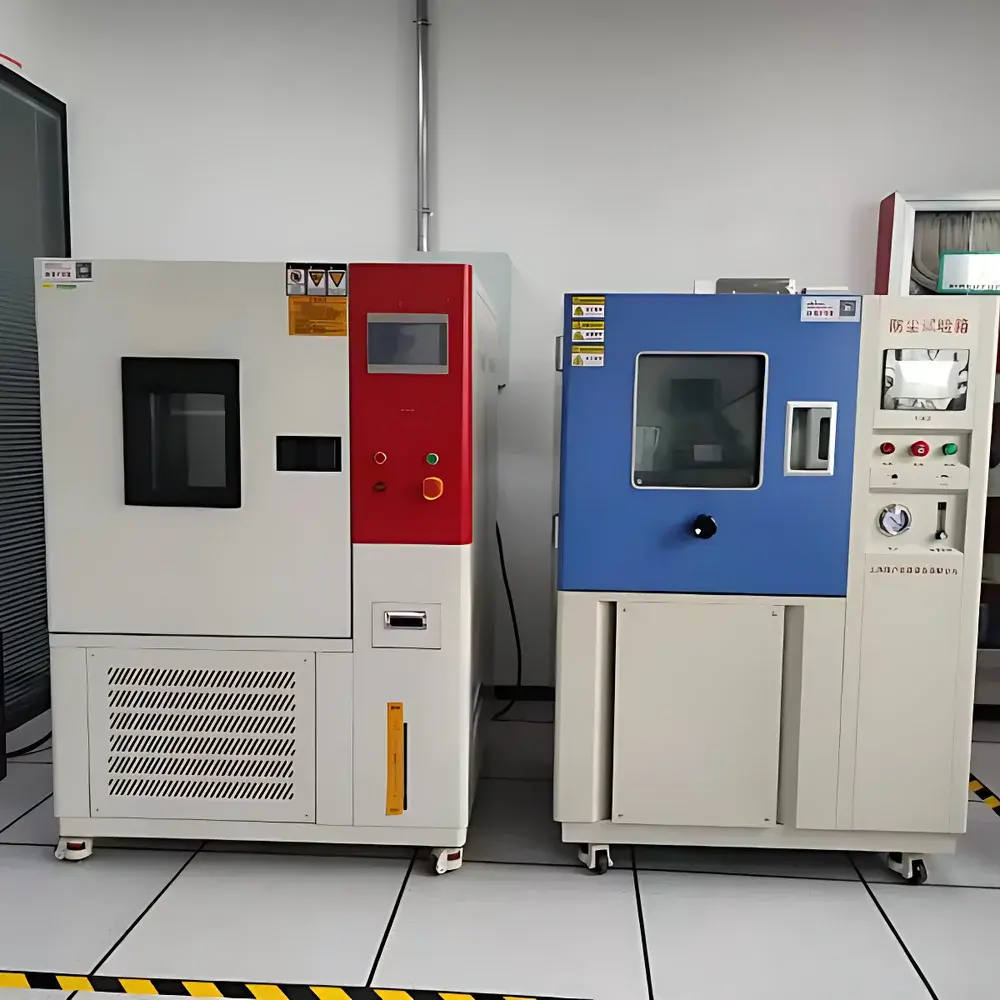
Jianhu JH-2026 Automotive Wheel & Brake Pad Thermal Shock Test Chamber
| Brand | Jianhu |
|---|---|
| Origin | Shanghai, China |
| Manufacturer Type | Authorized Distributor & OEM Manufacturer |
| Product Category | Domestic |
| Model | JH-2026 |
| Price Range | USD 900 – 9,000 (FOB Shanghai) |
| Temperature Range | −70 °C to +150 °C |
| Cooling Method | Compressor-based Refrigeration |
| Explosion-Proof Design | Yes |
| Temperature Fluctuation | ±0.5 °C |
| Temperature Deviation | ±2.0 °C |
| Temperature Uniformity | ±2.0 °C |
| Heating Rate | ≤60 min (from −40 °C to +150 °C) |
| Cooling Rate | ≤45 min / ≤60 min / ≤80 min (model-dependent, typical from +150 °C to −40 °C) |
| Interior Dimensions | Custom-engineered per client specification |
Overview
The Jianhu JH-2026 Automotive Wheel & Brake Pad Thermal Shock Test Chamber is a purpose-built environmental simulation system engineered for accelerated reliability validation of automotive braking components under extreme thermal transients. It operates on the principle of two-zone (hot/cold) dynamic thermal cycling with rapid pneumatic or servo-actuated transfer mechanisms—enabling precise replication of real-world operational stressors such as high-speed braking followed by cold ambient exposure, or sub-zero parking conditions succeeded by immediate aggressive acceleration. Designed in strict conformance with ISO 9001:2015 quality management systems and key automotive test standards—including GB/T 2423.22–2002 (equivalent to IEC 60068-2-14), GB/T 2423.1–2008 (cold), GB/T 2423.2–2008 (dry heat), and ISO 16750-4 (road vehicles—environmental conditions)—the chamber supports deterministic failure mode analysis (FMA) and lifetime prediction for cast aluminum wheel hubs, sintered metallic/ceramic brake pads, and composite friction materials. Its architecture integrates dual independent refrigeration circuits, high-efficiency aluminum finned evaporators, and electro-pneumatic isolation valves to achieve ≤3-second transfer time between chambers and ≤5-minute temperature recovery post-transfer—critical parameters for simulating transient thermal gradients exceeding 200 °C/s at component interfaces.
Key Features
- Explosion-proof certified enclosure (Class II, Division 1, Group D compliant per GB 3836.1–2010), suitable for testing brake materials containing volatile binders or friction modifiers.
- 7-inch full-color TFT touchscreen HMI supporting both fixed-value and programmable thermal profiles; stores up to 96 user-defined test programs, each accommodating 3200 cycles.
- Dual independent temperature control zones: low-temperature chamber (−80 °C to −10 °C), high-temperature chamber (60 °C to 200 °C); configured with French Tecumseh or Embraco compressors for long-term stability.
- Energy-optimized design featuring servo-controlled refrigerant flow regulation, reducing average power consumption by ≥30% versus conventional on/off cycling systems.
- Automatic post-test ambient return function prevents condensation-induced corrosion or microcracking during sample retrieval.
- Structural safety enhancements: electrical/water separation layout, over-temperature/over-pressure cut-off relays, and NIST-traceable calibration ports for third-party verification.
Sample Compatibility & Compliance
The JH-2026 accommodates wheel assemblies up to 22 inches in diameter and brake pad stacks up to 150 mm × 120 mm × 25 mm, with custom interior dimensions available upon engineering review. All units undergo factory calibration against ISO/IEC 17025-accredited reference standards and include full traceability documentation. The system meets requirements for GLP-compliant testing environments when paired with optional audit-trail-enabled software (see Software & Data Management). It supports test execution under ASTM D573, SAE J2527, and ISO 16750-4 Annex C protocols for thermal shock endurance of non-metallic automotive components. Electrical safety complies with GB 4793.1–2007 (equivalent to IEC 61010-1), and EMC performance conforms to GB/T 18268.1–2010.
Software & Data Management
Equipped with embedded RS232 and USB 2.0 interfaces, the chamber logs real-time temperature, cycle count, transfer timing, and alarm status with 250-day onboard storage (10 Hz sampling). Optional Jianhu TestSuite™ software provides Windows-based remote monitoring, automated report generation (PDF/CSV), and curve overlay analysis for comparative batch evaluation. When deployed with validated configuration, the software satisfies FDA 21 CFR Part 11 requirements for electronic records and signatures—including role-based access control, biometric or token-based authentication, and immutable audit trails for all parameter changes and test initiations. Data export formats are compatible with LIMS integration (ASTM E1482, ASTM E2500).
Applications
- Validation of thermal fatigue resistance in carbon-ceramic brake rotors and semi-metallic pads under repeated 150 °C ↔ −40 °C transitions.
- Assessment of interfacial delamination risk in aluminum alloy wheel hubs bonded with polymer-based coatings or sealants.
- Accelerated aging studies for brake caliper piston boots and dust boots exposed to cyclic UV-thermal stress.
- Qualification testing per OEM-specific specifications (e.g., Ford WSS-M99P1111-A, GMW14872, VW TL 226).
- Research-grade material screening in university and national laboratory settings (e.g., Tsinghua University, CAS Institute of Physics, SGS China Automotive Lab).
FAQ
Does the JH-2026 support automated data export to Excel or LIMS?
Yes—via USB mass storage mode or RS232 serial protocol using standard Modbus RTU framing; optional Jianhu TestSuite™ enables direct CSV/PDF export and LIMS API integration.
What is the shortest achievable dwell time in hot/cold zones?
Minimum dwell time is configurable down to 1 minute per zone, subject to thermal mass loading and required stabilization tolerance (±0.5 °C).
Can the chamber be integrated into an existing factory MES system?
Yes—through optional OPC UA server module (IEC 62541 compliant) enabling bidirectional communication with Siemens SIMATIC, Rockwell FactoryTalk, or custom SCADA platforms.
Is third-party calibration certification included with delivery?
Each unit ships with a factory calibration certificate (traceable to CNAS-accredited labs); ISO/IEC 17025-certified field calibration services are available upon request.
What maintenance intervals are recommended for compressor and refrigerant systems?
Compressor oil and filter replacement every 12 months or 4,000 operating hours; annual leak check and refrigerant charge verification per GB/T 26217–2010 guidelines.



