
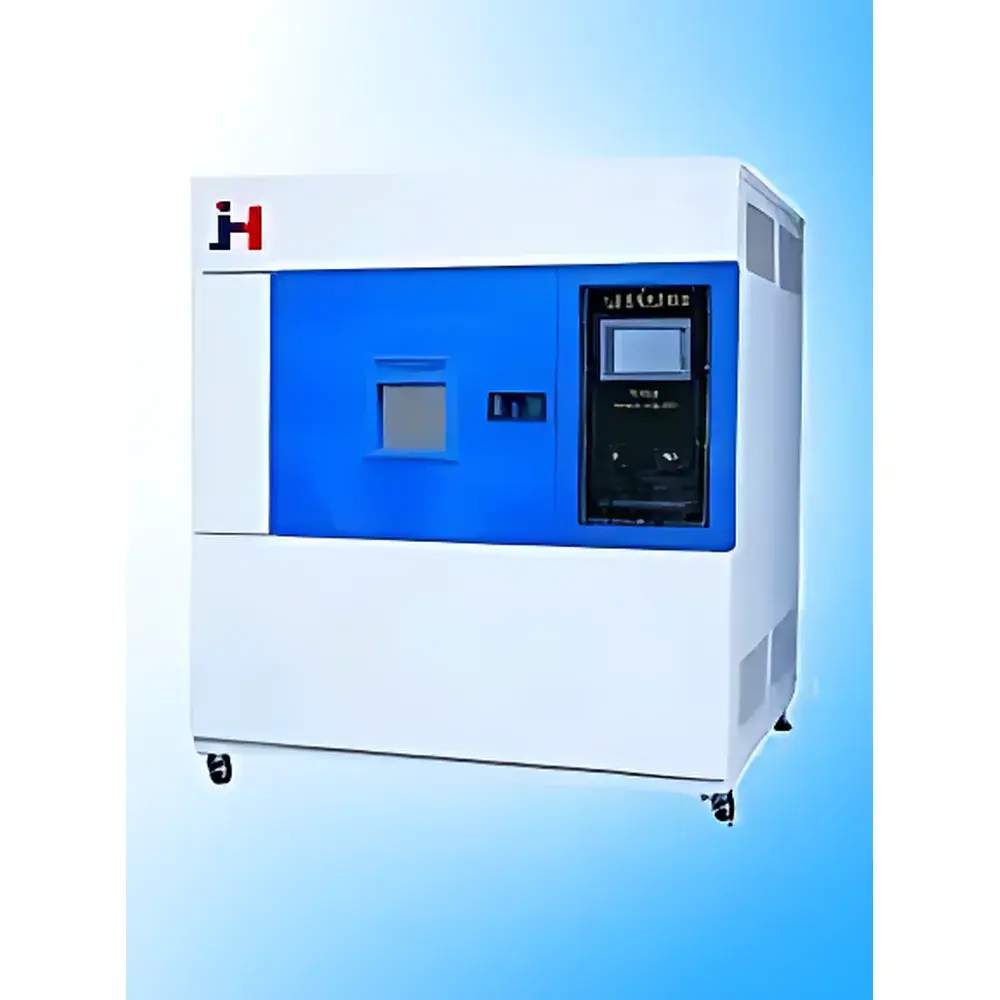
JH Ozone Aging Test Chamber
| Brand | Jianhu |
|---|---|
| Origin | Shanghai, China |
| Manufacturer Type | Authorized Distributor |
| Country of Origin | China |
| Model | JH |
| Price | Upon Request |
| Ozone Concentration Range | 10–1000 pphm (parts per hundred million) |
| Ozone Control Accuracy | ≤ ±10% |
| Test Chamber Temperature Range | Ambient to 60 °C |
| Temperature Uniformity | ±2 °C |
| Specimen Rack Rotation Speed | 2 r/min (QL-J variant) |
| Specimen Extension Frequency | 0.5 ± 0.25 Hz (QL-D variant) |
| Gas Flow Rate | 20–80 L/min |
| Chamber Construction | Cold-rolled steel exterior with powder coating |
| Interior Liner | 304 Stainless Steel |
| Ozone Generation | Silent Discharge Generator |
| Ozone Detection | Imported Nondispersive UV Absorption Analyzer (254 nm) & Electrochemical Sensor |
| Air Pretreatment | High-efficiency desiccant drying tower + air purification system |
| Thermal Regulation | Microprocessor-controlled digital temperature controller with PID algorithm |
| Safety System | Real-time fault diagnostics, audible/visual alarm, over-temperature and ozone over-concentration interlock |
Overview
The JH Ozone Aging Test Chamber is an engineered environmental simulation system designed to evaluate the ozone resistance of elastomeric materials—particularly vulcanized rubber compounds, rubber-coated fabrics, and polymer-based seals and gaskets—under accelerated, controlled atmospheric conditions. Ozone-induced degradation remains a primary failure mechanism in outdoor rubber components, where trace concentrations (as low as 0.01–0.1 ppm) cause surface cracking via ozonolysis of unsaturated carbon–carbon bonds. This chamber replicates and intensifies real-world tropospheric ozone exposure while decoupling confounding variables such as UV radiation and humidity—enabling precise isolation of ozone-specific aging kinetics. It operates on the principle of continuous-flow dynamic exposure: ambient air is dried, filtered, and enriched with precisely metered ozone generated via silent corona discharge; the resulting gas mixture is circulated at regulated flow rates through a thermally stabilized stainless-steel test chamber. The system conforms to core international standards including ASTM D1149, ISO 1431-1, GB/T 7762, and JIS K 6259 for rubber ozone resistance testing.
Key Features
- High-fidelity ozone concentration control (10–1000 pphm) using dual-sensor feedback: a calibrated nondispersive ultraviolet absorption analyzer (254 nm wavelength) and a redundant electrochemical ozone sensor—ensuring trace-level accuracy and long-term stability.
- Microprocessor-based digital temperature controller with PID algorithm, maintaining chamber setpoints from ambient to 60 °C with uniformity within ±2 °C across the working volume.
- Two standardized specimen motion configurations: rotational rack (2 r/min) for static tension evaluation per ASTM D1149, and dynamic extension rack (0.5 ± 0.25 Hz) for cyclic strain simulation per ISO 1431-1 Type B.
- Integrated air pretreatment train comprising a high-capacity silica gel desiccant tower and multi-stage particulate/activated carbon filtration—reducing moisture content to <10 ppmv and eliminating catalytic contaminants that interfere with ozone generation or material response.
- Robust chamber architecture: exterior cold-rolled steel with epoxy-polyester powder coating; interior 304 stainless steel liner resistant to ozone corrosion and facilitating cleanroom-compatible maintenance.
- Comprehensive safety architecture including over-temperature cutoff, ozone over-concentration shutdown, door interlock, and real-time fault logging with LED status indicators and audible alarm.
Sample Compatibility & Compliance
The chamber accommodates standard dumbbell-shaped test specimens (e.g., ASTM D412 Type C), ring samples, and finished parts up to Ø150 mm × 50 mm height. It supports both unstressed and pre-strained (typically 20% elongation) configurations. All operational parameters—including ozone setpoint, temperature ramp profiles, gas flow rate, and motion mode—are configurable to meet method-specific requirements in ASTM D1149 (Method A/B), ISO 1431-1 (Types A/B/C), GB/T 7762, and JIS K 6259. Data logging complies with GLP principles: timestamps, sensor readings, and alarm events are stored internally with optional RS485/Modbus RTU output for integration into LIMS or SCADA systems. While not certified to IEC 61000-4-x EMC standards out-of-box, the unit meets CE marking essential requirements for laboratory equipment under Directive 2014/30/EU (EMC) and 2014/35/EU (LVD).
Software & Data Management
The embedded controller provides local parameter configuration, real-time display of ozone concentration (pphm), chamber temperature (°C), and runtime. No proprietary PC software is required for basic operation; however, optional Modbus RTU communication enables remote monitoring and data acquisition via third-party SCADA platforms (e.g., Ignition, WinCC). All measurement channels support 1-second sampling resolution with internal non-volatile memory retaining ≥30 days of 1-minute averaged data. Audit trails include operator ID (if enabled via external authentication), parameter change logs, and alarm history—supporting FDA 21 CFR Part 11 readiness when deployed with validated electronic signature workflows.
Applications
- Accelerated evaluation of antioxidant and antiozonant additive efficacy in SBR, NR, BR, and EPDM formulations.
- Quality control screening of extruded rubber profiles, automotive weatherstrips, and conveyor belts prior to field deployment.
- Comparative lifetime modeling of rubber components exposed to urban vs. industrial ozone environments.
- Validation of protective coatings and surface passivation treatments against ozone-initiated microcracking.
- Supporting ISO 9001 and IATF 16949 process validation protocols for elastomer suppliers in Tier-1 automotive supply chains.
FAQ
What ozone concentration units does the chamber use, and how do they relate to ppm?
The system displays and controls ozone in parts per hundred million (pphm), where 100 pphm = 0.1 ppm. This unit is standard in rubber aging standards (e.g., ASTM D1149 specifies 50 ± 5 pphm) to improve resolution at low, physiologically relevant concentrations.
Can the chamber operate without specimen motion?
Yes—static exposure mode is supported for baseline assessment; however, dynamic motion (rotation or extension) is required to meet the conditioning criteria of ASTM D1149 Method B and ISO 1431-1 Type B.
Is calibration certification included with shipment?
A factory calibration report traceable to NIM (China National Institute of Metrology) is provided, covering ozone sensor linearity (10–1000 pphm), temperature uniformity mapping, and flowmeter verification. On-site recalibration services are available upon request.
What maintenance intervals are recommended?
Ozone generator electrodes require cleaning every 500 operational hours; silica gel desiccant must be regenerated or replaced every 3 months under continuous use; UV sensor quartz windows should be inspected monthly for contamination.
Does the system support automated test sequencing?
No built-in multi-step program scheduler is included; however, external PLC or LabVIEW control via Modbus RTU allows full sequence automation—including ramp-and-soak temperature profiles, timed ozone modulation, and motion start/stop triggers.



