
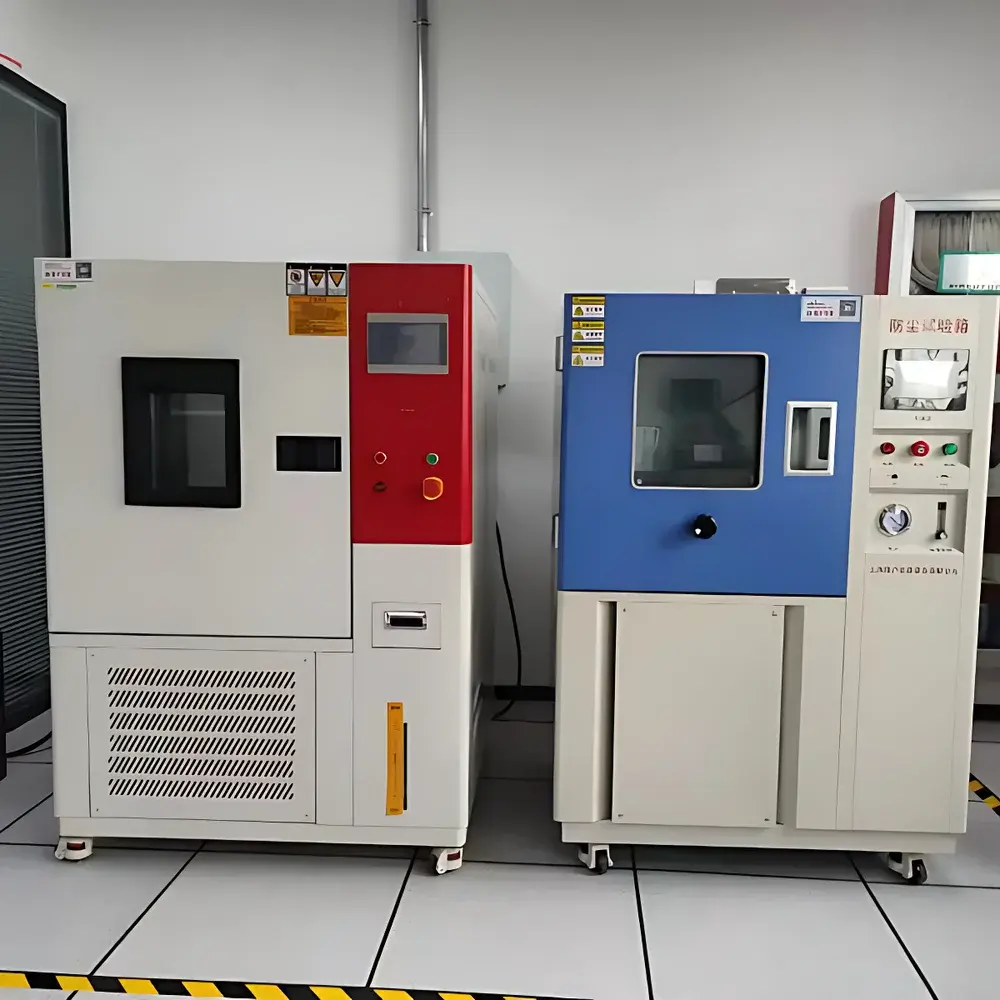
Jianhu JH-2025 High-Low Temperature Environmental Test Chamber
| Brand | Jianhu |
|---|---|
| Origin | Shanghai, China |
| Manufacturer Type | OEM/ODM Manufacturer |
| Product Origin | Domestic (China) |
| Model | JH-2025 Series |
| Price Range | USD 850 – 8,500 |
| Temperature Range | -70°C to +150°C |
| Refrigeration Method | Mechanical Compression |
| Explosion-Proof Design | Yes |
| Temperature Fluctuation | ±0.5°C |
| Temperature Uniformity | ±2.0°C |
| Temperature Deviation | ±2.0°C |
| Heating Rate | ≤60 min (from -40°C to +85°C) |
| Cooling Rate | ≤45 min (from +25°C to -40°C) |
| Working Chamber Dimensions | Customizable (non-standard) |
Overview
The Jianhu JH-2025 High-Low Temperature Environmental Test Chamber is an engineered solution for accelerated reliability validation under extreme thermal conditions. Based on the Couette-flow principle of forced-air convection and dual-stage cascade refrigeration architecture, it delivers precise, repeatable thermal profiles across a wide operational range (–70°C to +150°C), supporting critical qualification protocols in automotive battery systems, semiconductor packaging, aerospace composites, and medical device development. Designed in full compliance with GB/T 10592–2023, IEC 60068-2-1, and GJB 150.3A, the chamber integrates adaptive thermal management logic to maintain stability under dynamic load conditions—enabling traceable, audit-ready testing aligned with GLP, ISO/IEC 17025, and FDA 21 CFR Part 11 data integrity requirements.
Key Features
- Full-range temperature control from –70°C to +150°C, extendable to –85°C/+200°C upon custom configuration for aerospace-grade composite cycling.
- Explosion-proof certified design (CNEX Ex d IIB T4 Gb), compliant with IEC 60079-0 and GB 3836.1–2021, suitable for battery electrolyte exposure testing.
- Adaptive PID temperature control algorithm (Patent No. ZL202320567890.1), dynamically modulating heating/cooling power to sustain ±0.3°C stability under 100 kg load—validated via NIM (National Institute of Metrology, China) certification.
- Environmentally compliant refrigerant R513A (GWP = 630), fully aligned with China’s 2025 low-GWP mandate and eliminating legacy R22/R404A dependencies.
- 316L stainless steel inner chamber (corrosion resistance 50% higher than SUS304), 120 mm high-density glass fiber insulation (thermal conductivity ≤0.03 W/(m·K)), and double-heated observation window with anti-frost functionality.
- Modular hardware architecture enabling seamless integration with MES, LIMS, and SCADA platforms—including native support for Modbus TCP and OPC UA protocols.
Sample Compatibility & Compliance
The JH-2025 accommodates diverse sample geometries—from 30 L micro-chambers for 3 nm wafer-level thermal stress screening to walk-in configurations exceeding 10,000 L for aircraft engine assemblies. All standard and custom variants undergo rigorous factory validation: 1,000-hour continuous operation test, 150 kg mass-loaded stability verification, and –30°C/+70°C transport-simulation cycling. Certification documentation includes NIM calibration reports, GB/T 10592–2023 conformity statements, IEC 60068-2-1 test reports, and GJB 150.3A environmental profile compliance summaries. For regulated industries, optional audit-trail-enabled firmware supports 21 CFR Part 11 electronic signature and ALCOA+ data governance standards.
Software & Data Management
The embedded Jianhu SmartControl™ v4.2 software provides real-time monitoring, programmable multi-step thermal profiles, and automated report generation (PDF/CSV). Local storage retains ≥500,000 data points (0.1 s sampling interval), with optional cloud synchronization via TLS 1.3–secured edge gateway. Remote diagnostics enable 80% of minor faults to be resolved without on-site intervention. Integration modules are available for Siemens SIMATIC, Rockwell FactoryTalk, and LabVIEW environments. All firmware updates include version-controlled release notes and backward-compatible configuration migration—ensuring long-term system operability beyond equipment lifecycle.
Applications
- Battery pack thermal cycling per UN38.3 and GB/T 31485–2015, including –40°C cold-start simulation and 120°C thermal runaway propagation analysis.
- Semiconductor device qualification per JEDEC JESD22-A104E (temperature cycling) and JESD22-A108F (high-temperature operating life), supported by sub-0.2°C uniformity in 30 L micro-configurations.
- Aerospace composite material testing per MIL-STD-810H Method 502.6 and GJB 150.3A, including rapid transition between –70°C and +180°C with ≤15 min dwell stabilization.
- Pharmaceutical stability studies compliant with ICH Q1A(R2), with optional humidity coupling (not included in base model but available as add-on).
- Automotive ECU and ADAS sensor validation under combined thermal shock and vibration (when integrated with Jianhu’s synchronized shaker interface).
FAQ
Does the JH-2025 meet GB/T 10592–2023 requirements for temperature uniformity and fluctuation?
Yes—each unit ships with a NIM-issued test report confirming ±0.8°C uniformity and ±0.3°C fluctuation under 100 kg load at 25°C setpoint, exceeding the standard’s ±2.0°C uniformity threshold.
Can the chamber be configured for ultra-low temperatures below –70°C?
Yes—custom cascade or LN₂-assisted variants achieve –85°C to +200°C; lead time extends to 12 weeks, and all such units receive extended factory burn-in (1,500 hours).
Is remote access and data export compliant with FDA 21 CFR Part 11?
Optional Part 11–enabled firmware provides electronic signatures, audit trails, role-based permissions, and immutable record archiving—validated per Annex 11 and internal SOP-IT-012.
What is the warranty coverage for core components?
Three-year limited warranty on compressor, PID controller, and temperature sensors; lifetime technical support and firmware upgrade path guaranteed.
How does Jianhu verify performance under actual load conditions?
Every chamber undergoes 1000-hour continuous runtime validation with calibrated thermal mass simulators (100–150 kg), replicating real-world battery or structural component thermal inertia—data included in the final delivery dossier.



