
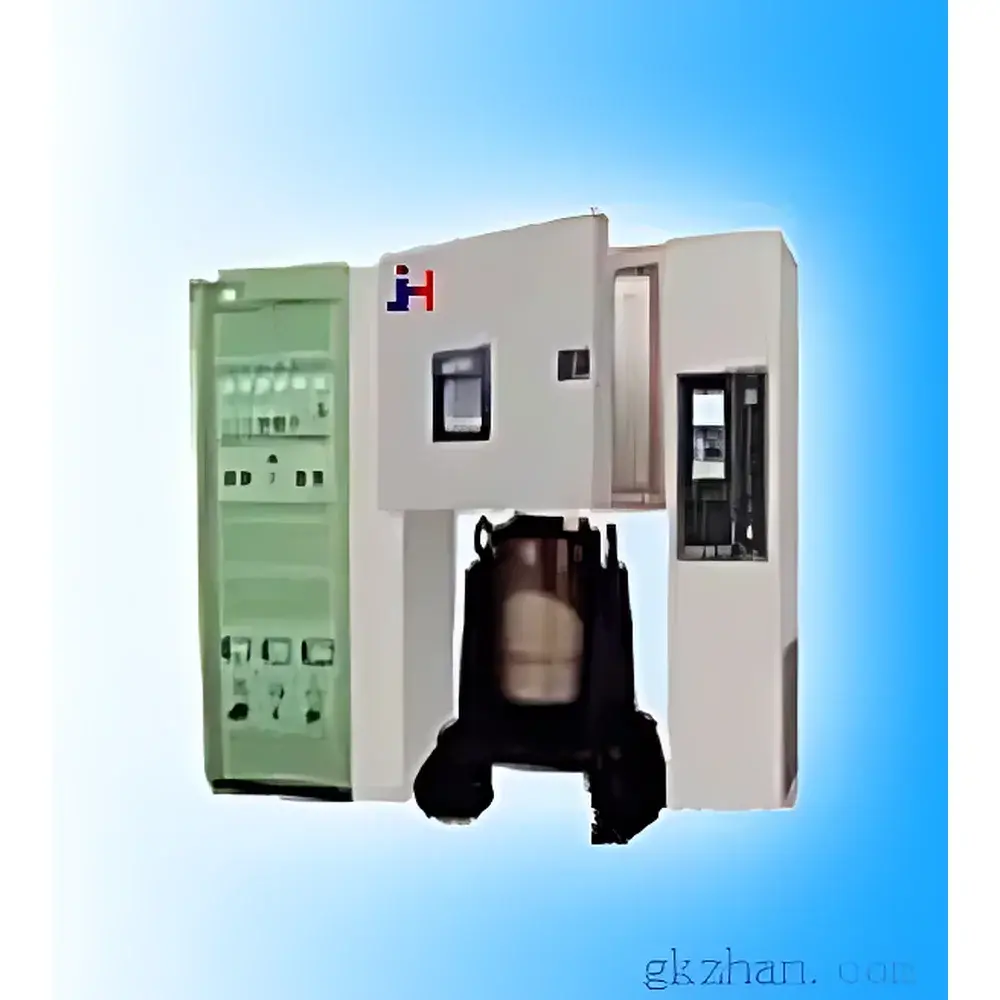
Jianhu JH Series Tri-Environmental Test Chamber (Temperature, Humidity, Vibration)
| Brand | Jianhu |
|---|---|
| Origin | Shanghai, China |
| Manufacturer Type | Authorized Distributor |
| Country of Origin | China |
| Model | JH-VTH-A / VTH-B / VTH-C |
| Temperature Range | −70.0 °C to +150.0 °C (optional +180.0 °C) |
| Humidity Range | 10.0 %RH to 98.0 %RH |
| Internal Dimensions (W×H×D) | 500×600×870 mm / 600×800×870 mm / 1000×800×870 mm |
| Vibration Frequency Range | 3 Hz to 2000 Hz (up to 4000 Hz) |
| Max. Vibration Amplitude | 0–20 mm (up to 40 mm) |
| Max. Dynamic Thrust | 100–1200 kgf (up to 2000 kgf) |
| Control System | THS-2001 Microcontroller (10,000-segment programmable) |
| Cooling Medium | HFC-based eco-refrigerant with French Servo Valve regulation |
| Low-Humidity Capability | 10.0 %RH via LHC regenerative desiccant system |
| Cryogenic Option | LN2V liquid nitrogen rapid cooling module |
| Data Interface | DATA PHYSICS DP-540 PC-compatible control and acquisition system |
| Compliance Support | ASTM D4332, MIL-STD-810H, IEC 60068-2, ISO 16750-4, GB/T 2423.1–2423.10 |
Overview
The Jianhu JH Series Tri-Environmental Test Chamber is an integrated reliability validation platform engineered for simultaneous or independent application of temperature, humidity, and mechanical vibration stressors. Designed in accordance with the physical modeling requirements of accelerated life testing and environmental stress screening (ESS), this chamber implements a coupled multi-stress methodology grounded in real-world operational profiles—particularly those defined in MIL-STD-810H Method 520.2 (Combined Environments) and IEC 60068-2-68 (Combined Temperature/Humidity/Vibration). Its architecture enables precise synchronization of thermal-hygrometric transients with broadband vibrational excitation (sine, random, or swept-frequency modes), replicating field-relevant failure mechanisms such as solder joint fatigue, polymer creep under hygrothermal load, and condensation-induced electrical leakage during cyclic shock. The system is not a simple aggregation of three standalone chambers; rather, it features thermally isolated vibration shaker integration, active moisture management during dynamic loading, and closed-loop refrigerant modulation to maintain ±0.5 °C and ±2.0 %RH stability—even under 1200 kgf thrust at sub-zero temperatures.
Key Features
- Triple-stress synchronization engine supporting concurrent temperature ramping (−70 °C to +150 °C), humidity conditioning (10–98 %RH), and electrodynamic vibration (3–2000 Hz, up to 4000 Hz optional)
- THS-2001 microcontroller with 10,000-segment programmability, dual SRAM and removable disk-based test profile storage, and on-screen Help-assisted operation interface
- LHC (Low-Humidity Control) subsystem featuring regenerative desiccant wheel and high-sensitivity RH sensor, enabling stable 10.0 %RH operation without nitrogen purge
- LN2V cryogenic assist module for rapid thermal transition rates exceeding 15 °C/min from ambient to −70 °C
- French Servo Valve-controlled HFC refrigeration circuit with adaptive load compensation—reducing energy consumption by 30 % and water usage by 20 % versus conventional systems
- DATA PHYSICS DP-540 digital controller interface for real-time waveform monitoring, spectral analysis, and traceable data export compliant with FDA 21 CFR Part 11 audit trail requirements
- Full-spectrum vibration control: sine sweep (linear/logarithmic), resonant dwell, random PSD shaping (up to 6400 lines), and transient shock synthesis
Sample Compatibility & Compliance
The JH chamber accommodates unit-under-test (UUT) footprints up to 1000 mm × 800 mm × 870 mm (VTH-C model), with payload capacity matched to dynamic thrust ratings (100–2000 kgf). Structural mounting interfaces comply with ISO 5344 and DIN 45673-3 for shaker table coupling. All models support standardized test specimen fixtures per MIL-STD-810H Appendix A and IEC 60068-2-64. Environmental compliance includes full alignment with ASTM D4332 (conditioning of plastics), ISO 16750-4 (road vehicle electronics), GB/T 2423.1–2423.10 (Chinese national standards for environmental testing), and EU RoHS Directive 2011/65/EU. Optional GLP/GMP configuration includes electronic signature, user access levels, and immutable test log archiving.
Software & Data Management
Embedded firmware supports native CSV and binary data logging at user-defined intervals (10 ms to 1 min resolution), with timestamped metadata including chamber setpoints, actual readings, vibration spectra (FFT), and alarm events. The DP-540 PC interface provides real-time graphical overlay of temperature/humidity trajectories against vibration acceleration PSDs. Exported datasets conform to ASTM E2918-22 format for third-party statistical analysis (e.g., Weibull life estimation, HALT boundary mapping). Audit trails record operator ID, parameter changes, manual overrides, and calibration verification timestamps—fully traceable for ISO/IEC 17025 laboratory accreditation.
Applications
- Aerospace avionics qualification per DO-160G Section 25 (combined temperature/vibration)
- Military-grade electronics ESS per MIL-STD-810H Method 520.2
- Automotive ECUs and ADAS sensors subjected to road-simulated vibration under humid tropical conditions (ISO 16750-4)
- Consumer electronics drop-and-environmental resilience validation (e.g., smartphone PCBs under thermal cycling + 20 g random vibration)
- Medical device sterilization packaging integrity testing under cyclic humidity and mechanical flexure
- Renewable energy power converters exposed to desert-level low-RH and wide-temperature swings
FAQ
What standards does the JH tri-environmental chamber support for combined stress testing?
It natively supports MIL-STD-810H Method 520.2, IEC 60068-2-68, ISO 16750-4, and ASTM D4332. Custom profiles can be configured for automotive OEM-specific specifications (e.g., GMW3172, Ford CETP).
Can vibration testing be performed at sub-zero temperatures without condensation or icing?
Yes—the LHC desiccant system maintains internal dew point below −40 °C throughout the −70 °C operating range, while the servo-valve refrigerant loop prevents localized frost formation on shaker armatures.
Is remote monitoring and control available?
Standard Ethernet TCP/IP connectivity enables integration into enterprise MES/LIMS platforms. Optional OPC UA server module supports secure cloud-based supervision with TLS 1.2 encryption.
What is the maximum allowable payload mass for the 1200 kgf vibration system?
Maximum inertial mass is 120 kg at full-rated thrust (2000 kgf model: 200 kg), calculated per ISO 5344 static deflection limits and shaker coil thermal derating curves.
Does the system provide NIST-traceable calibration documentation?
Factory calibration certificates include traceability to NIST standards for temperature (PT100 Class A), humidity (capacitive sensor calibrated against chilled mirror hygrometer), and vibration (reference accelerometer per ISO 16063-21).



