
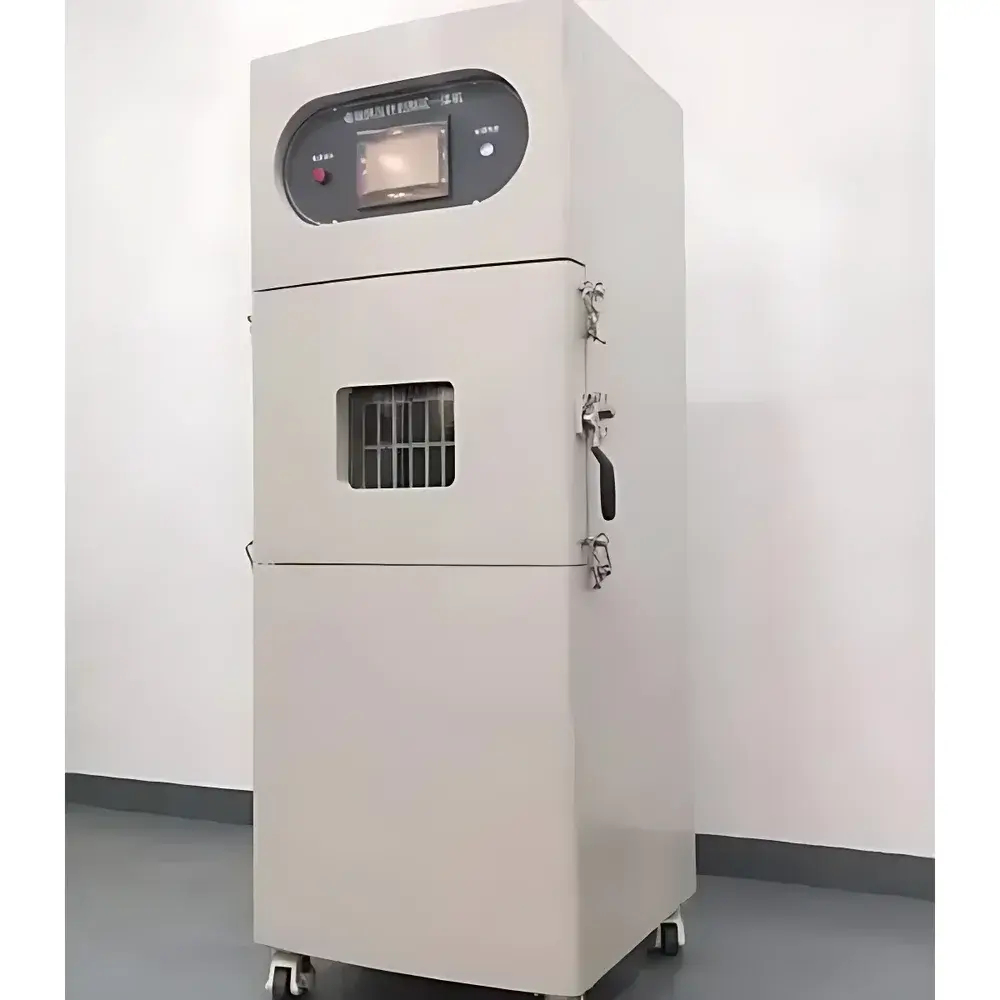
Jianhu JH-Integrated Battery Crush & Nail Penetration Tester
| Brand | Jianhu |
|---|---|
| Origin | Shanghai, China |
| Manufacturer Type | Authorized Distributor |
| Country of Origin | China |
| Model | JH-Integrated Battery Crush & Nail Penetration Tester |
| Price Range | USD 1,280 – 12,800 |
Overview
The Jianhu JH-Integrated Battery Crush & Nail Penetration Tester is an engineered safety evaluation system designed for controlled mechanical abuse testing of lithium-ion and other rechargeable battery cells and modules. It operates on dual-mode mechanical loading principles: uniaxial quasi-static compression (crush) and dynamic penetration (nail puncture), both compliant with internationally recognized electrochemical safety test protocols. The system replicates real-world mechanical failure scenarios—including vehicle crash-induced deformation, tool impact, or foreign object intrusion—enabling quantitative assessment of thermal runaway initiation, voltage collapse, gas venting, and structural integrity loss. Built for laboratory-grade reproducibility, the tester integrates force-controlled actuation, position-synchronized data acquisition, and fail-safe containment architecture to ensure operator protection and test fidelity across R&D, quality assurance, and third-party certification workflows.
Key Features
- Integrated dual-function design: simultaneous capability for crush (flat plate compression) and nail penetration (cylindrical steel probe insertion) within a single test chamber
- Programmable hydraulic/pneumatic actuation system with closed-loop force and displacement feedback control
- Real-time synchronized monitoring of battery voltage, surface temperature (via thermocouple or IR sensor input), and load/displacement profiles
- Explosion-resistant test chamber with transparent polycarbonate viewport, integrated exhaust ducting, and optional gas detection interface
- Compliance-ready firmware supporting pre-configured test sequences aligned with IEC 62660-2, UL 2580, GB/T 31485, and GB 38031-2020 requirements
- Modular fixture interface accommodating cylindrical (18650, 21700), prismatic, and pouch cell formats up to 200 mm × 150 mm × 80 mm
- Emergency stop circuitry with redundant hardware interlocks, pressure relief valves, and automatic power cutoff upon thermal or pressure threshold violation
Sample Compatibility & Compliance
The JH-Series supports standardized sample mounting for single-cell and small-module configurations per ISO 12100 (functional safety of machinery) and IEC 61000-6-2/6-4 (EMC immunity/emission). All mechanical interfaces comply with dimensional tolerances defined in UN Manual of Tests and Criteria Part III, subsection 38.3.2 (mechanical tests). The system meets structural integrity requirements under GB/T 2423.10–2019 (vibration resistance) and GB/T 2423.5–2019 (impact resistance), verified via third-party factory acceptance testing. For regulatory submissions, raw data export includes timestamped binary logs compatible with FDA 21 CFR Part 11 audit trail requirements when used with validated software packages.
Software & Data Management
The embedded control interface provides intuitive setup of test parameters—including crush speed (0.1–10 mm/s, ±0.05 mm/s repeatability), crush force limit (up to 200 kN), nail diameter (3–8 mm), penetration depth (≥5 mm beyond full cell thickness), and dwell time (0–300 s). Test execution triggers automated data capture at ≥100 Hz sampling rate for voltage, current, and thermocouple channels. Export formats include CSV, MATLAB (.mat), and XML-based ASTM E2927-compliant structured reports. Optional PC-based software enables GLP-compliant user access control, electronic signatures, and revision-tracked calibration logs traceable to NIST-traceable standards.
Applications
- Cell-level safety validation during electrode formulation and electrolyte screening
- Module-level mechanical robustness verification prior to pack integration
- Production line 100% QA screening for manufacturing defects (e.g., separator misalignment, tab weld weakness)
- Root cause analysis of field failures involving external mechanical damage
- Supporting UN 38.3 certification documentation for air transport compliance
- Academic research on thermal propagation kinetics and failure mode mapping
FAQ
What international standards does this tester support out-of-the-box?
Pre-loaded test templates align with IEC 62660-2 (crush speed: 1.0 ± 0.1 mm/s; nail speed: 25 ± 5 mm/s), UL 2580 Section 9, and GB 38031-2020 Annex C.
Can the system accommodate custom probe geometries or non-standard cell sizes?
Yes—modular fixture plates and adjustable support rails allow adaptation for oversized prismatic cells or proprietary penetration tools, subject to maximum stroke and load envelope limits.
Is remote operation supported for hazardous testing environments?
The unit features Ethernet/IP connectivity and OPC UA server integration, enabling secure remote monitoring and emergency shutdown via authenticated network access.
How frequently must force transducers be recalibrated?
Annual calibration against certified deadweight standards is recommended; internal zero-point drift compensation occurs automatically at startup.
Does the system include fire suppression capabilities?
No built-in suppression—however, the chamber is rated for integration with external CO₂ or dry chemical suppression systems via dry-contact relay outputs.



