
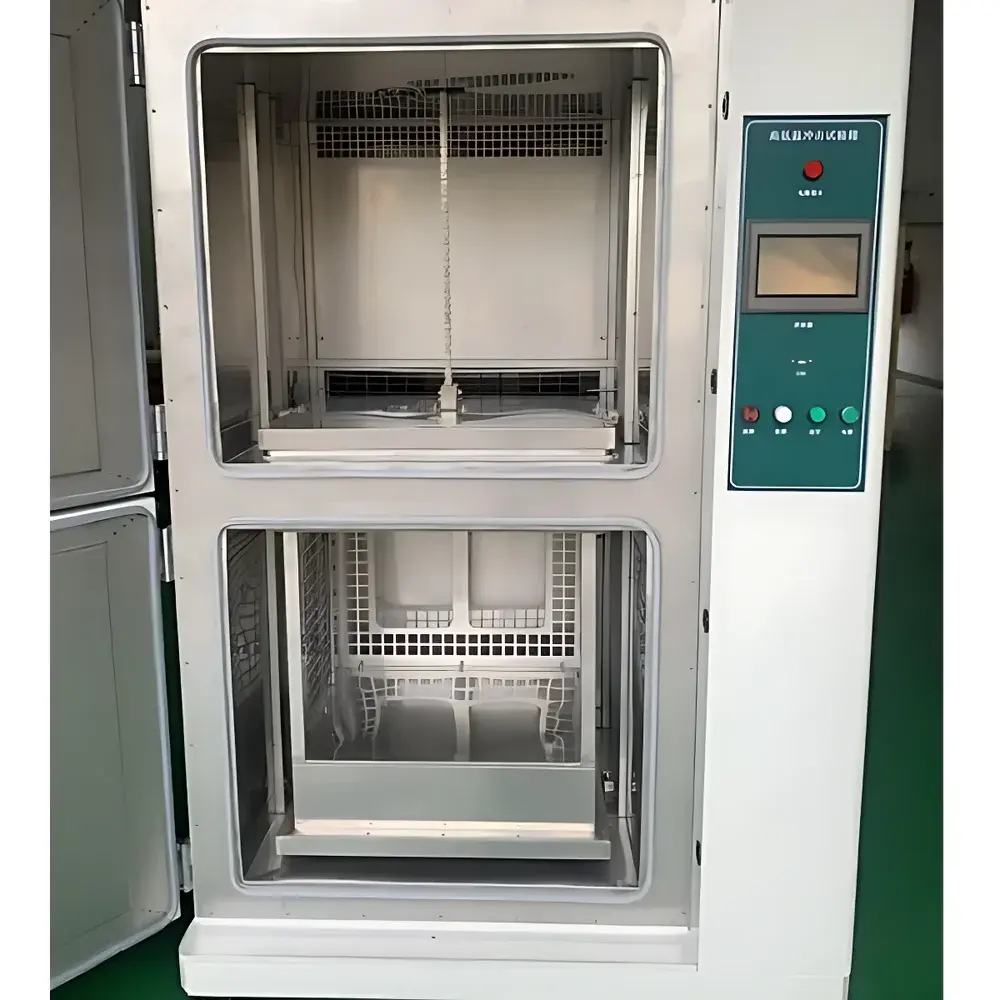
JianHu JH Series Thermal Shock Test Chamber with Rapid Temperature Transition Capability
| Brand | JianHu |
|---|---|
| Origin | Shanghai, China |
| Model | JH-Series |
| Temperature Range (High) | +60°C to +200°C |
| Temperature Range (Low) | −70°C to 0°C |
| Thermal Shock Range | −60°C to +150°C |
| Temperature Stability | ±0.5°C to ±2.0°C |
| Heating Rate | 3–20°C/min |
| Cooling Rate | 3–15°C/min |
Overview
The JianHu JH Series Thermal Shock Test Chamber is an engineered environmental simulation system designed for accelerated reliability assessment of materials, components, and electronic assemblies under extreme transient thermal conditions. Based on the principle of rapid air-to-air thermal transfer—achieved through dual- or tri-zone chamber architecture with independent high-temperature and low-temperature reservoirs—the system enables precise, repeatable thermal shock cycling between predefined temperature extremes. Unlike steady-state environmental chambers, this instrument subjects test specimens to abrupt thermal gradients that induce mechanical stress via differential expansion/contraction across material interfaces, thereby exposing latent defects such as solder joint fatigue, delamination in multilayer PCBs, sealant cracking, or intermetallic phase instability. Its operational envelope—spanning −60°C to +150°C with programmable transition times down to <10 seconds between zones—aligns with critical test profiles defined in IEC 60068-2-14, MIL-STD-810H Method 503.5, and GB/T 2423.22. The chamber is not intended for continuous operation at static setpoints but rather for controlled, time-bound exposure to thermally aggressive environments representative of field service life cycles in aerospace, automotive, and semiconductor applications.
Key Features
- Tri-zone configuration (high-temp zone, low-temp zone, test zone) with pneumatically actuated transfer mechanism for sub-15-second specimen relocation between thermal extremes
- Independent refrigeration and heating circuits utilizing cascade refrigeration technology for stable low-temperature maintenance at −70°C and rapid recovery after door opening
- High-efficiency axial fan array with laminar airflow design ensures uniform temperature distribution (±1.0°C within working volume per ISO 16750-4 Annex A)
- Programmable ramp-and-soak profiles supporting up to 999 cycles, multi-segment sequences, and dwell time adjustment from 1 minute to 999 hours per segment
- Industrial-grade 7-inch TFT-LCD touchscreen HMI with embedded real-time graphing, event logging, and password-protected parameter access levels
- Modular PID control architecture with auto-tuning capability for consistent thermal response across ambient temperature fluctuations (15–35°C)
Sample Compatibility & Compliance
The JH Series accommodates standard test specimens up to 500 mm × 500 mm × 500 mm (W×D×H), with customizable internal racks and non-corrosive stainless-steel shelves. Sample mounting fixtures are compatible with MIL-STD-883H Test Method 1010.8 (Temperature Cycling) and JEDEC JESD22-A104F (Temperature Cycling). All thermal sensors conform to ASTM E220 calibration traceability requirements, and chamber validation reports include temperature mapping per ISO/IEC 17025-accredited protocols. The system supports GLP/GMP-compliant operation through optional audit trail functionality, user-defined electronic signatures, and data integrity safeguards aligned with FDA 21 CFR Part 11 Annex 11 principles. It is certified to CE marking requirements (2014/30/EU EMC Directive and 2014/68/EU PED), and meets RoHS 2011/65/EU material restrictions.
Software & Data Management
JianHu’s proprietary JianHuTest Control Suite (v4.2+) provides Windows-based remote supervision via Ethernet (TCP/IP), Modbus TCP, or optional Wi-Fi module. The software enables full parameter upload/download, real-time trend visualization with overlay comparison across multiple test runs, and automated report generation in PDF/CSV formats compliant with internal QA documentation standards. All temperature readings are timestamped with millisecond resolution and stored locally on a redundant SD card and external NAS drive simultaneously. Data export includes raw sensor values, controller setpoints, alarm logs, and system status flags—structured to support integration into LIMS platforms such as LabWare or Thermo Fisher SampleManager. Firmware updates are delivered via secure HTTPS channel with SHA-256 signature verification to ensure integrity and prevent unauthorized modification.
Applications
This thermal shock chamber serves mission-critical qualification testing across regulated industries. In semiconductor manufacturing, it validates flip-chip interconnect integrity and wafer-level packaging robustness prior to burn-in. Automotive Tier-1 suppliers use it for ECUs subjected to ISO 16750-4 thermal shock endurance validation under simulated under-hood and cabin environments. Aerospace contractors apply it to avionics modules per RTCA DO-160G Section 4.4, particularly for radar transceivers and inertial measurement units exposed to stratospheric cold soak followed by engine bay heat-up. In medical device development, it supports ISO 14971 risk analysis for implantable electronics by accelerating thermal fatigue mechanisms in hermetic ceramic packages. Academic research labs employ it for fundamental studies on polymer crystallinity kinetics, shape-memory alloy hysteresis, and nanocomposite interfacial debonding under cyclic thermal loading.
FAQ
What distinguishes thermal shock testing from rapid temperature change (RTC) testing?
Thermal shock emphasizes near-instantaneous transfer between extreme temperature zones (typically <15 s), inducing high-magnitude transient stresses; RTC maintains continuous ramping within a single chamber at controlled rates (e.g., 10°C/min), simulating slower environmental transitions.
Can the JH Series perform dwell-time-variable cycling per IEC 60068-2-14 Method Na?
Yes—users may define asymmetric dwell durations at hot and cold extremes, including zero-dwell “shock-only” modes, with cycle count limits up to 9999 and automatic termination upon completion or fault detection.
Is third-party IQ/OQ/PQ validation support available?
JianHu provides prequalified protocol templates and on-site commissioning assistance; final validation remains the responsibility of the end-user’s qualified personnel per ISO/IEC 17025 requirements.
Does the system meet requirements for automotive PPAP submission?
When operated with documented calibration records, temperature mapping reports, and preventive maintenance logs, the JH Series fulfills AIAG CQI-15 and VDA 6.3 process audit criteria for environmental test equipment.
What maintenance intervals are recommended for optimal long-term stability?
Compressor oil and refrigerant filter replacement every 24 months; annual recalibration of PT100 sensors and verification of door gasket compression force; quarterly inspection of airflow baffles and heater element resistance balance.



