
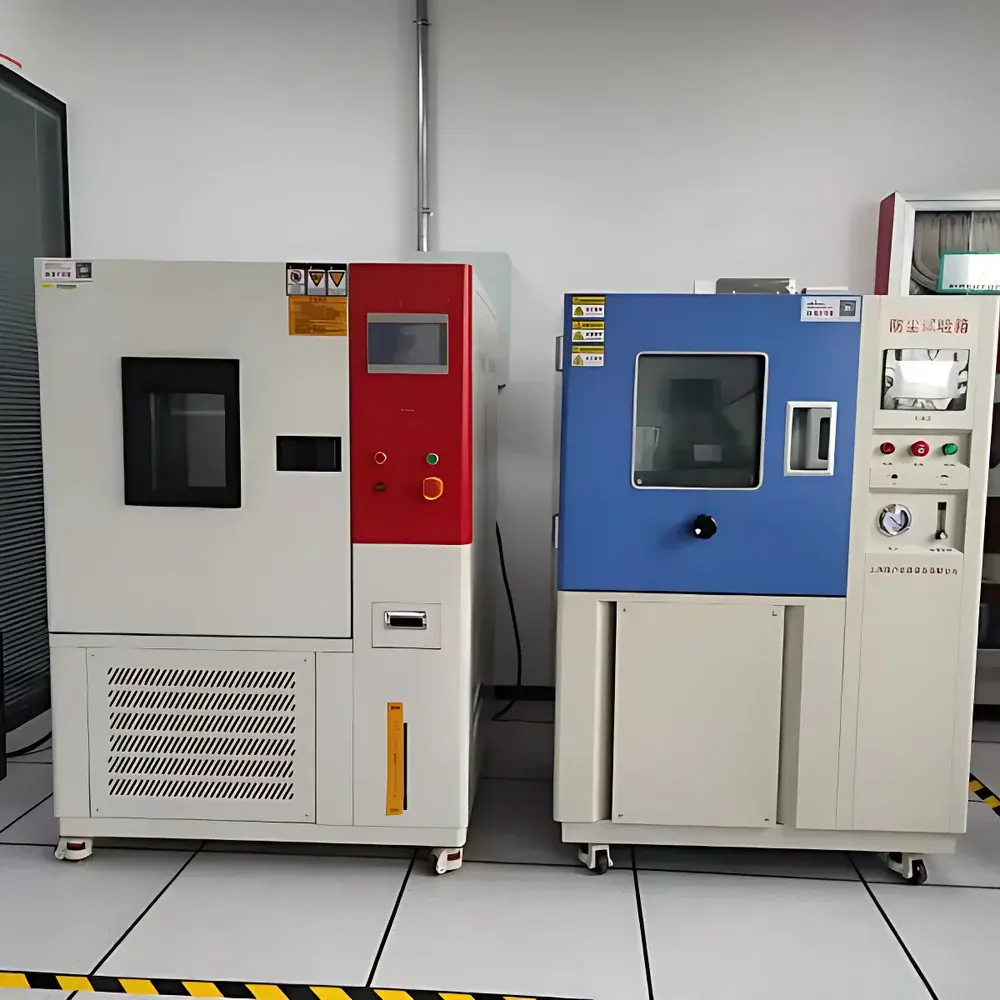
Jianhu JH-TCIC Series Semiconductor IC Thermal Shock Test Chamber
| Brand | Jianhu |
|---|---|
| Origin | Shanghai, China |
| Manufacturer Type | Authorized Distributor |
| Country of Origin | China |
| Model | JH-TCIC Series |
| Price Range | USD 750 – 7,600 |
| Temperature Range | -70 °C to +150 °C |
| Cooling Method | Compressor-Based Refrigeration |
| Explosion-Proof Design | Yes |
| Temperature Fluctuation | ±0.5 °C |
| Temperature Uniformity | ±2.0 °C |
| Temperature Deviation | ±2.0 °C |
| Heating Rate | ≤60 min (from -40 °C to +85 °C) |
| Cooling Rate | ≤45 min / ≤60 min / ≤80 min (depending on test profile and load) |
Overview
The Jianhu JH-TCIC Series Semiconductor IC Thermal Shock Test Chamber is an engineered environmental stress screening (ESS) system designed specifically for accelerated reliability validation of integrated circuits, bare die, wafer-level packages, and advanced semiconductor components. It operates on the principle of rapid thermal transition between extreme temperature extremes—typically cycling between -70 °C and +150 °C—to induce thermomechanical stress in microelectronic assemblies. This methodology replicates real-world operational transients (e.g., power-on/power-off cycles, ambient temperature shifts, or thermal gradients across multi-die modules), thereby accelerating failure mechanisms such as intermetallic growth, solder joint fatigue, die attach delamination, and coefficient-of-thermal-expansion (CTE) mismatch-induced cracking. The chamber conforms to core industry test standards including JEDEC JESD22-A104 (Temperature Cycling), MIL-STD-883 Method 1010 (Thermal Shock), and AEC-Q100 Stress Test Qualification for Automotive ICs.
Key Features
- Explosion-proof certified construction compliant with IEC 60079-0 and GB/T 3836.1–2021, enabling safe testing of devices containing volatile solvents or operating under inert gas purge conditions.
- Dual-zone independent refrigeration and heating architecture ensures high reproducibility in thermal ramp profiles, minimizing thermal inertia effects during rapid transitions.
- Precision-controlled air circulation system with laminar flow design achieves ±2.0 °C temperature uniformity across the working volume (standard 150 L chamber; optional 300 L and 500 L configurations available).
- Real-time monitoring of chamber internal pressure, dew point, and purge gas composition (N₂ or dry air) supports HAST-compatible preconditioning and moisture-sensitive device handling per IPC/JEDEC J-STD-033.
- Integrated safety interlocks include overtemperature cutoff, compressor high-pressure shutdown, door-open thermal lockout, and emergency ventilation activation.
- Compliant with ISO/IEC 17025:2017 calibration traceability requirements; factory calibration certificates include NIST-traceable reference sensor data.
Sample Compatibility & Compliance
The JH-TCIC accommodates standard JEDEC trays (JEDEC STD-20), gel packs, wafer carriers (FOUPs/FOSBs), and custom fixtures for flip-chip, WLCSP, and 2.5D/3D stacked die configurations. Its interior stainless-steel chamber and non-outgassing insulation materials meet Class 1000 cleanroom compatibility requirements (ISO 14644-1). The system supports qualification testing per multiple international standards: JEDEC JESD22-A106 (Highly Accelerated Temperature and Humidity Stress Test), AEC-Q100-011 (Electrostatic Discharge), and IEC 60749-26 (ESD Sensitivity Classification). For regulated environments, audit-ready operation logs—including timestamped temperature setpoints, actual chamber readings, alarm events, and user authentication records—support GLP/GMP and FDA 21 CFR Part 11 compliance when paired with optional electronic signature and audit trail software modules.
Software & Data Management
Equipped with Jianhu’s proprietary TC-Studio v4.2 control and analysis platform, the JH-TCIC provides deterministic test sequencing, multi-step profile definition (including dwell time, ramp rate, cycle count, and conditional branching), and real-time graphical overlay of up to eight simultaneous thermocouple inputs. All raw data are stored in IEEE-compliant CSV and HDF5 formats, with metadata embedded per ASTM E2918-20 guidelines for digital preservation. Remote access via TLS 1.2-secured web interface enables cross-site collaboration and integration into enterprise MES/QMS systems (e.g., Siemens Opcenter, ETQ Reliance) through RESTful API endpoints. Optional 21 CFR Part 11 module delivers role-based access control, biometric or smart-card login, electronic signatures, and immutable audit trails for all critical operations.
Applications
- Qualification of automotive-grade MCUs, power management ICs, and ADAS sensors per AEC-Q100 Rev G requirements.
- Reliability screening of GaN/SiC power devices subjected to repeated junction temperature excursions (>175 °C peak).
- Process validation for wafer-level packaging technologies including TSV, microbumps, and underfill dispensing.
- Failure analysis support for root cause identification in field returns involving thermal fatigue or interfacial delamination.
- Material compatibility assessment of underfills, molding compounds, and die-attach adhesives under cyclic thermal loading.
- Supporting DOE studies for thermal interface material (TIM) optimization in heterogeneous integration platforms.
FAQ
What is the minimum dwell time supported between temperature extremes?
The system supports configurable dwell times from 10 minutes to 24 hours per zone, programmable independently for hot and cold phases.
Can the chamber be integrated into a fully automated test line?
Yes—RS-485 Modbus RTU, Ethernet/IP, and optional SECS/GEM protocol support enable seamless integration with handler systems and automated optical inspection (AOI) stations.
Does the system comply with MIL-STD-810G Method 503.5 for temperature shock?
Yes—predefined test templates for MIL-STD-810G, Method 503.5 (including exposure durations, transition times, and stabilization criteria) are included in TC-Studio v4.2.
Is nitrogen purge capability standard or optional?
Nitrogen purge is standard, with mass flow controller (MFC)-regulated inlet and exhaust ports, supporting O₂ < 100 ppm operation.
How is calibration maintained over extended operational life?
The system includes dual-channel NIST-traceable platinum RTD sensors (Class A tolerance), with automatic self-calibration routines executed at startup and configurable periodic verification intervals (e.g., every 100 hours or weekly).



