
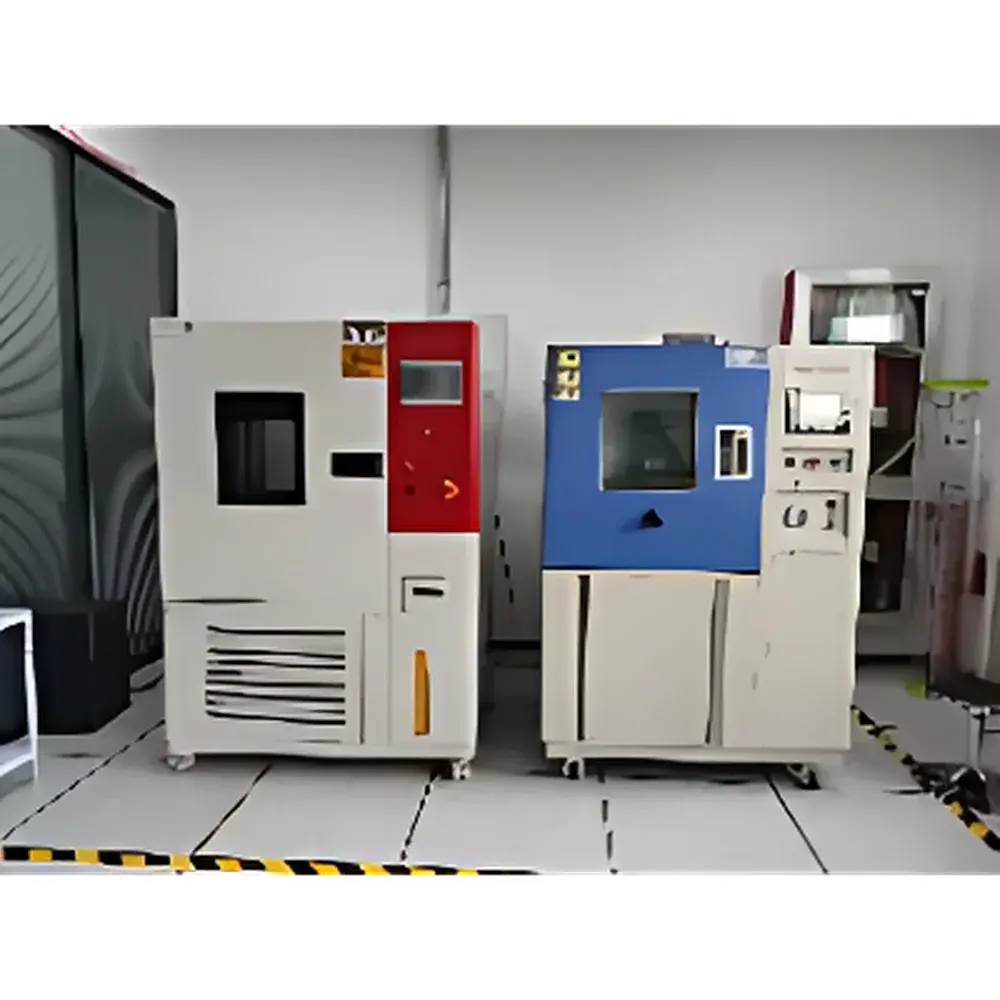
Jianhu NJ-CTH Series Programmable Thermal Shock Test Chamber
| Brand | Jianhu |
|---|---|
| Origin | Shanghai, China |
| Model | NJ-CTH Series |
| Temperature Range | -60°C to +150°C |
| Ramp Rate | Up to 15°C/min |
| Temperature Control Accuracy | ±0.5°C |
| Programmable Steps | ≥100 segments |
| Compliance | ISO 16750-4, GB/T 2423.22, IEC 60068-2-14 |
| Data Logging | Real-time curve display & auto-storage |
| Repeatability | ≤1.5% deviation |
Overview
The Jianhu NJ-CTH Series Programmable Thermal Shock Test Chamber is an engineered solution for accelerated temperature cycling validation of electronic components, automotive systems, and precision instrumentation. It operates on the principle of rapid air-to-air thermal shock—utilizing independent high-efficiency hot and cold chambers with a lift-type or rotary transfer mechanism—to subject test specimens to abrupt, repeatable transitions between extreme low and high temperatures. This methodology replicates real-world environmental stressors such as cold-start conditions in arctic climates followed by under-hood thermal exposure during summer operation. Designed for laboratory-grade reproducibility and industrial-scale reliability testing, the NJ-CTH chamber supports deterministic qualification per international environmental stress screening (ESS) protocols and serves as a core tool in design verification, process validation, and production line quality assurance.
Key Features
- Independent dual-chamber architecture with forced-air circulation and PID-controlled heating/cooling systems ensures stable thermal zones and minimized cross-contamination between temperature extremes.
- Precision temperature control with ±0.5°C uniformity across the working volume (per IEC 60068-3-5), validated via NIST-traceable sensor calibration.
- Ramp rates programmable from 5°C/min to 15°C/min, enabling simulation of transient thermal profiles required by automotive electronics standards including ISO 16750-4 Clause 4.3 (temperature change).
- 100+ segment programmable controller with touch-screen HMI, supporting nested loops, dwell times, and conditional branching for complex test sequences (e.g., -40°C/120 min → transfer → +85°C/120 min → repeat ×1000).
- Integrated data acquisition system records time-stamped temperature readings at user-defined intervals (1–60 sec), stores full-cycle thermal profiles locally, and exports CSV-compatible logs for traceability and statistical analysis.
- Structural integrity verified per ISO 13374-2 for mechanical robustness; insulated chamber walls with low thermal mass enable rapid recovery post-transfer and reduce energy consumption over extended test durations.
Sample Compatibility & Compliance
The NJ-CTH accommodates DUTs up to 300 mm × 300 mm × 300 mm (custom configurations available), including ECUs, power modules, radar sensors, navigation units, and battery management systems (BMS). Its thermal profile fidelity enables direct correlation with field failure modes—such as solder joint fatigue, encapsulant delamination, and MEMS drift—under controlled, auditable conditions. The system complies with key regulatory and industry frameworks: ISO 16750-4 (road vehicle environmental testing), GB/T 2423.22 (temperature change test method N), IEC 60068-2-14 (change of temperature), and supports GLP/GMP-aligned documentation workflows when integrated with external LIMS or ELN platforms. Optional audit trail logging meets FDA 21 CFR Part 11 requirements for electronic records and signatures.
Software & Data Management
The embedded controller firmware includes built-in test sequence editor, real-time graphical overlay of setpoint vs. actual temperature curves, and automatic pass/fail flagging based on user-defined tolerance bands. Data export supports USB flash drive transfer and Ethernet-based remote monitoring via Modbus TCP or HTTP API. For enterprise integration, optional PC-based software provides advanced features: multi-chamber fleet management, SPC chart generation (X̄-R, Cpk), automated report generation (PDF/Excel), and version-controlled test method libraries compliant with ISO/IEC 17025 documentation hierarchy. All stored data retains immutable timestamps and operator ID metadata, satisfying traceability requirements for internal audits and third-party certification bodies.
Applications
- Automotive Electronics: Qualification of MCU controllers, ADAS sensors, and infotainment modules per ISO 16750-4 cold-hot cycling; identification of thermal-induced functional anomalies prior to vehicle-level integration.
- Battery Systems: Evaluation of BMS thermal response during simulated cold-start → fast-charge scenarios; correlation of state-of-charge estimation error against cumulative thermal cycles.
- Radar & RF Modules: Stability assessment of millimeter-wave signal output under rapid ambient transitions (e.g., -45°C → +30°C at 5°C/min), detecting phase drift or gain compression onset.
- Precision Instrumentation: Validation of optical alignment stability in navigation modules across -20°C to +60°C cycling; verification of GPS positioning accuracy remains within ≤10 m RMS under thermal transients.
- Materials & Packaging: Screening of conformal coatings, potting compounds, and flexible printed circuits for interfacial adhesion loss or coefficient-of-thermal-expansion (CTE) mismatch-induced cracking.
FAQ
What standards does the NJ-CTH Series support for automotive qualification?
It natively supports ISO 16750-4, GB/T 2423.22, and IEC 60068-2-14. Custom test profiles can be configured to align with OEM-specific specifications (e.g., Ford WSS-M99P1111-A, GMW3172).
Can the chamber accommodate large-format battery packs?
Standard models support up to 300 mm cube DUTs; custom-engineered variants with extended workspaces (up to 600 mm × 600 mm × 600 mm) are available upon request.
Is remote monitoring and data export compatible with existing lab IT infrastructure?
Yes—Ethernet connectivity enables integration with SCADA, MES, or cloud-based analytics platforms via standard protocols (Modbus TCP, HTTP REST API).
How is temperature uniformity validated and maintained over time?
Uniformity is verified annually using a 9-point sensor array per IEC 60068-3-5; chamber recalibration certificates include uncertainty budgets traceable to national metrology institutes.
Does the system support automated reporting for ISO/IEC 17025 compliance?
With optional software, it generates audit-ready reports containing test parameters, raw data logs, equipment calibration status, and operator authentication—all structured to meet ILAC P14 documentation requirements.



