
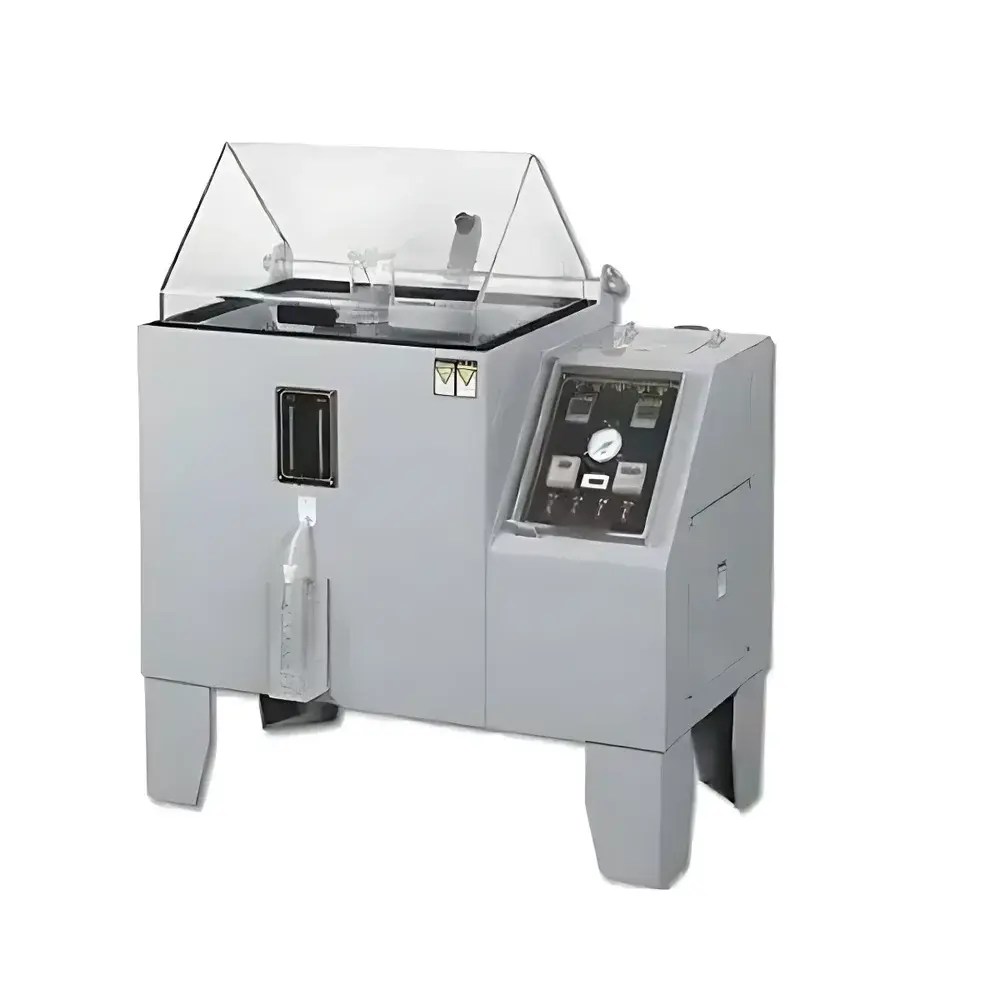
Jianhu Composite Salt Spray Corrosion Test Chamber
| Brand | Jianhu |
|---|---|
| Origin | Shanghai, China |
| Manufacturer Type | Manufacturer |
| Model | Jianhu Composite Salt Spray Corrosion Test Chamber |
| Spray Method | Continuous Atomization |
| Fog Output | 1–2 mL / 80 cm²·hr |
| Nozzle Pressure | 0.7–1.0 kg/cm² |
| De-fogging Method | Air-pressurized Exhaust |
| Salt Fog Deposition Rate | 2 mL/80 cm²·hr |
| Temperature Range | 2°C (ambient reference |
Overview
The Jianhu Composite Salt Spray Corrosion Test Chamber is an engineered environmental test system designed to simulate aggressive chloride-laden atmospheres—such as coastal marine, de-icing road salt, and industrial pollution environments—for accelerated corrosion evaluation of metallic and coated materials. It operates on the principle of controlled continuous atomization of standardized sodium chloride (NaCl) or modified salt solutions (e.g., CuCl₂-accelerated, acetic acid-acidified) into fine aerosol droplets within a thermally stabilized chamber. The system maintains precise control over critical corrosion acceleration parameters—including fog deposition rate, nozzle pressure, chamber temperature, and post-test de-fogging—enabling reproducible, standards-compliant testing per ISO 9227, ASTM B117, JIS Z2371, and GB/T 2423.17. Unlike basic single-function salt spray cabinets, this composite chamber integrates configurable humidity conditioning and optional cyclic test modes (e.g., salt fog → drying → humid storage), supporting both static and dynamic corrosion assessment protocols required for automotive, aerospace, electronics, and infrastructure component qualification.
Key Features
- Continuous pneumatic atomization system with calibrated nozzle pressure regulation (0.7–1.0 kg/cm²) ensures consistent droplet size distribution and spatial uniformity of salt fog deposition across the test zone.
- Verified fog output of 1–2 mL per 80 cm² per hour—aligned with ISO 9227 tolerance limits—and validated via standardized collection funnels placed at multiple chamber locations.
- Air-pressurized de-fogging mechanism rapidly evacuates residual mist after test completion, minimizing post-exposure condensation and enabling safe, timely specimen retrieval without manual venting delays.
- Stable thermal environment maintained within ±2°C of setpoint across the working volume, supporting rigorous adherence to ASTM B117’s 35 ± 2°C requirement and extended high-temperature corrosion studies up to 50°C.
- Corrosion-resistant chamber construction using PP (polypropylene) or PVC-coated stainless steel interior surfaces, non-reactive fluid pathways, and sealed electrical compartments to prevent cross-contamination and ensure long-term operational integrity.
- Integrated digital controller with password-protected parameter locking, real-time logging of chamber temperature and operation status, and compliance-ready event timestamps.
Sample Compatibility & Compliance
The chamber accommodates standard test specimens up to 600 mm × 450 mm × 400 mm (W × D × H), including coated steel panels, fasteners, brake calipers, electronic housings, and galvanized sheet metal coupons. Fixtures are supplied with non-metallic, corrosion-inert supports to eliminate galvanic interference. All operational parameters meet the metrological and procedural requirements of ISO 9227:2022 (Salt spray tests), ASTM B117–23 (Standard Practice for Operating Salt Spray (Fog) Apparatus), and JIS Z2371:2019. Optional calibration kits—including NIST-traceable temperature sensors and certified fog collection vessels—are available to support internal audit readiness and GLP/GMP-aligned validation documentation. The system architecture permits integration into laboratory quality management systems requiring traceability per ISO/IEC 17025.
Software & Data Management
While the base model features a dedicated microprocessor-based controller with LCD interface and local data retention (≥30 days), optional PC-based software enables full remote monitoring, automated report generation (PDF/CSV), and audit trail functionality compliant with FDA 21 CFR Part 11. Software modules support multi-step cyclic test programming (e.g., 4-hr salt fog → 4-hr dry → 4-hr RH 95% @ 40°C), real-time deviation alerts, and export of time-stamped temperature/fog status logs. All firmware updates are delivered via secure USB protocol, with version history and change logs retained in device memory for regulatory review.
Applications
This chamber is routinely deployed in R&D laboratories and QC departments for: evaluating coating adhesion and blistering resistance per ISO 2409; assessing zinc and aluminum alloy sacrificial protection performance under cyclic corrosion testing (CCT); validating corrosion inhibitors in automotive under-hood components; qualifying printed circuit board conformal coatings per IPC-CC-830B; and verifying passivation efficacy on stainless steel surgical instruments per ASTM A967. Its reproducible fog deposition and stable thermal profile make it suitable for inter-laboratory round-robin studies and supplier qualification programs where test-to-test variability must remain below ±5% for key metrics such as time-to-white-rust or time-to-red-rust.
FAQ
What standards does this chamber comply with?
It meets the core operational requirements of ISO 9227, ASTM B117, JIS Z2371, and GB/T 2423.17. Full compliance verification requires periodic third-party calibration and chamber mapping per ISO/IEC 17025 procedures.
Can the chamber perform cyclic corrosion tests (CCT)?
Yes—when equipped with optional humidity control and programmable controller, it supports multi-phase cycles including salt fog, drying, and high-humidity storage phases per SAE J2334 or VDA 621-415 specifications.
How is fog deposition uniformity verified?
Uniformity is confirmed using five standardized 100 cm² collection funnels placed at prescribed locations (center + four corners) per ISO 9227 Annex A; measured deposition must fall within 1–2 mL/80 cm²·hr across all positions.
Is temperature calibration included with delivery?
A factory calibration certificate for chamber temperature uniformity and stability is provided. On-site IQ/OQ documentation and annual recalibration services are available upon request.
What maintenance intervals are recommended?
Daily: rinse nozzles and inspect solution reservoirs. Weekly: clean chamber walls and verify air filter condition. Quarterly: calibrate temperature sensor and validate fog output. Annual: full system performance verification and pressure regulator servicing.



