
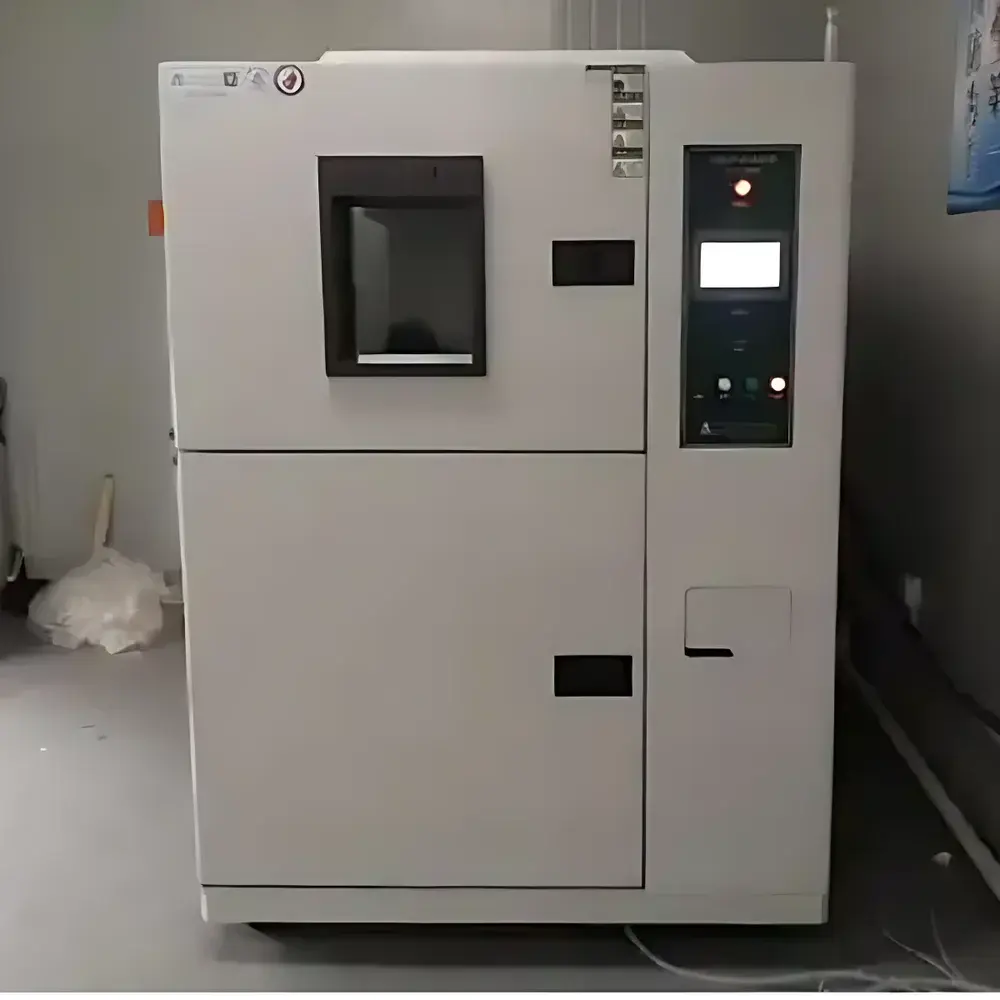
Jianhu JH-CT Series Thermal Shock Test Chamber with Rapid Temperature Transition
| Brand | Jianhu |
|---|---|
| Origin | Shanghai, China |
| Manufacturer Type | Authorized Distributor |
| Product Category | Domestic |
| Model | JH-CT Series |
| Price Range | USD 900 – 90,000 |
| Temperature Range | -70 °C to +150 °C |
| Refrigeration Method | Compressor-based Cooling |
| Explosion-Proof Configuration | Available |
| Temperature Fluctuation | ±0.5 °C |
| Temperature Uniformity | ±2.0 °C (per IEC 60068-3-5) |
| Temperature Deviation | ±2.0 °C (per ISO 16750-4) |
| Heating Rate | ≤60 min (from -40 °C to +85 °C) |
| Cooling Rate | ≤45 min / ≤60 min / ≤80 min (depending on chamber volume and configuration) |
| Working Chamber Dimensions | Customizable (standard internal volumes: 50 L to 1000 L) |
Overview
The Jianhu JH-CT Series Thermal Shock Test Chamber is an engineered environmental test system designed for accelerated reliability assessment of electronic components, automotive modules, aerospace subsystems, and medical devices under extreme thermal stress conditions. It operates on the principle of rapid, high-fidelity temperature transition between independently controlled hot and cold zones—typically using dual-chamber or single-chamber air-shuttle configurations—to induce thermal strain via repeated expansion and contraction of materials. Unlike standard temperature cycling chambers, the JH-CT series achieves defined transition times (≤45–80 min depending on specification) compliant with industry-critical standards including MIL-STD-810H Method 503.5, JEDEC JESD22-A104F, and IEC 60068-2-14. Its core architecture integrates a high-efficiency compressor refrigeration circuit, PID-controlled resistive heating elements, and a turbulence-optimized airflow system—designed to minimize thermal lag and ensure repeatable shock profiles across the full operating range of −70 °C to +150 °C.
Key Features
- High-stability dual-zone thermal shock architecture with independent hot/cold reservoirs and pneumatic or mechanical transfer mechanisms
- Compressor-based refrigeration system with cascade or single-stage configuration, enabling stable low-temperature maintenance at −70 °C
- Precision-engineered air circulation system featuring symmetrical duct layout, adjustable high-torque centrifugal fans, and flow-distribution baffles to suppress dead zones and enhance thermal uniformity
- Temperature uniformity maintained at ±2.0 °C across working volume per IEC 60068-3-5, verified by multi-point sensor mapping during factory calibration
- Explosion-proof variants available (ATEX/IECEx-certified enclosures, intrinsically safe instrumentation, non-sparking fan assemblies) for testing volatile or flammable material samples
- Programmable ramp-and-soak profiles with up to 99 segments, dwell time control from 1 min to 999 h, and automatic transition triggering based on chamber setpoint attainment
- Integrated real-time monitoring of chamber pressure differential, fan status, refrigerant saturation temperature, and heater current load
Sample Compatibility & Compliance
The JH-CT series accommodates test specimens ranging from surface-mount IC packages and PCBAs to structural composites and sealed battery modules. Standard chamber interiors feature stainless steel 304 construction with removable shelves and configurable mounting fixtures. Optional accessories include thermocouple feedthroughs (up to 16 channels), inert gas purge ports (N₂ or dry air), and humidity control add-ons (for combined thermal-hygroshock applications). All units comply with electromagnetic compatibility (EMC) requirements per EN 61326-1 and safety standards per IEC 61010-1. Calibration documentation supports traceability to NIST-traceable references, and validation protocols align with IQ/OQ/PQ frameworks required under ISO/IEC 17025 and FDA 21 CFR Part 11 for regulated industries.
Software & Data Management
Control and data acquisition are managed via the Jianhu TSCore™ software platform—a Windows-based application supporting local operation and remote supervision over Ethernet. The interface provides real-time graphical display of all monitored parameters (chamber setpoints, actual temperatures, fan speed, compressor discharge temperature), event logging with timestamped alarms, and export of CSV/Excel-compatible datasets. Audit trails record all user actions—including profile edits, manual overrides, and calibration interventions—with role-based access control (administrator/operator modes). Data integrity safeguards include cyclic redundancy checking (CRC), encrypted storage, and optional integration with enterprise LIMS or MES systems via OPC UA or Modbus TCP. Software validation packages (including IQ/OQ documentation templates) are provided for GxP environments.
Applications
This chamber serves critical qualification workflows in multiple sectors: qualification of solder joint integrity in automotive ECUs per ISO 16750-4; evaluation of die-attach reliability in power semiconductors per AEC-Q100; validation of hermetic seal performance in implantable medical devices per ISO 10993-12; screening of polymer encapsulant delamination in LED packages; and thermal fatigue life modeling for satellite payload electronics subjected to orbital thermal cycling. Its reproducible shock profiles support failure mode analysis (FMA), accelerated life testing (ALT), and design verification testing (DVT) where thermal gradient-induced microcracking, intermetallic growth, or CTE mismatch are primary concern vectors.
FAQ
What standards does the JH-CT series meet for thermal shock testing?
It conforms to MIL-STD-810H Method 503.5, JEDEC JESD22-A104F, IEC 60068-2-14, and ISO 16750-4 for automotive applications.
Can the chamber be validated for GLP/GMP compliance?
Yes—full IQ/OQ documentation, NIST-traceable calibration certificates, and 21 CFR Part 11-compliant audit trail functionality are available upon request.
Is custom chamber volume supported?
Yes—working chamber dimensions are fully customizable from 50 L to 1000 L internal volume, with structural reinforcement and thermal inertia optimization performed per configuration.
How is temperature uniformity verified during commissioning?
A 9-point sensor mapping procedure is conducted per IEC 60068-3-5, with results documented in the Factory Acceptance Test (FAT) report.
Does the system support remote diagnostics and predictive maintenance?
Standard Ethernet connectivity enables remote firmware updates, diagnostic log retrieval, and compressor performance trending via built-in health monitoring algorithms.



