
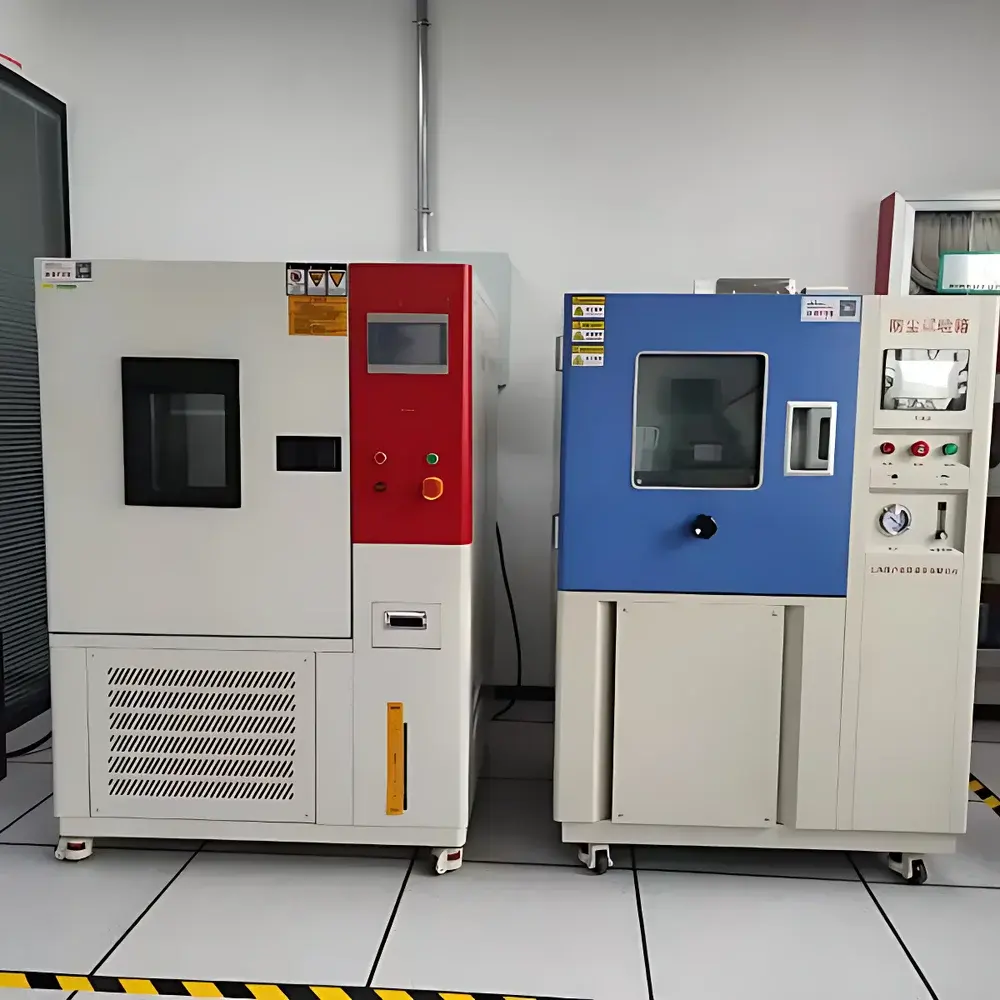

Jianhu PV Module Damp Heat Environmental Test Chamber
| Brand | Jianhu |
|---|---|
| Origin | Shanghai, China |
| Manufacturer Type | Authorized Distributor |
| Product Category | Domestic |
| Model | PV Module Damp Heat Constant Temperature & Humidity Test Chamber |
| Price Range | USD 700 – 70,000 |
| Temperature Range | -70 °C to +150 °C |
| Refrigeration Method | Compressor-Based Cooling |
| Explosion-Proof Design | Yes |
| Temperature Fluctuation | ±0.5 °C |
| Temperature Uniformity | ±2.0 °C |
| Temperature Deviation | ±2.0 °C |
| Heating Rate (RT to +150 °C) | ≤60 min |
| Cooling Rate (+25 °C to -70 °C) | ≤45 min |
Overview
The Jianhu PV Module Damp Heat Environmental Test Chamber is a precision-engineered climatic test system specifically designed to replicate accelerated aging conditions for photovoltaic (PV) modules in accordance with IEC 61215-2, IEC 61646, and UL 1703 standards. It operates on a dual-control principle—simultaneous regulation of temperature and relative humidity—using a closed-loop PID-controlled refrigeration circuit, high-efficiency steam humidification, and forced-air convection with optimized airflow distribution. The chamber maintains stable thermal-hygrometric profiles across its working volume, enabling reliable evaluation of moisture ingress resistance, encapsulant delamination, corrosion of metallization, and long-term power degradation mechanisms under sustained damp heat stress (e.g., 85 °C / 85% RH for up to 1,000 hours). Its structural integrity, thermal insulation performance, and condensation management are engineered for uninterrupted operation in GLP-compliant quality assurance laboratories and PV module certification facilities.
Key Features
- Explosion-proof certified enclosure (ATEX/IECEx-compliant design option), suitable for testing modules containing volatile organic compounds or operating in hazardous area environments.
- High-stability dual-sensor humidity control system utilizing Vaisala HUMICAP® or equivalent traceable capacitive sensors, calibrated per ISO/IEC 17025 requirements.
- Multi-stage cascade refrigeration system with semi-hermetic compressors (e.g., Bitzer or Tecumseh), ensuring consistent cooling capacity across the full -70 °C to +150 °C range.
- Microprocessor-based controller with real-time data logging, alarm history, and programmable ramp-soak profiles—including multi-step cycles with humidity hold phases.
- Double-wall construction with vacuum-insulated panels (VIP) or high-density polyurethane foam (≥150 mm thickness), minimizing thermal bridging and energy consumption.
- Internal stainless-steel chamber (SUS304) with seamless welding, corrosion-resistant fan assembly, and condensate drainage management to prevent secondary moisture accumulation.
Sample Compatibility & Compliance
The chamber accommodates standard-sized PV modules (up to 2.2 m × 1.2 m) on adjustable stainless-steel racks with non-conductive mounting fixtures. Internal dimensions and airflow patterns comply with IEC 60068-3-5 for uniform environmental exposure. All operational parameters—including temperature deviation, uniformity, and humidity accuracy—are verified per ASTM E744 and ISO 16750-4 test protocols. The system supports audit-ready documentation for FDA 21 CFR Part 11 compliance when paired with validated software (optional). Calibration certificates traceable to NIM (National Institute of Metrology, China) or UKAS-accredited labs are available upon request. It meets CE marking requirements under the EU Machinery Directive 2006/42/EC and Low Voltage Directive 2014/35/EU.
Software & Data Management
The integrated control software provides local touchscreen operation and optional Ethernet/IP connectivity for remote monitoring via secure web interface. Logged data includes timestamped temperature, relative humidity, setpoint tracking error, compressor runtime, and alarm events—all stored in CSV or SQL-compatible formats. Audit trails record user logins, parameter changes, and calibration interventions, satisfying GLP/GMP traceability mandates. Optional validation packages include IQ/OQ documentation templates aligned with GAMP5 guidelines. Data export supports integration with LIMS platforms (e.g., LabWare, Thermo Fisher SampleManager) and third-party analytics tools for statistical process control (SPC) of aging test outcomes.
Applications
- Accelerated damp heat testing of crystalline silicon (c-Si), thin-film (CIGS, CdTe), and perovskite PV modules per IEC 61215-2 MQT 10.1.
- Qualification of backsheet materials, edge seals, and encapsulants against hydrolytic degradation and adhesion loss.
- Reliability screening of junction boxes, bypass diodes, and interconnect ribbons under combined thermal-hygrometric stress.
- Supporting R&D for bifacial module durability assessment under elevated humidity and irradiance co-stress conditions.
- Environmental stress screening (ESS) of solar inverters and balance-of-system (BOS) components prior to field deployment.
FAQ
What international standards does this chamber support for PV module qualification?
It fully supports IEC 61215-2 (MQT 10.1), IEC 61646 (for thin-film), UL 1703, and JIS C 8910, with configurable test profiles matching specified temperature/humidity setpoints and duration tolerances.
Is third-party performance verification available before delivery?
Yes—Jianhu provides factory acceptance test (FAT) reports including temperature/humidity uniformity maps, stability measurements over 24-hour continuous operation, and sensor calibration certificates issued by CNAS-accredited laboratories.
Can the chamber be integrated into an existing lab-wide environmental monitoring system?
Yes, it features Modbus TCP and RS485 interfaces for integration with centralized building management systems (BMS) or enterprise-level test orchestration platforms.
What maintenance intervals are recommended for long-term reliability?
Compressor oil analysis every 2,000 operating hours; humidity sensor recalibration annually or after 500 test cycles; full preventive maintenance (including refrigerant leak check and airflow verification) every 12 months.
Does the explosion-proof configuration affect temperature or humidity performance specifications?
No—the ATEX-certified version maintains identical thermal and hygrometric specifications; structural reinforcements and sealed electrical conduits do not compromise chamber uniformity or control fidelity.



