
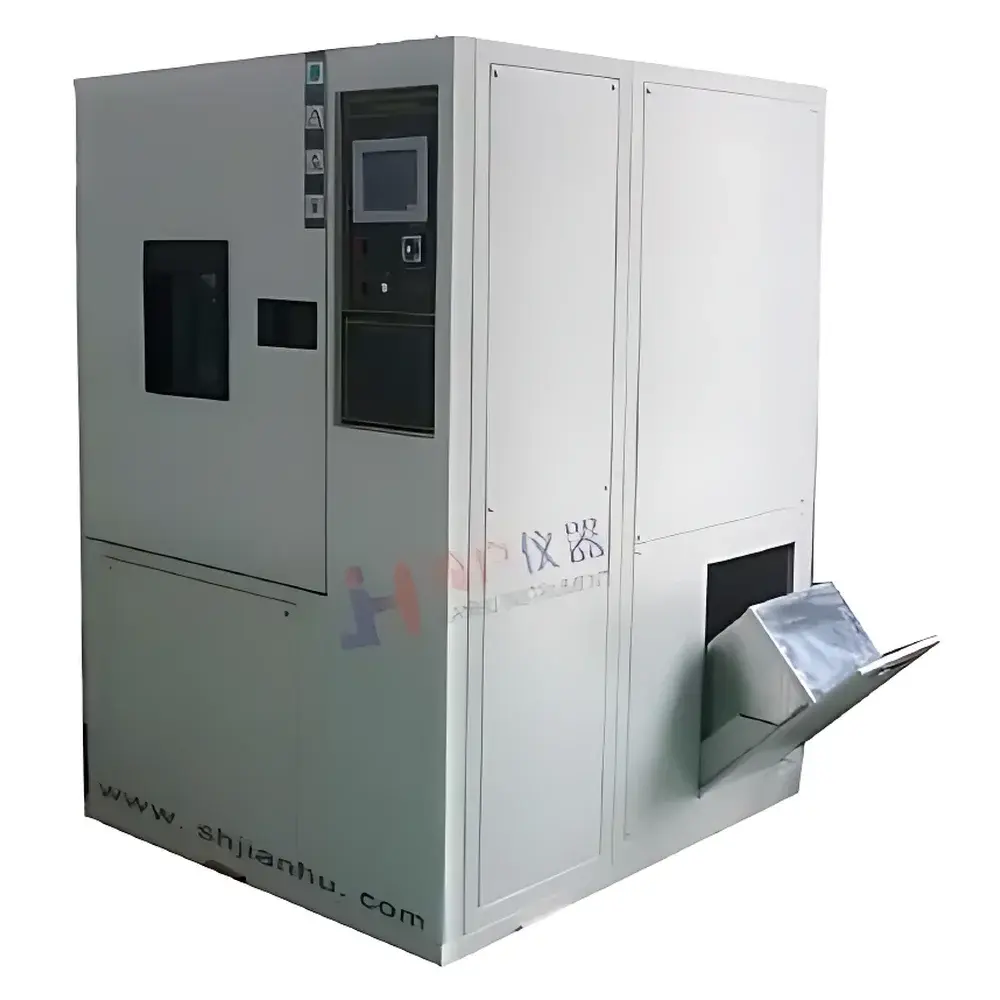
JTH Environmental Chamber (Constant Temperature & Humidity Test Chamber)
| Origin | Shanghai, China |
|---|---|
| Manufacturer Type | Authorized Distributor |
| Origin Category | Domestic (China) |
| Model | JTH |
| Pricing | Available Upon Request |
Overview
The JTH Environmental Chamber is an engineered precision climate simulation system designed for controlled evaluation of material and component performance under defined temperature and relative humidity (RH) conditions. Operating on the principles of closed-loop thermodynamic control—integrating refrigeration, heating, humidification, and dehumidification subsystems—the chamber maintains stable, repeatable environmental profiles essential for accelerated aging, reliability validation, and compliance testing in R&D and quality assurance laboratories. It conforms to core test methodologies referenced in IEC 60068-2-1 (cold), IEC 60068-2-2 (dry heat), IEC 60068-2-30 (damp heat cyclic), and ISO 16750-4 (road vehicles—environmental conditions). Its architecture supports long-duration, unattended operation with high thermal and hygrometric stability—critical for assessing degradation mechanisms in electronics, automotive assemblies, elastomers, metallic coatings, and polymer-based components.
Key Features
- Interior chamber constructed from imported SUS304 mirror-finish stainless steel; exterior enclosure fabricated from cold-rolled steel with electrostatic powder coating for corrosion resistance and structural rigidity.
- High-efficiency thermal insulation using dual-layer composite: rigid polyurethane (PU) foam (≥30 mm thickness) combined with high-density glass fiber batting—minimizing thermal bridging and reducing energy consumption by up to 22% versus conventional single-layer designs.
- Large-format, anti-fog viewing window featuring double-glazed construction with integrated electrically heated ITO-coated film and built-in LED illumination—enabling real-time visual monitoring without compromising chamber integrity or condensation control.
- Intuitive 7-inch TFT-LCD touchscreen interface with graphical user interface (GUI), supporting multi-segment programmable cycles, data logging, and password-protected parameter access.
- Advanced PID + fuzzy logic temperature/humidity controller delivering ±0.3 °C temperature uniformity and ±2.0% RH stability across the working volume (per IEC 60068-3-5).
- Standard RS-232 serial interface compliant with Modbus RTU protocol; optional RS-485 expansion and Ethernet connectivity available for integration into centralized lab management systems.
- Dedicated timing relay outputs (dry contact) for synchronized external device triggering—e.g., data acquisition units, power analyzers, or mechanical load frames during dynamic environmental stress screening (DESS).
- Comprehensive safety architecture including over-temperature cutoff, compressor high-pressure protection, humidity sensor failure detection, door-open alarm, and non-volatile memory retention for cycle state recovery after power interruption.
- Cryogenic system powered by a hermetically sealed French-manufactured Tecumseh (or equivalent OEM-grade) scroll compressor; utilizes environmentally compliant refrigerants (R134a for standard range, R404A/R23 for sub-zero configurations) in accordance with EU F-Gas Regulation (EU) No 517/2014.
- Modular refrigeration design: single-stage for standard ranges (−20 °C to +150 °C / 20–98% RH) or cascade two-stage configuration for extended low-temperature capability (down to −70 °C).
- Optimized air circulation via backward-curved multi-blade centrifugal fan with variable-frequency drive (VFD)—ensuring laminar flow distribution and ≤±1.0 °C spatial uniformity per ASTM E145 Annex A3.
- Rear-mounted air outlet with top-down recirculation path—reducing thermal inertia and enabling ≤3 min recovery time to setpoint after 30-second door opening (tested at 60 °C / 90% RH).
- Independent heating and cooling circuits eliminate cross-interference, improving control responsiveness, extending component service life, and lowering operational cost per test hour.
Sample Compatibility & Compliance
The JTH chamber accommodates samples up to 500 L internal volume (standard configuration), with customizable interior dimensions and shelf loading options. It supports standardized test specimens per IPC-TM-650 (electronics), SAE J2412 (automotive interiors), ASTM D4332 (conditioning of plastics), and GB/T 2423.3 (Chinese national standard for damp heat testing). All electrical components meet CE marking requirements (EN 61000-6-2/6-4); temperature and humidity sensors are NIST-traceable and calibrated per ISO/IEC 17025-accredited procedures. The system supports GLP-compliant audit trails when paired with optional data acquisition software.
Software & Data Management
Bundled PC-based control software provides remote monitoring, real-time graphing, alarm history, and exportable CSV/Excel reports. Optional FDA 21 CFR Part 11-compliant version includes electronic signatures, role-based access control, and immutable audit logs—suitable for regulated pharmaceutical, medical device, and aerospace QA environments. Data can be archived to network drives or cloud storage via FTP/SFTP protocols; API support enables integration with LIMS (e.g., LabWare, Thermo Fisher SampleManager) and MES platforms.
Applications
- Accelerated life testing of printed circuit boards (PCBs) and semiconductor packaging under thermal-hygric cycling.
- Validation of sealing integrity and gasket performance in automotive lighting modules and EV battery enclosures.
- Evaluation of tensile strength retention and dimensional stability in rubber compounds and thermoplastic elastomers (TPEs).
- Corrosion resistance assessment of galvanized steel, aluminum alloys, and coated fasteners per ISO 9227 salt spray correlation protocols.
- Pre-conditioning of adhesives, sealants, and conformal coatings prior to peel or shear testing (ASTM D3359, D1002).
- Stability studies for active pharmaceutical ingredients (APIs) and excipients under ICH Q1A(R2) climatic zone IV conditions.
FAQ
What temperature and humidity ranges does the JTH chamber support?
Standard configuration: −20 °C to +150 °C and 20–98% RH. Extended low-temperature models reach −70 °C using cascade refrigeration.
Is the chamber suitable for continuous 24/7 operation in a production QA lab?
Yes—designed for Class 3 industrial duty cycle per IEC 60068-1; includes predictive maintenance alerts and redundant safety interlocks.
Can humidity be controlled independently of temperature?
Yes—dual independent control loops allow decoupled setpoint programming for complex profiles such as humidity soak at constant temperature or ramp-and-soak sequences.
Does the system comply with ISO/IEC 17025 calibration requirements?
Chamber validation kits (IQ/OQ/PQ documentation, sensor calibration certificates, and uncertainty budgets) are available upon request through accredited third-party providers.
What refrigerant options are supported, and are they compliant with current environmental regulations?
R134a (GWP = 1430), R404A (GWP = 3922), and R23 (GWP = 14800) are offered; all comply with regional phase-down schedules under the Kigali Amendment and EPA SNAP program guidelines.



