
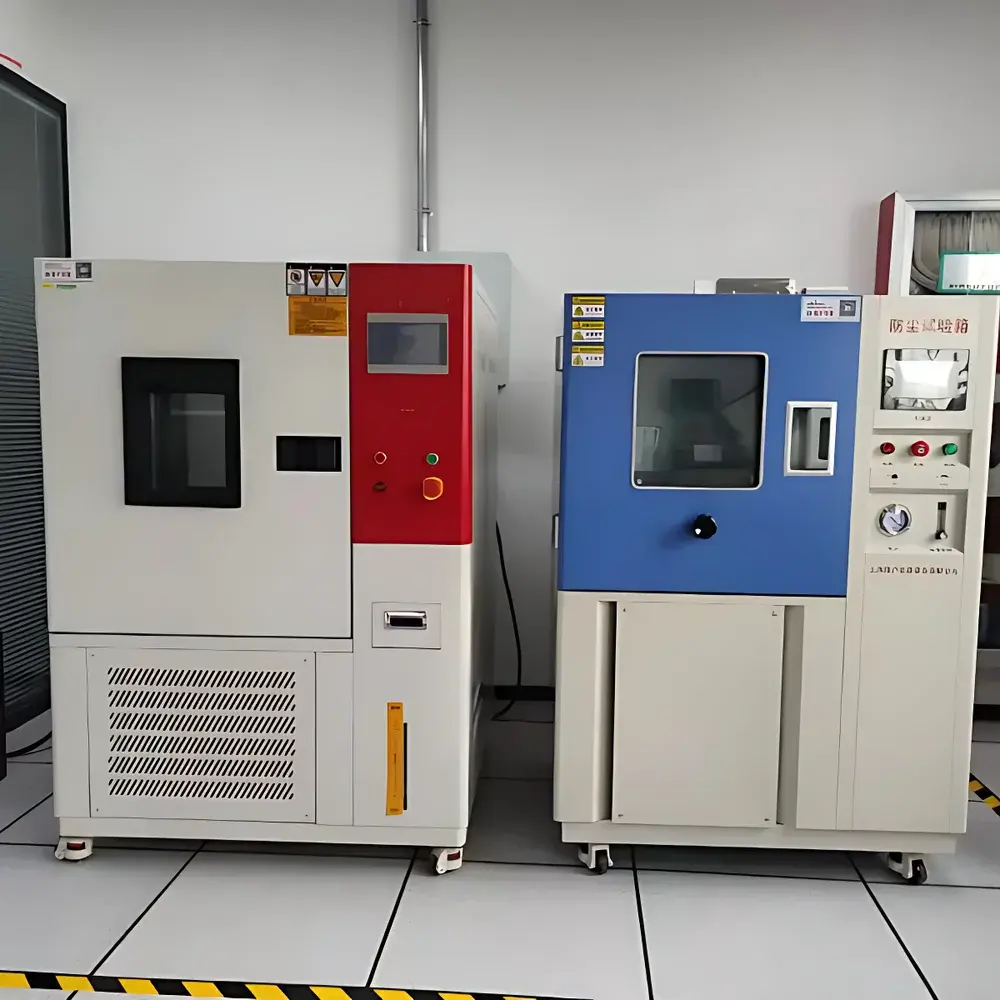
Jianhu JH-ET Series High-Low Temperature Environmental Test Chamber for Electronics Industry
| Brand | Jianhu |
|---|---|
| Origin | Shanghai, China |
| Manufacturer Type | Authorized Distributor |
| Product Category | Domestic |
| Model | JH-ET Series |
| Price Range | USD 1,200 – 12,000 (FOB Shanghai) |
| Temperature Range | −70 °C to +150 °C |
| Cooling Method | Liquid Nitrogen Assisted Refrigeration |
| Explosion-Proof Design | Yes |
| Temperature Fluctuation | ±0.5 °C |
| Temperature Uniformity | ±2.0 °C |
| Temperature Deviation | ±2.0 °C |
| Heating Rate | ≤60 min (−40 °C to +85 °C) |
| Cooling Rate | ≤45 min (25 °C to −40 °C), ≤60 min (25 °C to −55 °C), ≤80 min (25 °C to −70 °C) |
| Interior Dimensions | Customizable |
Overview
The Jianhu JH-ET Series High-Low Temperature Environmental Test Chamber is engineered for precision thermal stress evaluation of electronic components and assemblies under controlled, repeatable, and compliant environmental conditions. Based on forced-air convection with liquid nitrogen-assisted rapid cooling and high-efficiency heating circuits, the chamber delivers deterministic thermal profiles aligned with industry-standard temperature cycling protocols—including JEDEC JESD22-A104 (Temperature Cycling), MIL-STD-810H Method 501.7 (High Temperature), and Method 502.7 (Low Temperature). Its architecture integrates dual-stage PID control, platinum RTD sensors (Class A, IEC 60751), and a stainless-steel insulated chamber structure with multi-layer vacuum-sealed insulation panels—enabling stable operation across the full −70 °C to +150 °C range while maintaining ≤±0.5 °C short-term fluctuation and ≤±2.0 °C spatial uniformity per IEC 60068-3-5.
Key Features
- Ultra-fast thermal transition: Achieves ≥15 °C/min average ramp rate between −40 °C and +85 °C under standard load conditions—validated per ASTM E1545 and IEC 60068-3-11—eliminating thermal lag during dynamic profile execution.
- Explosion-proof certified construction (Ex d IIB T4 Gb / Ex tb IIIC T135°C Db per GB 3836.1–2021 & EN 60079-0:2018), suitable for testing lithium-based batteries, PCBs with volatile solvents, or conformal-coated modules in Class I/II hazardous locations.
- Acoustically optimized operation: Integrated low-noise scroll compressors, variable-frequency EC fans with adaptive speed modulation, and acoustic-dampening chamber linings ensure sustained operational noise ≤50 dB(A) at 1 m distance—meeting ISO 7779 and ANSI S12.2 requirements for laboratory environments.
- Robust safety architecture: Dual independent overtemperature cut-offs (mechanical and digital), phase-loss protection, refrigerant leak detection, ground-fault circuit interruption (GFCI), and real-time compressor discharge temperature monitoring comply with UL 61010-1 and IEC 61010-1.
- Modular interior configuration: Stainless-steel 304 work chamber with removable shelves, cable ports (IP65-rated), and optional humidity integration (for combined temp/humidity variants) support custom DUT mounting and instrumentation routing.
Sample Compatibility & Compliance
The JH-ET Series accommodates printed circuit boards (PCBs), semiconductor packages (QFN, BGA, CSP), power modules, automotive ECUs, RF front-end modules, and optoelectronic subassemblies up to 500 mm × 500 mm × 500 mm (customizable larger volumes available). All thermal profiles are traceable to NIST-traceable reference standards and fully auditable for GLP/GMP-regulated workflows. The system meets critical compliance benchmarks including ISO/IEC 17025 calibration requirements for environmental test equipment, supports IQ/OQ/PQ validation documentation packages, and enables 21 CFR Part 11-compliant electronic signatures and audit trails when paired with Jianhu’s optional validated software suite.
Software & Data Management
Equipped with Jianhu’s proprietary TEMPCONTROL v4.2 software (Windows 10/11 compatible), the chamber provides real-time multi-channel logging (up to 16 external thermocouple inputs), programmable step/ramp/soak profiles with conditional branching, automatic report generation (PDF/CSV/XLSX), and remote monitoring via Ethernet or optional Wi-Fi module. Data integrity safeguards include cyclic redundancy checksum (CRC-32) validation, encrypted local storage, and configurable retention policies. Software validation kits—including installation qualification (IQ), operational qualification (OQ), and performance qualification (PQ) protocols—are supplied as part of GxP-ready deployment packages.
Applications
- Qualification testing of automotive-grade ICs per AEC-Q200 Rev D temperature cycling requirements.
- Reliability screening of 5G mmWave RF components under accelerated thermal shock (−55 °C ↔ +125 °C).
- Pre-conditioning of MEMS sensors prior to hermeticity and functional verification.
- Thermal aging studies of encapsulants and underfill materials used in advanced packaging (Fan-Out WLP, SiP).
- Environmental stress screening (ESS) of medical electronics per IEC 60601-1 Clause 11.1.2.
- Process validation of solder reflow simulation and post-reflow board-level reliability assessment.
FAQ
What temperature ramp rates are achievable under loaded conditions?
Typical ramp rates of 15–20 °C/min between −40 °C and +85 °C are verified using a 2 kg aluminum mass load per IEC 60068-3-11 Annex B.
Is the chamber suitable for testing lithium-ion battery cells?
Yes—when configured with explosion-proof certification, integrated gas venting, and optional oxygen depletion monitoring, it complies with UN 38.3 Section 4.1 thermal test requirements.
Can the system be integrated into an existing MES or LIMS environment?
Yes—OPC UA server support (IEC 62541) and RESTful API endpoints enable bidirectional data exchange with LabVantage, Thermo Fisher SampleManager, and Siemens Opcenter.
Does the controller support multi-segment profiles with dwell, ramp, and conditional logic?
Yes—up to 999 segments per profile, including time-based triggers, sensor threshold events, and external signal interlocks.
What calibration documentation is provided at shipment?
NIST-traceable factory calibration certificate covering temperature uniformity, fluctuation, and deviation across three points (−40 °C, 25 °C, +85 °C), plus uncertainty budget per ISO/IEC 17025:2017 Annex A.



