
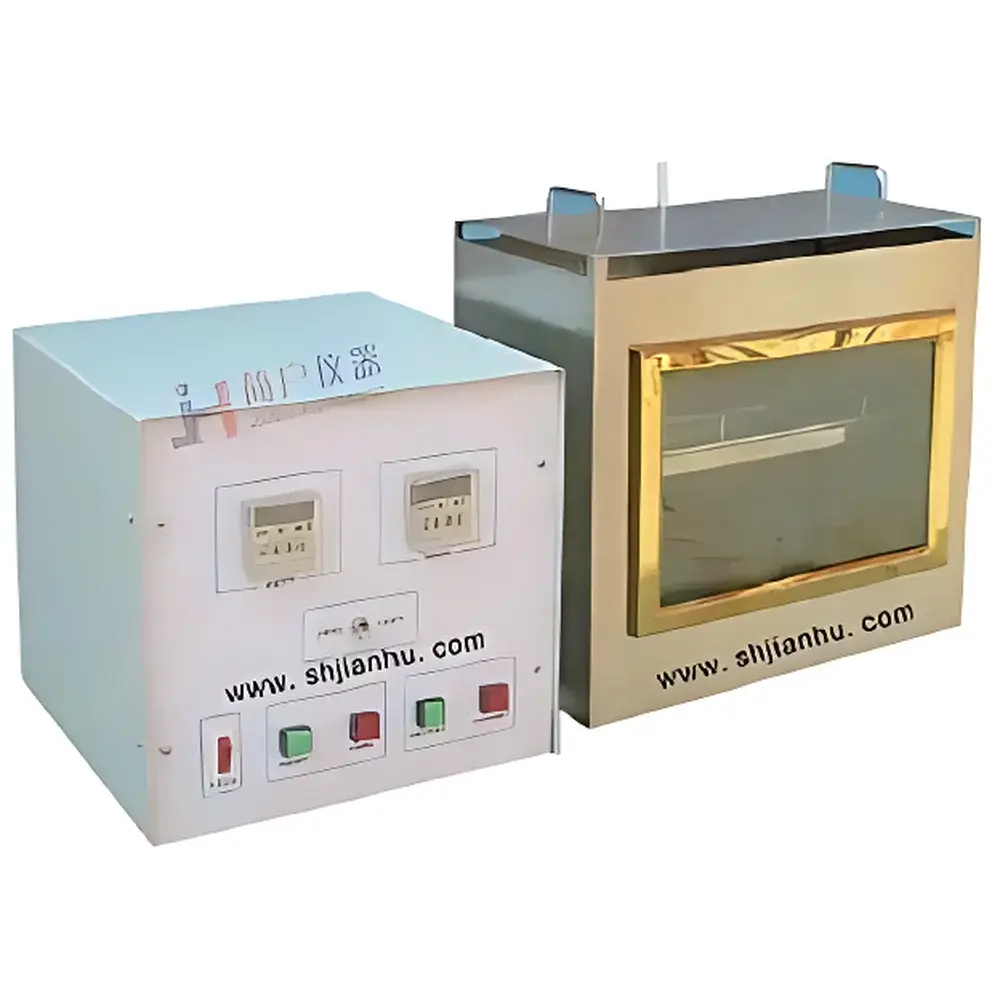
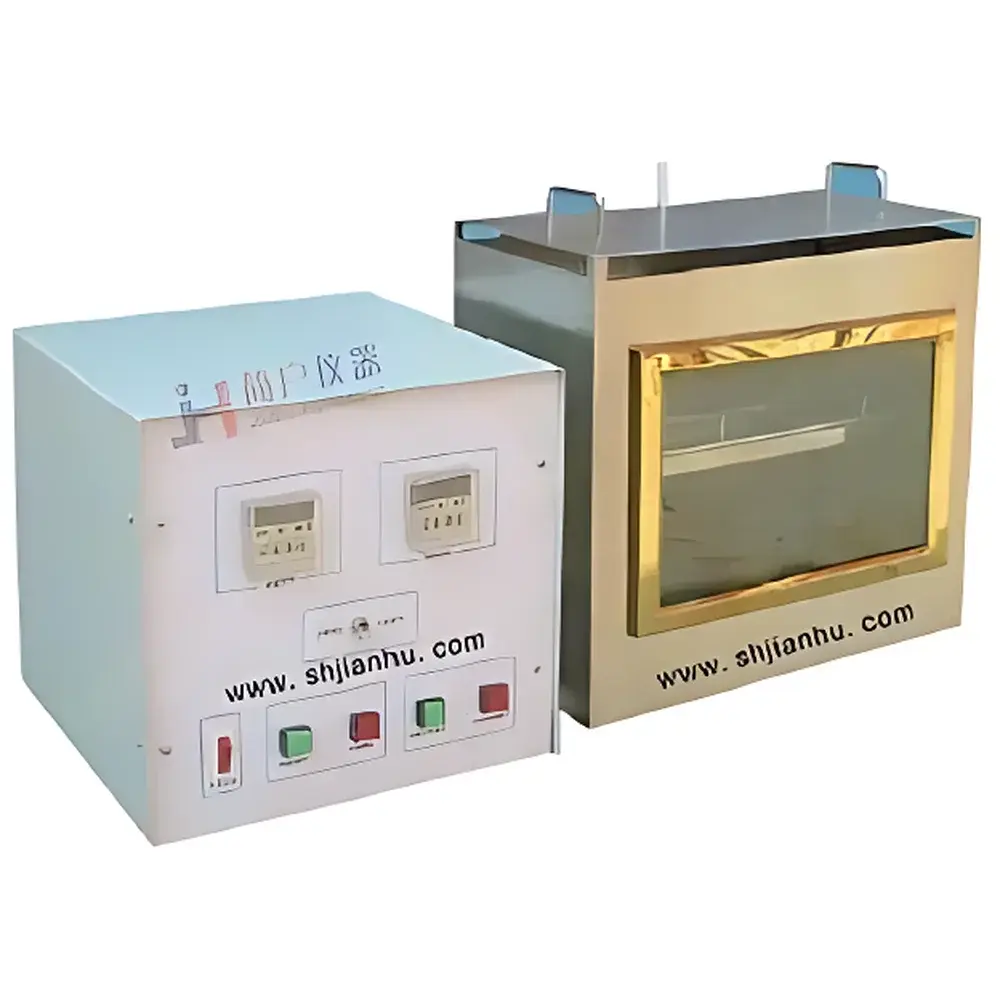
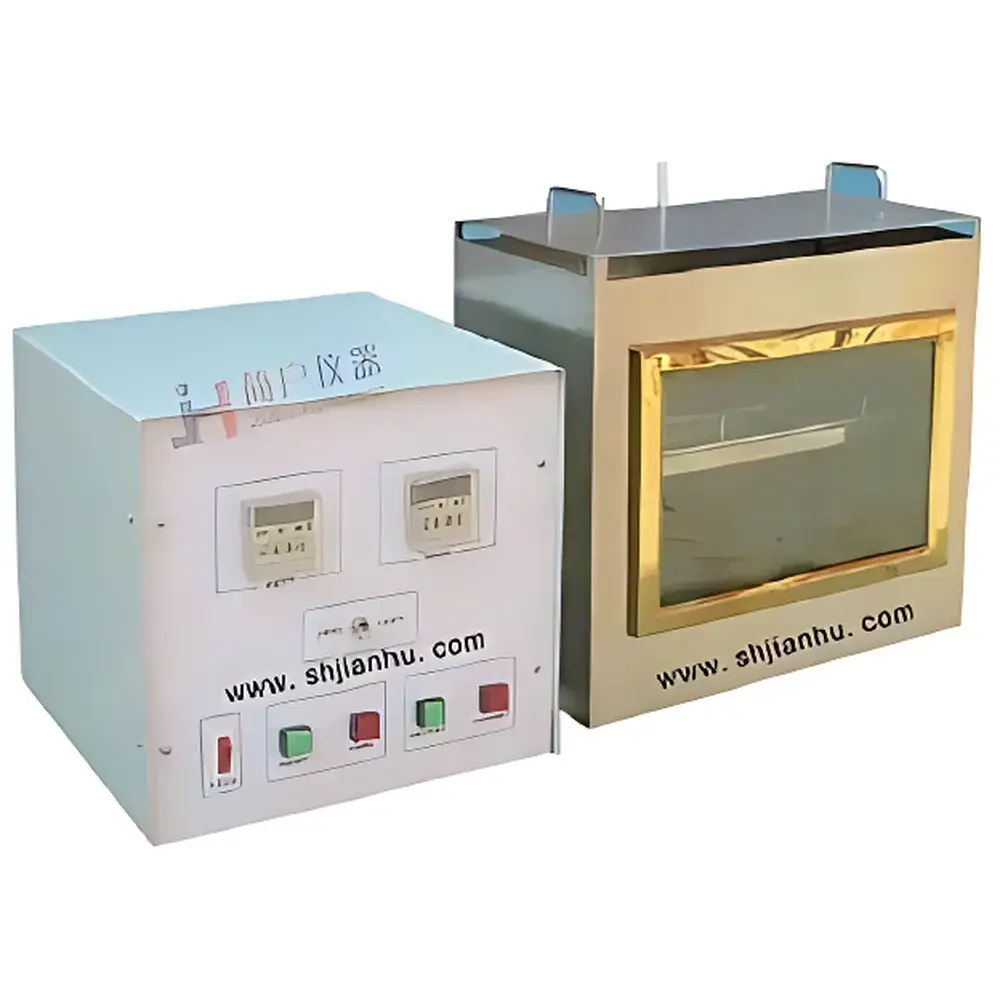
Jianhu GB8410 Automotive Interior Materials Horizontal Burning Tester
| Brand | Jianhu |
|---|---|
| Origin | Shanghai, China |
| Model | GB8410 |
| Compliance | GB 8410, FMVSS 302, ISO 3795, DIN 75200, SAE J369, TL 1010, NF P92-505, U.T.A.C. 18-502 T1, BMW N 60121.0, DBL 5307, GM L-T06-302G-79, Mitsubishi ES-X60410, VW TL 1010, Volvo STD 5031 |
| Burner Nozzle ID | 9.5 mm |
| Ignition Position Offset | 19 mm below specimen free end center |
| Combustion Chamber Dimensions (W×D×H) | 385 mm × 204 mm × 360 mm |
| Timer Range | 0–99.99 s/min/h |
| Comb Width | ≥110 mm, 7–8 smooth round teeth per 25 mm |
| Steel Ruler Accuracy | ±1 mm |
| Specimen Size | 102 mm × 356 mm × actual thickness (≤13 mm) |
| Flame Spread Limit | ≤102 mm/min or char length ≤51 mm within 60 s after timing initiation at 38 mm from ignition edge |
Overview
The Jianhu GB8410 Automotive Interior Materials Horizontal Burning Tester is an engineered test system designed to evaluate the horizontal flame spread behavior of polymeric interior materials used in motor vehicle occupant compartments. It operates in strict accordance with the fundamental principle of controlled open-flame exposure under standardized thermal and geometric conditions—specifically, a calibrated Bunsen-type burner delivering a defined propane or butane flame impinging at a fixed angle and position relative to the specimen’s lower edge. The instrument quantifies flame propagation rate and post-combustion char length, providing objective pass/fail determinations per internationally harmonized regulatory frameworks. Its primary function is not material flammability ranking, but rather conformance verification against mandatory safety thresholds established to mitigate fire propagation risk from incidental ignition sources such as matches or cigarette embers.
Key Features
- Modular combustion chamber constructed from corrosion-resistant cold-rolled steel with precise internal dimensions (385 mm L × 204 mm D × 360 mm H), ensuring consistent thermal boundary conditions and flame geometry across repeated tests.
- Adjustable precision burner assembly featuring a 9.5 mm inner-diameter nozzle, mounted so its tip center lies exactly 19 mm below the horizontal centerline of the specimen’s free end—per GB 8410 Clause 5.3 and FMVSS 302 §5.2.1.
- Digital programmable timer with resolution down to 0.01 second and configurable units (s/min/h), enabling accurate measurement of flame front transit time over the critical 102 mm evaluation zone beginning at the 38 mm mark from the ignition edge.
- Dedicated specimen holder with rigid clamping mechanism to maintain 45° upward tilt during testing, replicating real-world mounting orientation while preventing sagging or slippage under thermal stress.
- Integrated metal comb (≥110 mm long, 7–8 smooth rounded teeth per 25 mm) for standardized surface preparation prior to testing—ensuring repeatability in assessing surface-limited flame spread behavior.
- High-stability gas control circuit incorporating solenoid valve and piezoelectric ignition module, supporting consistent flame height (20 ± 1 mm) and thermal flux delivery using commercial-grade propane or butane fuel.
Sample Compatibility & Compliance
This tester accommodates flat, rigid or semi-rigid specimens measuring 102 mm wide × 356 mm long × nominal thickness (up to 13 mm; thicker samples are trimmed). It supports multi-directional sampling when anisotropic flame spread is suspected—requiring five specimens cut parallel and five perpendicular to the dominant fiber or extrusion direction. The system fully implements test protocols defined in GB 8410–2018, FMVSS 302 (49 CFR §571.302), ISO 3795:2022, DIN 75200:2021, SAE J369–2020, and TL 1010:2023. It also supports ancillary assessments required by OEM specifications including BMW N 60121.0 (2022), Mercedes-Benz DBL 5307 (Rev. 2021), General Motors GM L-T06-302G-79 (2019), and Volvo STD 5031 (2020). All operational parameters—including burner positioning, specimen tilt, flame height calibration, and timing reference point—are traceable to documented calibration procedures aligned with ISO/IEC 17025 principles.
Software & Data Management
The GB8410 tester operates as a standalone hardware platform without embedded software; however, it interfaces seamlessly with laboratory information management systems (LIMS) via RS-232 or optional USB-to-serial adapters. Test logs—including start time, flame arrival at 38 mm, burn-through time, final char length, operator ID, and environmental ambient data (recorded manually or via external hygrothermograph)—can be exported in CSV format for integration into electronic batch records. When deployed in GLP- or GMP-regulated environments, users may implement supplementary audit-trail modules compliant with FDA 21 CFR Part 11 requirements, ensuring data integrity, user authentication, and change history retention for all recorded test outcomes.
Applications
- Quality assurance screening of seat fabrics, headliners, door trims, carpet backings, and insulation foams prior to vehicle assembly.
- Regulatory submission support for type-approval applications submitted to CNCA (China), NHTSA (USA), UN ECE (Europe), and JASO (Japan).
- Comparative development testing of flame-retardant additives, intumescent coatings, and halogen-free polymer formulations.
- Root-cause analysis of non-conforming batches through repeatable horizontal burn replication under identical thermal input conditions.
- Internal training and proficiency testing for laboratory technicians performing OEM-mandated safety evaluations.
FAQ
What flame fuel types are permitted under GB 8410 and FMVSS 302?
Propane or butane meeting ASTM D1835 specifications; fuel purity and pressure must be validated prior to each test series to ensure flame height remains 20 ± 1 mm.
Is vertical burning assessment supported by this instrument?
No—this is a dedicated horizontal burning apparatus. Vertical flame tests (e.g., UL 94 V-0/V-1/V-2) require separate equipment conforming to ASTM D3801 or IEC 60695-11-10.
How often must the burner nozzle be cleaned or replaced?
The 9.5 mm nozzle should be inspected before every test run and cleaned with acetone and stainless-steel wire brush if carbon deposits are observed; replacement is recommended after 200 test cycles or upon dimensional deviation exceeding ±0.1 mm.
Does the system include calibration certification?
Factory calibration certificates for timer accuracy (±0.02 s), steel ruler traceability (NIM-certified), and burner alignment fixture are provided with shipment; annual third-party verification is advised per ISO/IEC 17025 clause 6.5.
Can test reports generated on this device satisfy OEM audit requirements?
Yes—when combined with documented SOPs, equipment maintenance logs, environmental monitoring records, and trained operator sign-offs, outputs meet evidentiary standards for BMW, Mercedes-Benz, and VW Tier-1 supplier audits.



