
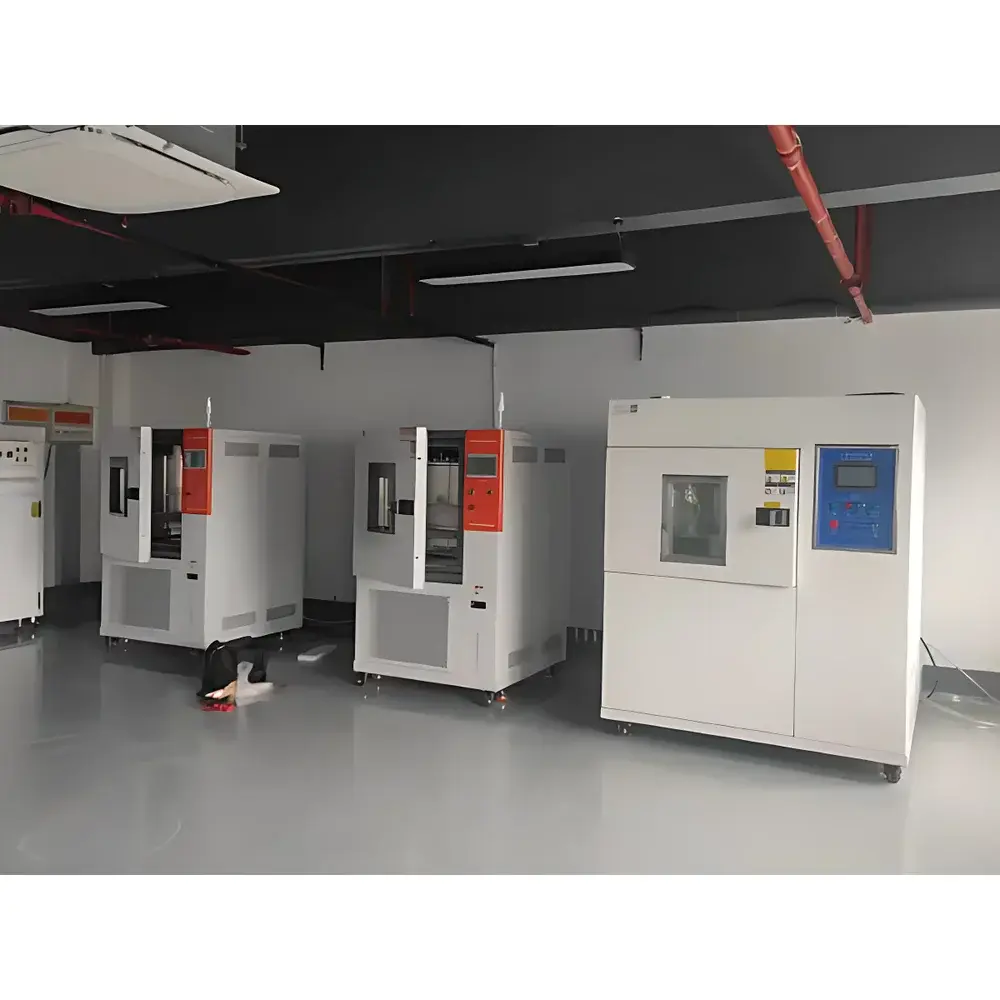
Jianhu JH-TC Series Intelligent Thermal Shock Test Chamber with Predictive Fault Warning System
| Brand | Jianhu |
|---|---|
| Origin | Shanghai, China |
| Model | JH-TC Series |
| Temperature Range | -70 °C to +150 °C |
| Refrigeration Method | Compressor-based |
| Explosion-Proof Design | Yes |
| Temperature Fluctuation | ±0.5 °C |
| Temperature Uniformity | ±2.0 °C |
| Temperature Deviation | ±2.0 °C |
| Heating Rate | ≤60 min (from −40 °C to +150 °C) |
| Cooling Rate | ≤45 min / ≤60 min / ≤80 min (depending on configuration) |
| Chamber Dimensions | Customizable (Small / Medium / Large) |
Overview
The Jianhu JH-TC Series Intelligent Thermal Shock Test Chamber is engineered for high-reliability environmental stress screening in aerospace, automotive electronics, semiconductor packaging, and advanced materials development. It implements a physics-informed, sensor-fused predictive maintenance architecture grounded in real-time thermomechanical monitoring and time-series anomaly detection. Unlike conventional thermal shock chambers relying solely on static threshold alarms, the JH-TC Series employs a multi-layered fault awareness system that continuously evaluates operational health across refrigeration cycles, chamber dynamics, electrical loading, and mechanical integrity—enabling early-stage deviation detection before parameter thresholds are breached.
Key Features
- Multi-Modal Sensor Fusion Architecture: Integrates high-frequency temperature arrays (PT100 Class A), current transducers (±0.2% accuracy), triaxial vibration sensors (10 Hz–5 kHz bandwidth), acoustic emission microphones, and differential pressure transducers—synchronized at 100 Hz sampling rate for temporal coherence.
- Adaptive Threshold Engine: Replaces fixed alarm limits with statistically derived dynamic boundaries using rolling-window Gaussian mixture modeling (GMM), updated hourly based on ambient load, test profile phase, and historical baseline drift compensation.
- LSTM-Based Anomaly Detection Core: Trained on >12,000 hours of anonymized operational telemetry from global customer deployments, the embedded neural model identifies subtle degradation patterns—including compressor valve leakage precursors, evaporator frost propagation anomalies, and fan motor bearing wear signatures—without requiring labeled fault data.
- Fault Knowledge Graph (FKG): A domain-specific ontology maps 47 failure modes across refrigeration, heating, control, and structural subsystems. When anomalous sensor clusters are detected, FKG performs causal inference to rank probable root causes and recommend diagnostic verification steps per ISO 13374-2 guidelines.
- Explosion-Proof Certification: Complies with IEC 60079-0 and GB 3836.1–2021 standards for Group II C hazardous atmospheres; all internal cabling, junction boxes, and actuator housings meet flameproof enclosure requirements (Ex d IIB T4 Gb).
- Modular Chamber Scalability: Standard configurations include small (20 L), medium (80 L), and large (200 L) working volumes, all sharing identical control firmware, sensor topology, and diagnostic engine—ensuring consistent prognostic performance across platform variants.
Sample Compatibility & Compliance
The JH-TC Series accommodates rigid and semi-flexible test specimens up to 300 mm × 300 mm × 300 mm (L×W×H), with optional custom fixtures for PCB assemblies, EV battery modules, and MEMS packages. All models comply with ASTM D5229/D5229M (low-temperature impact resistance), MIL-STD-810H Method 503.6 (temperature shock), and IEC 60068-2-14 (change of temperature). The embedded diagnostics engine supports audit-ready traceability under FDA 21 CFR Part 11 via configurable electronic signatures, ALCOA+ data integrity controls, and immutable event logging with SHA-256 hashing.
Software & Data Management
Jianhu’s proprietary ThermoShield™ v4.2 software provides role-based access to live diagnostics dashboards, predictive alert history, and maintenance recommendation logs. Raw sensor streams are stored in HDF5 format with metadata tagging (test ID, operator, ambient conditions, calibration status). Export options include CSV, MATLAB .mat, and ASAM MDF 4.2 for integration into enterprise MES/QMS platforms. The system supports TLS 1.3 encrypted remote monitoring and integrates with Siemens Opcenter, Rockwell FactoryTalk, and LabVantage LIMS via RESTful API and OPC UA PubSub over MQTT. All algorithm outputs—including remaining useful life (RUL) estimates and confidence intervals—are timestamped, version-controlled, and exportable for regulatory submission.
Applications
- Aerospace component qualification per DO-160 Section 24 (temperature shock)
- Automotive ECUs and ADAS sensors undergoing AEC-Q200 stress screening
- Wafer-level reliability testing of GaN and SiC power devices
- Accelerated aging studies of polymer encapsulants and conformal coatings
- Validation of hermetic seal integrity in medical implant housings
- Pre-certification testing for UL 62368-1 and IEC 60950-1 Annex Q
FAQ
How does the predictive warning system differ from traditional over-temperature alarms?
It operates on deviation-from-normal behavior—not absolute thresholds. For example, it detects rising compressor current harmonic distortion (THD > 8.5%) during ramp phases, indicating winding insulation degradation—weeks before temperature or pressure parameters exceed specification limits.
Can the system integrate with our existing CMMS platform?
Yes. Native support for Maximo, SAP PM, and UpKeep via standard OData v4 endpoints and configurable webhooks. Maintenance tickets auto-generate with diagnostic context, RUL estimate, and recommended spare parts list.
Is firmware update capability available remotely?
All units ship with secure OTA (Over-The-Air) update infrastructure compliant with IEC 62443-3-3 SL2. Updates require dual-signature verification (Jianhu + customer admin) and staged deployment with rollback safeguards.
What validation documentation is provided for GxP environments?
IQ/OQ protocols aligned with ASTM E2500-21, traceable calibration certificates (NIST-traceable PT100, current shunts), algorithm validation reports per ISO/IEC 17025:2017 Annex B, and full source code escrow option for model interpretability audits.
Does the system support multi-chamber fleet monitoring?
Yes. Centralized ThermoShield™ Cloud Console aggregates health metrics across unlimited chamber installations, enabling cross-fleet failure pattern analysis and predictive spares inventory optimization using Weibull-based reliability modeling.



