
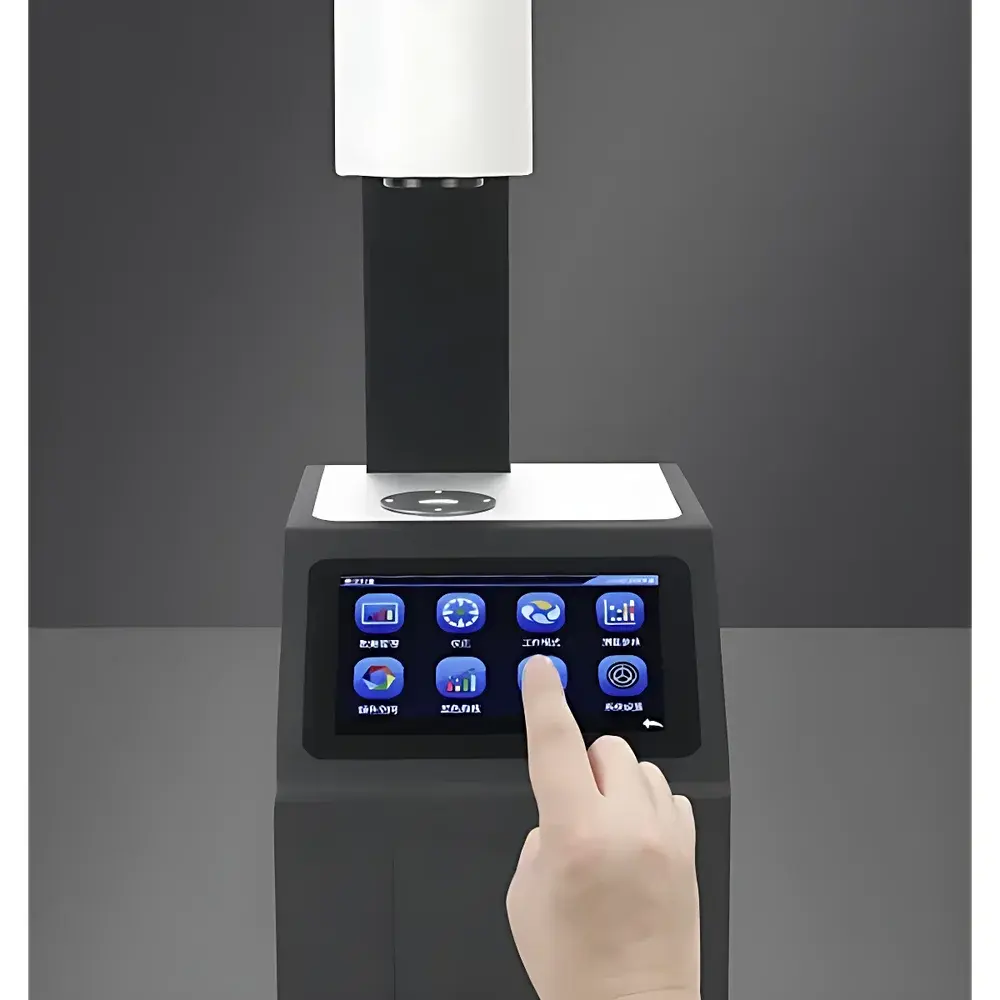
JianHu JH-Transmittance Analyzer – High-Precision Optical Transmittance Measurement System
| Brand | JianHu |
|---|---|
| Origin | Shanghai, China |
| Model | JH-Transmittance Analyzer |
| Price Range | USD 1,400 – 3,150 |
| Compliance | ISO 9022-17, ASTM D1003, GB/T 2410, EN 410 |
| Light Source | Tungsten-Halogen (360–780 nm, CIE Illuminant A) |
| Detector | Silicon Photodiode with Cosine-Corrected Input |
| Measurement Range | 0.01% – 100.00% T (Transmittance), ±0.2% T repeatability (n=10, standard quartz reference) |
| Sample Port Diameter | 20 mm (standard), optional 10 mm & 30 mm apertures |
| Data Interface | USB 2.0, RS-232, optional Ethernet |
| Software | JianHu OptiCal v3.2 (GLP-compliant audit trail, user-level access control, FDA 21 CFR Part 11 ready) |
Overview
The JianHu JH-Transmittance Analyzer is a benchtop optical transmittance measurement system engineered for precision, stability, and regulatory traceability in quality control and R&D laboratories. It operates on the principle of spectrophotometric transmittance analysis—measuring the ratio of radiant flux transmitted through a specimen to that incident upon it, within the visible spectrum (360–780 nm), under standardized illuminant A conditions per CIE and ISO definitions. The instrument employs a stabilized tungsten-halogen light source, thermally regulated optical path, and a calibrated silicon photodiode detector with cosine-corrected geometry to ensure accurate angular response—critical for non-diffusing or slightly scattering samples such as flat glass, polymer films, coated optics, and laminated safety glazing. Its modular aperture design accommodates diverse sample geometries while maintaining consistent beam collimation and stray-light suppression (<0.1% at 1% T), enabling high reproducibility across repeated measurements and inter-laboratory comparisons.
Key Features
- Optical architecture compliant with ASTM D1003 (Standard Test Method for Haze and Luminous Transmittance of Transparent Plastics) and ISO 9022-17 (Optics and optical instruments — Environmental test methods — Part 17: Contamination)
- Thermally stabilized light source and detector assembly ensures <±0.15% T drift over 8-hour continuous operation—critical for production-line QA shifts and long-duration material aging studies
- Three interchangeable sample port diameters (10 mm, 20 mm, 30 mm) support thin films, architectural glass panes, display cover lenses, and automotive lighting diffusers without reconfiguration
- Integrated zero-reference and 100% reference calibration routines with NIST-traceable quartz standards supplied with each unit
- Robust mechanical housing with anti-vibration base plate and ESD-safe enclosure, rated IP20 for controlled laboratory environments
- Real-time transmittance trending with statistical process control (SPC) overlays directly exportable to CSV or PDF reports
Sample Compatibility & Compliance
The JH-Transmittance Analyzer accepts rigid and semi-rigid planar specimens up to 25 mm thick and 150 × 150 mm in footprint. Compatible materials include float glass, tempered laminated glass, polycarbonate sheets, PET and PMMA optical films, anti-reflective coated substrates, OLED encapsulation layers, and medical-grade transparent polymers. All measurement protocols align with international regulatory frameworks: ASTM D1003 for plastics haze/transmittance; EN 410 for architectural glazing optical characterization; GB/T 2410 for Chinese national standardization; and ISO 9050 for daylight transmittance of building glazing. Instrument firmware supports dual-mode reporting (luminous transmittance per CIE 15:2018 and spectral transmittance at 5-nm intervals), satisfying both QC documentation and materials science research requirements. Full compliance documentation—including factory calibration certificates, uncertainty budgets, and metrological traceability statements—is provided with each shipment.
Software & Data Management
JianHu OptiCal v3.2 is a Windows-based application designed for GLP/GMP environments. It features role-based user authentication (administrator, operator, reviewer), electronic signatures, and immutable audit trails meeting FDA 21 CFR Part 11 requirements. Data integrity safeguards include automatic timestamping, revision-controlled method templates, and encrypted local database storage (SQLite with AES-256). The software supports automated pass/fail evaluation against configurable specification limits, generates IQ/OQ documentation packages, and exports raw spectral data in ASTM E131-compliant .jdx format for third-party analysis in MATLAB, Origin, or Python-based optical modeling tools. Remote monitoring via optional Ethernet module enables integration into centralized lab information management systems (LIMS) and MES platforms.
Applications
- Architectural glass manufacturing: Verifying daylight transmittance (Tlum) and solar heat gain coefficient (SHGC)-correlated metrics for LEED and BREEAM certification
- Display technology R&D: Quantifying transmission loss across AR/HR coatings on smartphone cover glass and VR lens substrates
- Automotive lighting validation: Measuring luminous transmittance of headlamp lenses and signal covers per SAE J576 and ECE R3
- Pharmaceutical packaging: Ensuring clarity and UV-blocking performance of blister foil and polyolefin vial closures per USP
- Academic optics labs: Supporting undergraduate spectroscopy curricula and graduate-level thin-film interference studies
- Quality assurance in semiconductor front-end processes: Monitoring transmittance uniformity of photomask blanks and EUV pellicles
FAQ
What standards does the JH-Transmittance Analyzer comply with?
It conforms to ASTM D1003, ISO 9022-17, EN 410, GB/T 2410, and ISO 9050. Calibration is traceable to NIST SRM 930e and certified by CNAS-accredited laboratories.
Can the instrument measure both transmittance and haze simultaneously?
Yes—when configured with the optional integrated haze module (JH-Haze Kit), it performs concurrent luminous transmittance and haze measurements per ASTM D1003 Section 8.
Is remote software update supported?
Firmware and software updates are delivered via secure HTTPS portal with digital signature verification; no physical media required.
Does the system support IQ/OQ/PQ validation protocols?
Pre-validated IQ/OQ templates are included; PQ execution requires user-defined acceptance criteria and reference standards per ISO/IEC 17025.
What is the recommended recalibration interval?
Annual recalibration is advised under normal use; biannual verification using supplied reference standards is mandatory per GLP guidelines.



